
Items related to Trapped in the Net
Synopsis
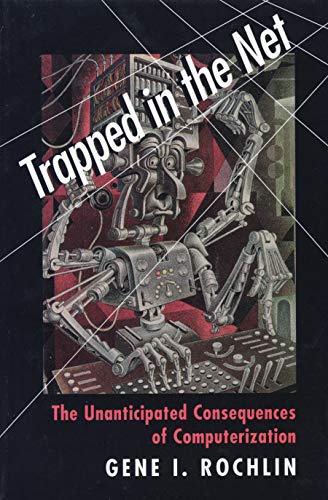
Voice mail. E-mail. Bar codes. Desktops. Laptops. Networks. The Web. In this exciting book, Gene Rochlin takes a closer look at how these familiar and pervasive productions of computerization have become embedded in all our lives, forcing us to narrow the scope of our choices, our modes of control, and our experiences with the real world. Drawing on fascinating narratives from fields that range from military command, air traffic control, and international fund transfers to library cataloging and supermarket checkouts, Rochlin shows that we are rapidly making irreversible and at times harmful changes in our business, social, and personal lives to comply with the formalities and restrictions of information systems.
The threat is not the direct one once framed by the idea of insane robots or runaway mainframes usurping human functions for their own purposes, but the gradual loss of control over hardware, software, and function through networks of interconnection and dependence. What Rochlin calls the computer trap has four parts: the lure, the snare, the costs, and the long-term consequences. The lure is obvious: the promise of ever more powerful and adaptable tools with simpler and more human-centered interfaces. The snare is what usually ensues. Once heavily invested in the use of computers to perform central tasks, organizations and individuals alike are committed to new capacities and potentials, whether they eventually find them rewarding or not. The varied costs include a dependency on the manufacturers of hardware and software--and a seemingly pathological scramble to keep up with an incredible rate of sometimes unnecessary technological change. Finally, a lack of redundancy and an incredible speed of response make human intervention or control difficult at best when (and not if) something goes wrong. As Rochlin points out, this is particularly true for those systems whose interconnections and mechanisms are so deeply concealed in the computers that no human being fully understands them.
"synopsis" may belong to another edition of this title.
About the Author
Gene I. Rochlin is Professor of Energy and Resources at the University of California, Berkeley. He has been the recipient of a John D. and Catherine T. MacArthur Foundation Individual Fellowship for Research and Writing in International Security and of a John Simon Guggenheim Memorial Fellowship.
From the Back Cover
"This is a major work of synthesis and insight that will prove invaluable not only to scholars and students but also to policymakers, large-system designers, and others concerned with the role of computers in society. Rochlin has mastered an amazingly broad body of literature, grasped its deeper implications, and presented his results in a highly readable form, well peppered with anecdote and narrative. He has also, and most importantly, hit upon the most important characteristic of the society-wide electronics infrastructures now being put into place: that such systems are socio-technical in nature and cannot be understood as mere hardware and/or software."--Paul N. Edwards, Author ofThe Closed World: Computers and the Politics of Discourse
From the Inside Flap
"This is a major work of synthesis and insight that will prove invaluable not only to scholars and students but also to policymakers, large-system designers, and others concerned with the role of computers in society. Rochlin has mastered an amazingly broad body of literature, grasped its deeper implications, and presented his results in a highly readable form, well peppered with anecdote and narrative. He has also, and most importantly, hit upon the most important characteristic of the society-wide electronics infrastructures now being put into place: that such systems are socio-technical in nature and cannot be understood as mere hardware and/or software."--Paul N. Edwards, Author of The Closed World: Computers and the Politics of Discourse
Reviews
". . . computerization is leading us into pretty dire straits. In financial markets, warp-speed automated trading creates opportunities for fraud and moves us further away from a stable investment climate. In the office, computers promise efficiency, but bring fragmented knowledge and reduced autonomy to workers. There's worse news. Pilots in the 'glass cockpits' of modern airplanes have too much data to interpret, and nuclear power plant operators are less likely to have an intuitive feel for things going wrong 'on the floor'. Most sobering of all is the discussion of automation and the military."
Computer good, lead pencil bad--that may encapsulate popular attitudes about PCs, but Rochlin's work cautions against thinking of computers as an unmitigated boon. Though on the scholarly side, his straightforward argument should be apparent to those managing and promoting increasing computerization: that greater dependence on computers implies greater disasters when they fail. This has already happened in the stock-market crash of 1987 and in crashes of highly computerized airplanes, two of several areas Rochlin examines. Even if computer systems work perfectly, they are unforgiving of human error, as when an American cruiser shot down an Iranian passenger jet in 1988. Even in less catastrophic contexts, in ordinary organizations, the computer (especially the mania to keep up with ever-more sophisticated hardware and programs) requires money and know-how that is typically a financial drag, not a productivity boost. Rochlin ends with an exploration of the new cyberized military and continues to pinpoint the unintended consequences that computer enthusiasts rarely think about, but should. Gilbert Taylor
"About this title" may belong to another edition of this title.
Search results for Trapped in the Net

Stock Image
Trapped in the Net
Published by
Princeton University Press, 1997
ISBN 10: 0691010803
ISBN 13: 9780691010809
Used
Hardcover
Seller: HPB-Diamond, Dallas, TX, U.S.A.
Seller rating 5 out of 5 stars

hardcover. Condition: Very Good. Connecting readers with great books since 1972! Used books may not include companion materials, and may have some shelf wear or limited writing. We ship orders daily and Customer Service is our top priority! Seller Inventory # S_427390991
Stock Image
Trapped in the Net : The Unanticipated Consequences of Computerization
Published by
Princeton University Press, 1997
ISBN 10: 0691010803
ISBN 13: 9780691010809
Used
Hardcover
Seller: Better World Books, Mishawaka, IN, U.S.A.
Seller rating 5 out of 5 stars
Condition: Very Good. Former library copy. Pages intact with possible writing/highlighting. Binding strong with minor wear. Dust jackets/supplements may not be included. Includes library markings. Stock photo provided. Product includes identifying sticker. Better World Books: Buy Books. Do Good. Seller Inventory # 12144280-6
Stock Image
Trapped in the Net : The Unanticipated Consequences of Computerization
Published by
Princeton University Press, 1997
ISBN 10: 0691010803
ISBN 13: 9780691010809
Used
Hardcover
Seller: Better World Books, Mishawaka, IN, U.S.A.
Seller rating 5 out of 5 stars
Condition: Good. Former library copy. Pages intact with minimal writing/highlighting. The binding may be loose and creased. Dust jackets/supplements are not included. Includes library markings. Stock photo provided. Product includes identifying sticker. Better World Books: Buy Books. Do Good. Seller Inventory # GRP38156228
Stock Image
Trapped in the Net
Published by
Princeton University Press, 1997
ISBN 10: 0691010803
ISBN 13: 9780691010809
Used
Hardcover
Seller: Midtown Scholar Bookstore, Harrisburg, PA, U.S.A.
Seller rating 5 out of 5 stars
hardcover. Condition: Good. Some pencil markings and writing. Torn/worn dj. Good hardcover with some shelfwear; may have previous owner's name inside. Standard-sized. Seller Inventory # mon0000224513
Seller Image
Trapped in the Net
Published by
Princeton University Press, 1997
ISBN 10: 0691010803
ISBN 13: 9780691010809
Used
Hardcover
Seller: -OnTimeBooks-, Phoenix, AZ, U.S.A.
Seller rating 5 out of 5 stars
Condition: good. A copy that has been read, remains in good condition. All pages are intact, and the cover is intact. The spine and cover show signs of wear. Pages can include notes and highlighting and show signs of wear, and the copy can include "From the library of" labels or previous owner inscriptions. 100% GUARANTEE! Shipped with delivery confirmation, if you're not satisfied with purchase please return item! Ships via media mail. Seller Inventory # OTV.0691010803.G
Seller Image
Trapped in the Net
Published by
Princeton University Press, 1997
ISBN 10: 0691010803
ISBN 13: 9780691010809
Used
Hardcover
Seller: -OnTimeBooks-, Phoenix, AZ, U.S.A.
Seller rating 5 out of 5 stars
Condition: very_good. Gently read. May have name of previous ownership, or ex-library edition. Binding tight; spine straight and smooth, with no creasing; covers clean and crisp. Minimal signs of handling or shelving. 100% GUARANTEE! Shipped with delivery confirmation, if you're not satisfied with purchase please return item! Ships USPS Media Mail. Seller Inventory # OTV.0691010803.VG
Stock Image
Trapped in the Net: The Unanticipated Consequences of Computerization
Published by
Princeton Univ Pr, Princeton, New Jersey, 1997
ISBN 10: 0691010803
ISBN 13: 9780691010809
Used
Hardcover
First Edition
Seller: Lowry's Books, Three Rivers, MI, U.S.A.
Seller rating 4 out of 5 stars

Hard Cover. Condition: Very Good. Dust Jacket Condition: Very Good. First Edition. Size: 8vo - over 7¾" - 9¾" tall. Seller Inventory # 044453
Stock Image
Trapped in the Net
Published by
Princeton University Press March 1997, 1997
ISBN 10: 0691010803
ISBN 13: 9780691010809
Used
Hardcover
Seller: Montclair Book Center, Montclair, NJ, U.S.A.
Seller rating 5 out of 5 stars
Hardcover. Condition: USED Very Good. Seller Inventory # 531967
Stock Image
Trapped in the Net
Published by
Princeton University Press, 1997
ISBN 10: 0691010803
ISBN 13: 9780691010809
Used
Hardcover
Seller: Phatpocket Limited, Waltham Abbey, HERTS, United Kingdom
Seller rating 5 out of 5 stars
Condition: Good. Your purchase helps support Sri Lankan Children's Charity 'The Rainbow Centre'. Ex-library, so some stamps and wear, but in good overall condition. Our donations to The Rainbow Centre have helped provide an education and a safe haven to hundreds of children who live in appalling conditions. Seller Inventory # Z1-T-005-01243
Buy Used
US$ 3.42
US$ 14.23 shipping
Ships from United Kingdom to U.S.A.
Ships from United Kingdom to U.S.A.
Quantity: 4 available
Stock Image
Trapped in the Net: The Unanticipated Consequences of Computerization
Published by
Princeton University Press, 1997
ISBN 10: 0691010803
ISBN 13: 9780691010809
Used
Hardcover
Seller: Kennys Bookshop and Art Galleries Ltd., Galway, GY, Ireland
Seller rating 5 out of 5 stars
Condition: Very Good. 1997. hardcover. Good clean copy with minor shelfwear, remains very good. . . . . Seller Inventory # KSG0034278
Buy Used
US$ 8.82
US$ 10.64 shipping
Ships from Ireland to U.S.A.
Ships from Ireland to U.S.A.
Quantity: 1 available