
Synopsis
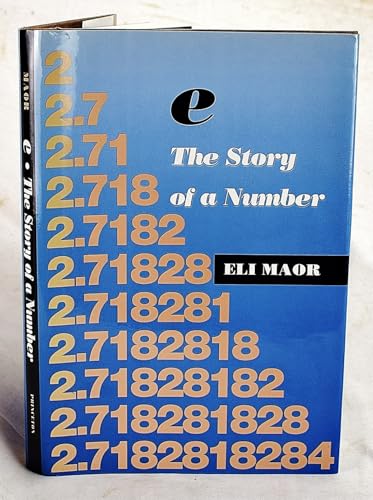
The interest earned on a bank account, the arrangement of seeds in a sunflower, and the shape of the Gateway Arch in St. Louis are all intimately connected with the mysterious number e. In this informal and engaging history, Eli Maor portrays the curious characters and the elegant mathematics that lie behind the number. Designed for a reader with only a modest mathematical background, this biography brings out the central importance of e to mathematics and illuminates a golden era in the age of science.
"synopsis" may belong to another edition of this title.
About the Author
Eli Maor is the author of Beautiful Geometry (with Eugen Jost), Venus in Transit, Trigonometric Delights, To Infinity and Beyond, and The Pythagorean Theorem: A 4,000-Year History (all Princeton).
Reviews
This book that dares to use ``e'' in its title is not for mathematicians only. Adults with open minds and students just beginning to make their way through algebra and trigonometry will find much that is easily digestible and even palatable in this lively presentation of the mathematical revolution that took place between the age of Newton and the late 19th century. Maor (Math/Northeastern Illinois) begins with logarithms, the work of John Napier, a well-born Scot and fervent anti-Papist inventor who spent 20 years working out the first log tables. The author then introduces ``e'' in a thoroughly practical fashion: The number (2.718...) is the limit of a special case of the formula for compound interest. With that as a teaser, Maor goes on to demonstrate how e crops up in marvelous ways in calculus and in beautiful graphs that link it with other memorable numbers. Indeed, one of the most celebrated equations in mathematics states that e raised to the pi times i power = -1 (i= the square root of -1). This is all nicely wrought, with diagrams and informal developments of equations in the text. (Appendices supply formal treatments.) But to the bare bones of the math Maor adds descriptions of the major innovators, their quirks, and their quarrels, ranging from Newton and Leibniz fighting over the invention of calculus to the not-so-petty jealousies among the Bernoullis, from the brilliance of Leonhard Euler (who first named e) to the eccentric Georg Cantor, who established orders of infinity and demonstrated that e and pi were only two of an infinite collection of transcendental numbers. It's worth reading the book just to find out exactly what that last phrase means. Pithy, punchy, and surprisingly accessible. -- Copyright ©1994, Kirkus Associates, LP. All rights reserved.
Everyone whose mathematical education has gone beyond elementary school is familiar with the number known as pi. Far fewer have been introduced to e, a number that is of equal importance in theoretical mathematics. Maor (mathematics, Northeastern Illinois Univ.) tries to fill this gap with this excellent book. He traces the history of mathematics from the 16th century to the present through the intriguing properties of this number. Maor says that his book is aimed at the reader with a "modest" mathematical background. Be warned that his definition of modest may not be yours. The text introduces and discusses logarithms, limits, calculus, differential equations, and even the theory of functions of complex variables. Not easy stuff! Nevertheless, the writing is clear and the material fascinating. Highly recommended.
- Harold D. Shane, Baruch Coll., CUNY
Copyright 1994 Reed Business Information, Inc.
The discovery of e (the base for natural logarithms) did much to confirm the faith--central to modern science--that the empirical world is encoded in mathematics. Indeed, today scientists and engineers rely heavily on e and its derivatives when solving numerous real-world problems. Yet many who routinely employ this powerful number know little of its history. Maor recounts the rich drama surrounding the number that emerged at the center of the investigations of some of the most brilliant thinkers of all time--Fermat and Descartes, Newton and Leibniz, Laplace and the Bernoullis, Euler and Gauss. Though the exposition inevitably requires many formulas and some abbreviated derivations, the author tries to smooth the way for general readers who do not know calculus or analytical geometry, while still conveying some sense of the imaginative daring of the pioneers who opened up these fields of mathematics. Through appendixes and footnotes, mathematicians can find their way to more rigorous and exhaustive treatment of the subject; nonspecialists can easily wend their way around the more theoretical questions while still enlarging their understanding of intellectual and cultural history. Bryce Christensen
"About this title" may belong to another edition of this title.
Other Popular Editions of the Same Title

Search results for e: The Story of a Number

Stock Image
e: The Story of a Number
Published by
Princeton University Press, 1994
ISBN 10: 0691033900
ISBN 13: 9780691033907
Used
Hardcover
Seller: World of Books (was SecondSale), Montgomery, IL, U.S.A.
Seller rating 5 out of 5 stars

Condition: Good. Item in good condition. Textbooks may not include supplemental items i.e. CDs, access codes etc. Seller Inventory # 00105615351
Stock Image
e: The Story of a Number
Published by
Princeton University Press, 1994
ISBN 10: 0691033900
ISBN 13: 9780691033907
Used
Hardcover
Seller: World of Books (was SecondSale), Montgomery, IL, U.S.A.
Seller rating 5 out of 5 stars
Condition: Very Good. Item in very good condition! Textbooks may not include supplemental items i.e. CDs, access codes etc. Seller Inventory # 00100715397
Seller Image
e: The Story of a Number
Published by
Princeton University Press, 1994
ISBN 10: 0691033900
ISBN 13: 9780691033907
Used
Hardcover
Seller: Dream Books Co., Denver, CO, U.S.A.
Seller rating 5 out of 5 stars
Condition: good. Gently used with minimal wear on the corners and cover. A few pages may contain light highlighting or writing, but the text remains fully legible. Dust jacket may be missing, and supplemental materials like CDs or codes may not be included. May be ex-library with library markings. Ships promptly! Seller Inventory # DBV.0691033900.G
Seller Image
e: The Story of a Number
Published by
Princeton University Press, 1994
ISBN 10: 0691033900
ISBN 13: 9780691033907
Used
Hardcover
Seller: Goodwill Books, Hillsboro, OR, U.S.A.
Seller rating 5 out of 5 stars
Condition: acceptable. Fairly worn, but readable and intact. If applicable: Dust jacket, disc or access code may not be included. Seller Inventory # GICWV.0691033900.A
Stock Image
e: The Story of a Number
Published by
Princeton University Press, 1994
ISBN 10: 0691033900
ISBN 13: 9780691033907
Used
Hardcover
Seller: ThriftBooks-Dallas, Dallas, TX, U.S.A.
Seller rating 5 out of 5 stars
Hardcover. Condition: Fair. No Jacket. Missing dust jacket; Readable copy. Pages may have considerable notes/highlighting. ~ ThriftBooks: Read More, Spend Less. Seller Inventory # G0691033900I5N01
Stock Image
e: The Story of a Number
Published by
Princeton University Press, 1994
ISBN 10: 0691033900
ISBN 13: 9780691033907
Used
Hardcover
Seller: HPB-Red, Dallas, TX, U.S.A.
Seller rating 5 out of 5 stars
Hardcover. Condition: Acceptable. Connecting readers with great books since 1972. Used textbooks may not include companion materials such as access codes, etc. May have condition issues including wear and notes/highlighting. We ship orders daily and Customer Service is our top priority! Seller Inventory # S_466509387
Stock Image
e: The Story of a Number
Published by
Princeton University Press, 1994
ISBN 10: 0691033900
ISBN 13: 9780691033907
Used
Hardcover
Seller: HPB-Red, Dallas, TX, U.S.A.
Seller rating 5 out of 5 stars
Hardcover. Condition: Good. Connecting readers with great books since 1972! Used textbooks may not include companion materials such as access codes, etc. May have some wear or writing/highlighting. We ship orders daily and Customer Service is our top priority! Seller Inventory # S_465603726
Stock Image
e: The Story of a Number
Published by
Princeton University Press, 1994
ISBN 10: 0691033900
ISBN 13: 9780691033907
Used
Hardcover
Seller: HPB-Emerald, Dallas, TX, U.S.A.
Seller rating 5 out of 5 stars
Hardcover. Condition: Very Good. Connecting readers with great books since 1972! Used books may not include companion materials, and may have some shelf wear or limited writing. We ship orders daily and Customer Service is our top priority! Seller Inventory # S_465925681
Stock Image
e: The Story of a Number
Published by
Princeton University Press, 1994
ISBN 10: 0691033900
ISBN 13: 9780691033907
Used
Hardcover
Seller: HPB-Diamond, Dallas, TX, U.S.A.
Seller rating 5 out of 5 stars
Hardcover. Condition: Very Good. Connecting readers with great books since 1972! Used books may not include companion materials, and may have some shelf wear or limited writing. We ship orders daily and Customer Service is our top priority! Seller Inventory # S_458686403
Stock Image
E: the Story of a Number
Published by
Princeton University Press, 1994
ISBN 10: 0691033900
ISBN 13: 9780691033907
Used
Hardcover
Seller: Better World Books, Mishawaka, IN, U.S.A.
Seller rating 5 out of 5 stars
Condition: Good. Former library copy. Pages intact with minimal writing/highlighting. The binding may be loose and creased. Dust jackets/supplements are not included. Includes library markings. Stock photo provided. Product includes identifying sticker. Better World Books: Buy Books. Do Good. Seller Inventory # GRP21429565