
Items related to Behind Deep Blue: Building the Computer that Defeated...
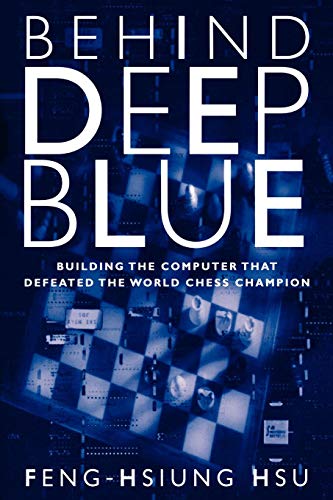
Synopsis
On May 11, 1997, as millions worldwide watched a stunning victory unfold on television, a machine shocked the chess world by defeating the defending world champion, Garry Kasparov. Written by the man who started the adventure, Behind Deep Blue reveals the inside story of what happened behind the scenes at the two historic Deep Blue vs. Kasparov matches. This is also the story behind the quest to create the mother of all chess machines. The book unveils how a modest student project eventually produced a multimillion dollar supercomputer, from the development of the scientific ideas through technical setbacks, rivalry in the race to develop the ultimate chess machine, and wild controversies to the final triumph over the world's greatest human player.
In nontechnical, conversational prose, Feng-hsiung Hsu, the system architect of Deep Blue, tells us how he and a small team of fellow researchers forged ahead at IBM with a project they'd begun as students at Carnegie Mellon in the mid-1980s: the search for one of the oldest holy grails in artificial intelligence--a machine that could beat any human chess player in a bona fide match. Back in 1949 science had conceived the foundations of modern chess computers but not until almost fifty years later--until Deep Blue--would the quest be realized.
Hsu refutes Kasparov's controversial claim that only human intervention could have allowed Deep Blue to make its decisive, "uncomputerlike" moves. In riveting detail he describes the heightening tension in this war of brains and nerves, the "smoldering fire" in Kasparov's eyes. Behind Deep Blue is not just another tale of man versus machine. This fascinating book tells us how man as genius was given an ultimate, unforgettable run for his mind, no, not by the genius of a computer, but of man as toolmaker.
"synopsis" may belong to another edition of this title.
About the Author
Feng-hsiung Hsu is the founding father of the Deep Blue project. He began it in 1985 as a graduate student at Carnegie Mellon University. From 1989 to 1997 he worked as the system architect and chip designer for the Deep Blue Chess machine at IBM's T. J. Watson Research Center. He is now a senior researcher at Microsoft Research Asia.
From the Back Cover
"Feng-hsiung Hsu, who masterminded Kasparov's match play defeat by a computer, tells his story. A nerdy book might be expected, delving into arcane topics (computer chip design, programming, chess), but instead we have something more like 'Indiana Jones and the Holy Grail.' No specialist knowledge is demanded. The author's adventures with phantom queens, etc. are fascinating. His will-to-win matched that of the legendary Kasparov."--Ken Whyld, Editor of theOxford Companion to Chess
"I don't play chess; never have. Most research, as Edison said, is 90% perspiration and 10% inspiration--not exciting to watch. Thus, I did not have high hopes forBehind Deep Blue. Wrong! It's a page-turner! Even if you don't follow the technical details of chip design or chess, Hsu has captured the very human dimension exquisitely! It's a great story!"--William A. Wulf, President of the National Academy of Engineering, AA&M Professor of Computer Science, University of Virginia
From the Inside Flap
"Feng-hsiung Hsu, who masterminded Kasparov's match play defeat by a computer, tells his story. A nerdy book might be expected, delving into arcane topics (computer chip design, programming, chess), but instead we have something more like 'Indiana Jones and the Holy Grail.' No specialist knowledge is demanded. The author's adventures with phantom queens, etc. are fascinating. His will-to-win matched that of the legendary Kasparov."--Ken Whyld, Editor of theOxford Companion to Chess
"I don't play chess; never have. Most research, as Edison said, is 90% perspiration and 10% inspiration--not exciting to watch. Thus, I did not have high hopes forBehind Deep Blue. Wrong! It's a page-turner! Even if you don't follow the technical details of chip design or chess, Hsu has captured the very human dimension exquisitely! It's a great story!"--William A. Wulf, President of the National Academy of Engineering, AA&M Professor of Computer Science, University of Virginia
Reviews
It was l949 when the eminent mathematician Claude E. Shannon suggested how to program a computer to play chess. "At that time, many renowned computer scientists believed that the Computer Chess Problem-- creating a chess computer that could beat the World Champion-- would be solved within a few years." It was, in fact, 48 years before the IBM computer Deep Blue-- capable of searching 200 million possible chess positions per second-- defeated world champion Garry Kasparov. Hsu, now a research scientist at the Western Research Lab of Compaq Computer, was the system architect for Deep Blue. He makes an exciting tale of computer chess evolution and the Kasparov match. Is Deep Blue intelligent? No, Hsu says: "It is only a finely-crafted tool that exhibits intelligent behavior in a limited domain."
Editors of Scientific American
Because the two matches that chess champ Garry Kasparov played six years ago against the author's supercomputer were so widely publicized, there's probably going to be a large audience for Hsu's behind-the-scenes account of the epic man-against-machine showdowns. Despite the arcane technical nature of both top-echelon chess and computer programming, Hsu's narrative does not suffer from indecipherable jargon, because he hews to human-interest-oriented storytelling. He starts with his student days at Carnegie-Mellon University, where he had to choose whether his future lay in designing chips for copiers or chess-playing computers. Taking the flashier option, he and his colleagues' first chess products caught IBM's publicity-seeking eye, and Hsu's group decamped for Big Blue. Hsu admits to his competitive desire to defeat Kasparov, who styled his rout of Hsu's first version of Deep Blue in 1996 as a defense of humanity. Stung, Hsu and his mates re-jiggered Deep Blue for the following year's grudge match, a battle regaled with drama and ripostes to Kasparov's disparagement of the electronic victor. A fascinating story. Gilbert Taylor
Copyright © American Library Association. All rights reserved
In 1997, a computer developed by a team of researchers at IBM shocked the world by defeating world chess champion Gary Kasparov in a six-game match. Hsu began developing Deep Blue, the first computer to achieve such a feat, as a graduate student at Carnegie Mellon University. Here he focuses on the events in his career that led to his involvement with the project. He tells the story of how the basic technical ideas took shape in the computer science department and describes the further evolution and culmination of the project at IBM. Not merely a rehashing of the engineering that was poured into creating the "mother of all chess machines," Hsu's account goes beyond the typical man vs. machine angle and attempts to capture the true essence of the contest between men in two distinct roles: Kasparov as performer and Hsu's team as toolmaker. The result is an intelligent, well-written account of a milestone in the history of computer science that stands out from the other books on Deep Blue. Recommended for general readers attracted to the history of chess and computing.
Joe J. Accardi, William Rainey Harper Coll. Lib., Palatine, IL
Copyright 2002 Reed Business Information, Inc.
Excerpt. © Reprinted by permission. All rights reserved.
Behind Deep Blue:
Building the Computer that Defeated the World Chess ChampionFeng-hsiung Hsu
Chapter 1
Show Time!
In late April 1997, posters for an unusual chess event were appearing on the streets of New York. They showed a somber and pondering gentleman in his early 30s peering over a chess set at the viewers. The small caption under his chin said, "How do you make a computer blink?" The gentleman on the poster was the World Chess Champion Garry Kasparov, possibly the strongest chess player who has ever lived.
Off the street, in the basement of the Equitable Building, I was staring at the blank screens in an empty auditorium. In a few days, the auditorium would be filled with an overflowing crowd; TV cameras would be entrenched at vantage locations and the three huge projection screens at the front would come to life. The left screen would be showing a live image from a TV studio on the 35th floor of the building, serving as the game room. The live image would usually show the two contestants sitting across a specially designed playing table. The contestant on the left would be Garry Kasparov. The contestant on the other side would be one of my two colleagues, Murray Campbell and Joe Hoane, or me. Garry's real opponent was the chess computer, Deep Blue, that the three of us had designed and programmed. During the games we acted merely as extensions of Deep Blue and made moves for it on the physical chessboard. In the auditorium itself, three chess commentators, sometimes with a guest commentator or two, would be using the center screen to show their analysis of the ongoing game. The right screen would be displaying the overhead shot of the chessboard. This way, the audience in the auditorium would have a clear view of the present game position.
It had taken me almost twelve years to reach this point. When I started, Garry was not the World Champion; it was a few months yet before he was crowned. For the past eleven years, since 1986, my partners and I had been building successively more powerful chess computers. Our eventual goal was to beat the World Chess Champion, whoever he or she was.
Before us, many pioneers, some famous and some not so famous, had made their contributions to the "Computer Chess Problem". In 1949, Claude Shannon made his proposal on how to program a computer to play chess. Since then, thousands of computer scientists, engineers, hobbyists, chess players, and even commercial organizations had worked on the problem. Some wanted to use chess as an experimental tool to find out how human intelligence worked. "If one could devise a successful chess machine, one would seem to have penetrated to the core of human intellectual endeavor," said Allen Newell, Cliff Shaw and Herbert Simon in one of the early computer chess papers. Other people viewed chess as a clear-cut, well-defined example of a complex problem. "Solving" chess could conceivably provide new techniques to solve other complex problems. The commercial entities did it for profit, of course, and some people, especially the hobbyists, did it just for fun.
We approached the problem from a different direction. We, or at least I, viewed the problem as a purely engineering one. Since the late 1970s, it had been established that chess computers became stronger as their hardware speed increased. By 1985, when I started my small project that eventually become Deep Blue, the extrapolation from the experimental data indicated that a one thousandfold increase in hardware speed might be sufficient to produce a World Champion-class chess machine. Our project began with a simple goal, namely, to find out whether a massive increase in hardware speed would be sufficient to "solve" the Computer Chess Problem. Building this "Mother of all Chess Machines" was an interesting problem by itself. Of course, it would be an added bonus if our machine could indeed defeat the World Champion.
The previous version of Deep Blue, lost a match to Garry Kasparov in Philadelphia in 1996. But two-thirds of the way into that match, we had played to a tie with Kasparov. That old version of Deep Blue was already faster than the machine that I conjectured in 1985, and yet it was not enough. There was more to solving the Computer Chess Problem than just increasing the hardware speed. Since that match, we rebuilt Deep Blue from scratch, going through every match problem we had and engaging Grandmasters extensively in our preparations. Somehow, all the work caused Grandmaster Joel Benjamin, our chess advisor, and one of the best chess players in the US, to say, "You know, sometimes Deep Blue plays chess." Joel could no longer distinguish with certainty Deep Blue's moves from the moves played by the top Grandmasters.
The press covered this new match with much anticipation. If the new Deep Blue won the match, then it would be a momentous occasion in the long history of men as toolmakers. It would also be the completion of a long-sought-after milestone for computer scientists and artificial intelligence researchers. It was almost certain that this match would be bigger than any World Chess Championship match, with possibly the sole exception of the Fischer vs. Spassky match in 1972. If we did win, perhaps not even that Fischer vs. Spassky match would compare.
The new Deep Blue was much improved, but would it be enough? Would the journey begun by my partners and me so many years ago finally be over?
"About this title" may belong to another edition of this title.
Search results for Behind Deep Blue: Building the Computer that Defeated...

Stock Image
Behind Deep Blue: Building the Computer that Defeated the World Chess Champion
Published by
Princeton University Press, 2002
ISBN 10: 0691090653
ISBN 13: 9780691090658
Used
Hardcover
Seller: HPB-Ruby, Dallas, TX, U.S.A.
Seller rating 5 out of 5 stars

hardcover. Condition: Very Good. Connecting readers with great books since 1972! Used books may not include companion materials, and may have some shelf wear or limited writing. We ship orders daily and Customer Service is our top priority! Seller Inventory # S_481661608
Stock Image
Behind Deep Blue : Building the Computer That Defeated the World Chess Champion
Published by
Princeton University Press, 2002
ISBN 10: 0691090653
ISBN 13: 9780691090658
Used
Hardcover
Seller: Better World Books, Mishawaka, IN, U.S.A.
Seller rating 5 out of 5 stars
Condition: Very Good. Former library copy. Pages intact with possible writing/highlighting. Binding strong with minor wear. Dust jackets/supplements may not be included. Includes library markings. Stock photo provided. Product includes identifying sticker. Better World Books: Buy Books. Do Good. Seller Inventory # 5369010-20
Stock Image
Behind Deep Blue: Building the Computer that Defeated the World Chess Champion
Published by
Princeton University Press, 2002
ISBN 10: 0691090653
ISBN 13: 9780691090658
Used
Hardcover
Seller: ThriftBooks-Atlanta, AUSTELL, GA, U.S.A.
Seller rating 5 out of 5 stars
Hardcover. Condition: Fair. No Jacket. Readable copy. Pages may have considerable notes/highlighting. ~ ThriftBooks: Read More, Spend Less. Seller Inventory # G0691090653I5N00
Stock Image
Behind Deep Blue: Building the Computer that Defeated the World Chess Champion
Published by
Princeton University Press, 2002
ISBN 10: 0691090653
ISBN 13: 9780691090658
Used
Hardcover
Seller: ThriftBooks-Atlanta, AUSTELL, GA, U.S.A.
Seller rating 5 out of 5 stars
Hardcover. Condition: Fair. No Jacket. Former library book; Readable copy. Pages may have considerable notes/highlighting. ~ ThriftBooks: Read More, Spend Less. Seller Inventory # G0691090653I5N10
Stock Image
Behind Deep Blue: Building the Computer that Defeated the World Chess Champion
Published by
Princeton University Press, 2002
ISBN 10: 0691090653
ISBN 13: 9780691090658
Used
Hardcover
Seller: HPB-Diamond, Dallas, TX, U.S.A.
Seller rating 5 out of 5 stars
Hardcover. Condition: Very Good. Connecting readers with great books since 1972! Used books may not include companion materials, and may have some shelf wear or limited writing. We ship orders daily and Customer Service is our top priority! Seller Inventory # S_485275846
Stock Image
Behind Deep Blue: Building the Computer that Defeated the World Chess Champion
Published by
Princeton University Press, 2002
ISBN 10: 0691090653
ISBN 13: 9780691090658
Used
Hardcover
Seller: Sequitur Books, Boonsboro, MD, U.S.A.
Seller rating 5 out of 5 stars
Hardcover. Condition: As New. Hardcover and dust jacket. Front end page excised. Good binding and cover. Clean, unmarked pages. Seller Inventory # 2210010068
Stock Image
Behind Deep Blue: Building the Computer that Defeated the World Chess Champion
Published by
Princeton University Press, 2002
ISBN 10: 0691090653
ISBN 13: 9780691090658
Used
Hardcover
First Edition
Seller: Taos Books, Santa Fe, NM, U.S.A.
Seller rating 4 out of 5 stars

Hardcover. Condition: Like New. First Edition. 1st print (full # line), text and boards new looking, tight clean unmarked with bright white pages, dust jacket undamaged, dj a little loose fitting, Fine/Very Good Plus. Seller Inventory # 37068
Stock Image
Behind Deep Blue: Building the Computer that Defeated the World Chess Champion
Seller: AwesomeBooks, Wallingford, United Kingdom
Seller rating 5 out of 5 stars
Hardcover. Condition: Very Good. Behind Deep Blue: Building the Computer that Defeated the World Chess Champion This book is in very good condition and will be shipped within 24 hours of ordering. The cover may have some limited signs of wear but the pages are clean, intact and the spine remains undamaged. This book has clearly been well maintained and looked after thus far. Money back guarantee if you are not satisfied. See all our books here, order more than 1 book and get discounted shipping. Seller Inventory # 7719-9780691090658
Buy Used
US$ 24.19
US$ 5.51 shipping
Ships from United Kingdom to U.S.A.
Ships from United Kingdom to U.S.A.
Quantity: 2 available
Stock Image
Behind Deep Blue: Building the Computer that Defeated the World Chess Champion
Seller: Bahamut Media, Reading, United Kingdom
Seller rating 4 out of 5 stars
Hardcover. Condition: Very Good. This book is in very good condition and will be shipped within 24 hours of ordering. The cover may have some limited signs of wear but the pages are clean, intact and the spine remains undamaged. This book has clearly been well maintained and looked after thus far. Money back guarantee if you are not satisfied. See all our books here, order more than 1 book and get discounted shipping. Seller Inventory # 6545-9780691090658
Buy Used
US$ 23.76
US$ 9.34 shipping
Ships from United Kingdom to U.S.A.
Ships from United Kingdom to U.S.A.
Quantity: 2 available
Stock Image
Behind Deep Blue: Building the Computer that Defeated the World Chess Champion
Published by
Princeton University Press, 2002
ISBN 10: 0691090653
ISBN 13: 9780691090658
New
Hardcover
First Edition
Seller: Griffin Books, Stamford, CT, U.S.A.
Seller rating 5 out of 5 stars
hardcover. Condition: New. First Edition. First edition, first printing. Brand new gift quality hardcover in jacket Please email for photos. Larger books or sets may require additional shipping charges. Books sent via US Postal. Seller Inventory # 130317