
Items related to Four Colors Suffice: How the Map Problem Was Solved
Synopsis
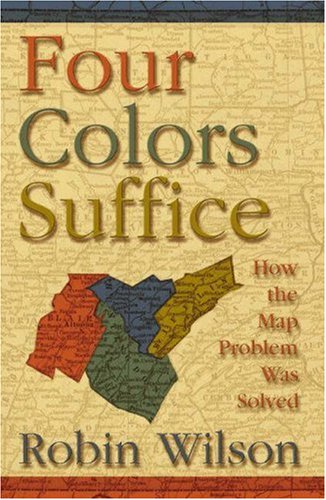
On October 23, 1852, Professor Augustus De Morgan wrote a letter to a colleague, unaware that he was launching one of the most famous mathematical conundrums in history--one that would confound thousands of puzzlers for more than a century. This is the amazing story of how the "map problem" was solved.
The problem posed in the letter came from a former student: What is the least possible number of colors needed to fill in any map (real or invented) so that neighboring counties are always colored differently? This deceptively simple question was of minimal interest to cartographers, who saw little need to limit how many colors they used. But the problem set off a frenzy among professional mathematicians and amateur problem solvers, among them Lewis Carroll, an astronomer, a botanist, an obsessive golfer, the Bishop of London, a man who set his watch only once a year, a California traffic cop, and a bridegroom who spent his honeymoon coloring maps. In their pursuit of the solution, mathematicians painted maps on doughnuts and horseshoes and played with patterned soccer balls and the great rhombicuboctahedron.
It would be more than one hundred years (and countless colored maps) later before the result was finally established. Even then, difficult questions remained, and the intricate solution--which involved no fewer than 1,200 hours of computer time--was greeted with as much dismay as enthusiasm.
Providing a clear and elegant explanation of the problem and the proof, Robin Wilson tells how a seemingly innocuous question baffled great minds and stimulated exciting mathematics with far-flung applications. This is the entertaining story of those who failed to prove, and those who ultimately did prove, that four colors do indeed suffice to color any map.
"synopsis" may belong to another edition of this title.
About the Author
Robin Wilson is Head of the Pure Mathematics Department at the Open University and Fellow of Keble College, Oxford University. He is Gresham Professor of Geometry at Gresham College, London, and is a frequent visitor to Colorado College. He has written and edited about 25 books on topics ranging from graph theory via philately, to the Gilbert and Sullivan operas, to the history of mathematics.
From the Back Cover
"I loved Robin Wilson's book on the four color problem, because it gives the history as well as the arguments. The history is presented so entertainingly, and the arguments so lucidly, that I'm sure the book will find a large audience, and delight any audience as much as it did me."--John Conway
"An intriguing historical account of one of the most baffling enigmas in mathematics: the Four Color Theorem. Robin Wilson provides fascinating insights into how mathematicians think, and shows that questions that are simple to ask may not be simple to answer."--Ian Stewart
"Robin Wilson has combined a complete history of the approach that led to the solution of the four color problem with a description of the techniques involved that can be read with pleasure and comprehension by undergraduates as well as professional mathematicians."--Kenneth Appel, University of New Hampshire
From the Inside Flap
"I loved Robin Wilson's book on the four color problem, because it gives the history as well as the arguments. The history is presented so entertainingly, and the arguments so lucidly, that I'm sure the book will find a large audience, and delight any audience as much as it did me."--John Conway
"An intriguing historical account of one of the most baffling enigmas in mathematics: the Four Color Theorem. Robin Wilson provides fascinating insights into how mathematicians think, and shows that questions that are simple to ask may not be simple to answer."--Ian Stewart
"Robin Wilson has combined a complete history of the approach that led to the solution of the four color problem with a description of the techniques involved that can be read with pleasure and comprehension by undergraduates as well as professional mathematicians."--Kenneth Appel, University of New Hampshire
Reviews
The four-color conjecture, formulated in 1852, was among the most popular unsolved problems in mathematics. Amateurs and professionals alike succumbed to its allure. It is, simply stated: four colors are all that is needed to fill in any map so that neighboring countries are always colored differently. That the proof, which was completed in 1976, consumed a thousand pages and gobs of computer time hints at the hidden complexity encountered by those attempting to solve it. Recreational mathematicians will find Wilson's history of the conjecture an approachable mix of its technical and human aspects, in part because the math involved is understandable even to able middle-schoolers. The conjecture seemed a snap to its originator, one Francis Guthrie, but his claimed proof has never surfaced; those proofs that did surface, prior to the final breakthrough by Kenneth Appel and Wolfgang Haken, contained fatal errors. Wilson explains all with exemplary clarity and an accent on the eccentricities of the characters, Lewis Carroll among them. Gilbert Taylor
Copyright © American Library Association. All rights reserved
"About this title" may belong to another edition of this title.
Search results for Four Colors Suffice: How the Map Problem Was Solved

Stock Image
Four Colors Suffice: How the Map Problem Was Solved
Published by
Princeton University Press, 2003
ISBN 10: 0691115338
ISBN 13: 9780691115337
Used
Hardcover
Seller: Gulf Coast Books, Cypress, TX, U.S.A.
Seller rating 5 out of 5 stars

hardcover. Condition: Very Good. Seller Inventory # 0691115338-2-33503044
Stock Image
Four Colors Suffice: How the Map Problem Was Solved
Published by
Princeton University Press, 2003
ISBN 10: 0691115338
ISBN 13: 9780691115337
Used
Hardcover
Seller: World of Books (was SecondSale), Montgomery, IL, U.S.A.
Seller rating 5 out of 5 stars
Hardback. Condition: Good. On October 23, 1852, Professor Augustus De Morgan wrote a letter to a colleague, unaware that he was launching one of the most famous mathematical conundrums in history - one that would confound thousands of puzzlers for more than a century. This is the amazing story of how the "map problem" was solved. The problem posed in the letter came from a former student: What is the least possible number of colors needed to fill in any map (real or invented) so that neighboring counties are always colored differently? This deceptively simple question was of minimal interest to cartographers, who saw little need to limit how many colors they used. But the problem set off a frenzy among professional mathematicians and amateur problem solvers, among them Lewis Carroll, an astronomer, a botanist, an obsessive golfer, the Bishop of London, a man who set his watch only once a year, a California traffic cop, and a bridegroom who spent his honeymoon coloring maps.In their pursuit of the solution, mathematicians painted maps on doughnuts and horseshoes and played with patterned soccer balls and the great rhombicuboctahedron. It would be more than one hundred years (and countless colored maps) later before the result was finally established. Even then, difficult questions remained, and the intricate solution - which involved no fewer than 1,200 hours of computer time - was greeted with as much dismay as enthusiasm. Providing a clear and elegant explanation of the problem and the proof, Robin Wilson tells how a seemingly innocuous question baffled great minds and stimulated exciting mathematics with far-flung applications. This is the entertaining story of those who failed to prove, and those who ultimately did prove, that four colors do indeed suffice to color any map. Seller Inventory # 00104367841
Stock Image
Four Colors Suffice: How the Map Problem Was Solved
Published by
Princeton University Press, 2003
ISBN 10: 0691115338
ISBN 13: 9780691115337
Used
Hardcover
Seller: World of Books Inc, Montgomery, IL, U.S.A.
Seller rating 4 out of 5 stars

Hardback. Condition: Good. On October 23, 1852, Professor Augustus De Morgan wrote a letter to a colleague, unaware that he was launching one of the most famous mathematical conundrums in history - one that would confound thousands of puzzlers for more than a century. This is the amazing story of how the "map problem" was solved. The problem posed in the letter came from a former student: What is the least possible number of colors needed to fill in any map (real or invented) so that neighboring counties are always colored differently? This deceptively simple question was of minimal interest to cartographers, who saw little need to limit how many colors they used. But the problem set off a frenzy among professional mathematicians and amateur problem solvers, among them Lewis Carroll, an astronomer, a botanist, an obsessive golfer, the Bishop of London, a man who set his watch only once a year, a California traffic cop, and a bridegroom who spent his honeymoon coloring maps.In their pursuit of the solution, mathematicians painted maps on doughnuts and horseshoes and played with patterned soccer balls and the great rhombicuboctahedron. It would be more than one hundred years (and countless colored maps) later before the result was finally established. Even then, difficult questions remained, and the intricate solution - which involved no fewer than 1,200 hours of computer time - was greeted with as much dismay as enthusiasm. Providing a clear and elegant explanation of the problem and the proof, Robin Wilson tells how a seemingly innocuous question baffled great minds and stimulated exciting mathematics with far-flung applications. This is the entertaining story of those who failed to prove, and those who ultimately did prove, that four colors do indeed suffice to color any map. Seller Inventory # CIN0691115338G
Stock Image
Four Colors Suffice: How the Map Problem Was Solved
Published by
Princeton University Press, 2003
ISBN 10: 0691115338
ISBN 13: 9780691115337
Used
Hardcover
Seller: ThriftBooks-Reno, Reno, NV, U.S.A.
Seller rating 5 out of 5 stars
Hardcover. Condition: Very Good. No Jacket. May have limited writing in cover pages. Pages are unmarked. ~ ThriftBooks: Read More, Spend Less. Seller Inventory # G0691115338I4N00
Stock Image
Four Colors Suffice: How the Map Problem Was Solved
Published by
Princeton University Press, 2003
ISBN 10: 0691115338
ISBN 13: 9780691115337
Used
Hardcover
Seller: ThriftBooks-Phoenix, Phoenix, AZ, U.S.A.
Seller rating 5 out of 5 stars
Hardcover. Condition: Very Good. No Jacket. May have limited writing in cover pages. Pages are unmarked. ~ ThriftBooks: Read More, Spend Less. Seller Inventory # G0691115338I4N00
Seller Image
Four Colors Suffice: How the Map Problem Was Solved
Published by
Princeton University Press, 2003
ISBN 10: 0691115338
ISBN 13: 9780691115337
Used
Hardcover
Seller: -OnTimeBooks-, Phoenix, AZ, U.S.A.
Seller rating 5 out of 5 stars
Condition: very_good. Gently read. May have name of previous ownership, or ex-library edition. Binding tight; spine straight and smooth, with no creasing; covers clean and crisp. Minimal signs of handling or shelving. 100% GUARANTEE! Shipped with delivery confirmation, if you're not satisfied with purchase please return item! Ships USPS Media Mail. Seller Inventory # OTV.0691115338.VG
Stock Image
Four Colors Suffice: How the Map Problem Was Solved
Published by
Princeton University Press, 2003
ISBN 10: 0691115338
ISBN 13: 9780691115337
Used
Hardcover
Seller: ThriftBooks-Atlanta, AUSTELL, GA, U.S.A.
Seller rating 5 out of 5 stars
Hardcover. Condition: Very Good. No Jacket. May have limited writing in cover pages. Pages are unmarked. ~ ThriftBooks: Read More, Spend Less. Seller Inventory # G0691115338I4N00
Stock Image
Four Colors Suffice: How the Map Problem Was Solved
Published by
Princeton University Press, 2003
ISBN 10: 0691115338
ISBN 13: 9780691115337
Used
Hardcover
Seller: ThriftBooks-Dallas, Dallas, TX, U.S.A.
Seller rating 5 out of 5 stars
Hardcover. Condition: Very Good. No Jacket. May have limited writing in cover pages. Pages are unmarked. ~ ThriftBooks: Read More, Spend Less. Seller Inventory # G0691115338I4N00
Stock Image
Four Colors Suffice : How the Map Problem Was Solved
Published by
Princeton University Press, 2003
ISBN 10: 0691115338
ISBN 13: 9780691115337
Used
Hardcover
Seller: Better World Books: West, Reno, NV, U.S.A.
Seller rating 5 out of 5 stars
Condition: Very Good. Former library copy. Pages intact with possible writing/highlighting. Binding strong with minor wear. Dust jackets/supplements may not be included. Includes library markings. Stock photo provided. Product includes identifying sticker. Better World Books: Buy Books. Do Good. Seller Inventory # 8194518-20
Stock Image
Four Colors Suffice: How the Map Problem Was Solved
Published by
Princeton University Press, 2003
ISBN 10: 0691115338
ISBN 13: 9780691115337
Used
Hardcover
Seller: Wonder Book, Frederick, MD, U.S.A.
Seller rating 5 out of 5 stars
Condition: Very Good. Very Good condition. Very Good dust jacket. A copy that may have a few cosmetic defects. May also contain light spine creasing or a few markings such as an owner's name, short gifter's inscription or light stamp. Seller Inventory # O09A-02331