
Items related to The Fall and Rise of the Islamic State (Council on...
Synopsis
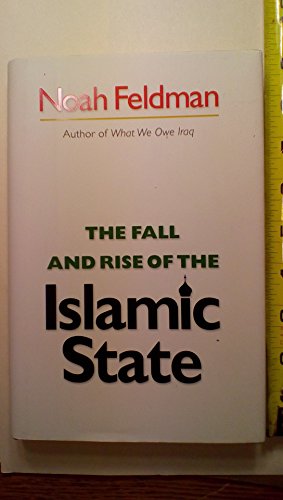
A critical study reveals the story behind the increasingly popular call for the establishment of the traditional Islamic state in the modern Muslim world and provides a sweeping history of the traditional Islamic constitution, examining the various provisions of the shari'a and arguing for the creation of new institutions that can restore a constitutional balance of power.
"synopsis" may belong to another edition of this title.
About the Author
Noah Feldman is Bemis Professor of Law at Harvard Law School. He is a contributing writer for the New York Times Magazine and an adjunct senior fellow at the Council on Foreign Relations. He is the author of Divided by God, What We Owe Iraq (Princeton), and After Jihad.
From the Back Cover
"In Feldman's fascinating intellectual journey through history, Islamic law, and modern politics, you will discover the power of 'justice.' It is both the driving force behind efforts in the Arab world to democratize, constitutionalize, and modernize Islam, and a weapon for the worst kind of abuses and authoritarianism. Feldman's book works through these tensions between theology and power with consummate dispassion and scholarship."--Leslie H. Gelb, president emeritus of the Council on Foreign Relations and former New York Times columnist
"Noah Feldman has raised a central discussion in Islam about the nature of the Islamic state that is too often missed or misunderstood. Regardless of ideological or religious affiliation, the reader needs to engage with Feldman's clear and sympathetic arguments in order to make sense of what is happening in the Muslim world today."--Akbar S. Ahmed, American University
"Scholarly and sophisticated yet highly accessible, this book makes an extremely important contribution to contemporary discussions of both Muslim politics and Islamic law. Feldman's work provides a historical depth that has often been lacking in studies of law and constitutionalism in modern Muslim societies."--Muhammad Qasim Zaman, author ofThe Ulama in Contemporary Islam
From the Inside Flap
"In Feldman's fascinating intellectual journey through history, Islamic law, and modern politics, you will discover the power of 'justice.' It is both the driving force behind efforts in the Arab world to democratize, constitutionalize, and modernize Islam, and a weapon for the worst kind of abuses and authoritarianism. Feldman's book works through these tensions between theology and power with consummate dispassion and scholarship."--Leslie H. Gelb, president emeritus of the Council on Foreign Relations and former New York Times columnist
"Noah Feldman has raised a central discussion in Islam about the nature of the Islamic state that is too often missed or misunderstood. Regardless of ideological or religious affiliation, the reader needs to engage with Feldman's clear and sympathetic arguments in order to make sense of what is happening in the Muslim world today."--Akbar S. Ahmed, American University
"Scholarly and sophisticated yet highly accessible, this book makes an extremely important contribution to contemporary discussions of both Muslim politics and Islamic law. Feldman's work provides a historical depth that has often been lacking in studies of law and constitutionalism in modern Muslim societies."--Muhammad Qasim Zaman, author ofThe Ulama in Contemporary Islam
Reviews
The growing clamor for a return to Sharia law in the Muslim world has often been met with alarm by the West. But Feldman remains coolheaded, placing the movement in a historical context and suggesting that its ideal of "a just legal system, one that administers the law fairly," is an understandable goal in a region dominated by unchecked oligarchies. At its heart, Sharia "aspires to be Law that applies equally to every human, great or small, ruler or ruled," Feldman writes. Of course, he argues, a radical rethinking of the classical model is in order if the system is to be implemented successfully in a contemporary Islamic state, but, if it fails, "the alternative may well be worse." The book is compelling as a theoretical exercise, but its usefulness is restricted by Feldman’s failure to confront practical considerations such as the rights of women.
Copyright ©2008Click here to subscribe to The New Yorker
"About this title" may belong to another edition of this title.
Search results for The Fall and Rise of the Islamic State (Council on...

Stock Image
The Fall and Rise of the Islamic State (Council on Foreign Relations)
Published by
Princeton University Press, 2008
ISBN 10: 0691120455
ISBN 13: 9780691120454
Used
Hardcover
Seller: World of Books (was SecondSale), Montgomery, IL, U.S.A.
Seller rating 5 out of 5 stars

Condition: Good. Item in good condition. Textbooks may not include supplemental items i.e. CDs, access codes etc. Seller Inventory # 00106935573
Stock Image
The Fall and Rise of the Islamic State (Council on Foreign Relations)
Published by
Princeton University Press, 2008
ISBN 10: 0691120455
ISBN 13: 9780691120454
Used
Hardcover
Seller: World of Books (was SecondSale), Montgomery, IL, U.S.A.
Seller rating 5 out of 5 stars
Condition: Very Good. Item in very good condition! Textbooks may not include supplemental items i.e. CDs, access codes etc. Seller Inventory # 00100522687
Stock Image
The Fall and Rise of the Islamic State (Council on Foreign Relations)
Published by
Princeton Univ Pr (edition First Edition), 2008
ISBN 10: 0691120455
ISBN 13: 9780691120454
Used
Hardcover
First Edition
Seller: BooksRun, Philadelphia, PA, U.S.A.
Seller rating 5 out of 5 stars
Hardcover. Condition: Very Good. First Edition. With dust jacket. It's a well-cared-for item that has seen limited use. The item may show minor signs of wear. All the text is legible, with all pages included. It may have slight markings and/or highlighting. Seller Inventory # 0691120455-11-1-29
Stock Image
The Fall and Rise of the Islamic State (Council on Foreign Relations)
Seller: ThriftBooks-Dallas, Dallas, TX, U.S.A.
Seller rating 5 out of 5 stars
Hardcover. Condition: Very Good. No Jacket. Former library book; May have limited writing in cover pages. Pages are unmarked. ~ ThriftBooks: Read More, Spend Less. Seller Inventory # G0691120455I4N10
Stock Image
The Fall and Rise of the Islamic State (Council on Foreign Relations)
Seller: ThriftBooks-Atlanta, AUSTELL, GA, U.S.A.
Seller rating 5 out of 5 stars
Hardcover. Condition: Very Good. No Jacket. May have limited writing in cover pages. Pages are unmarked. ~ ThriftBooks: Read More, Spend Less. Seller Inventory # G0691120455I4N00
Stock Image
The Fall and Rise of the Islamic State (Council on Foreign Relations)
Seller: ThriftBooks-Dallas, Dallas, TX, U.S.A.
Seller rating 5 out of 5 stars
Hardcover. Condition: As New. No Jacket. Pages are clean and are not marred by notes or folds of any kind. ~ ThriftBooks: Read More, Spend Less. Seller Inventory # G0691120455I2N00
Stock Image
The Fall and Rise of the Islamic State (Council on Foreign Relations)
Seller: ThriftBooks-Atlanta, AUSTELL, GA, U.S.A.
Seller rating 5 out of 5 stars
Hardcover. Condition: Very Good. No Jacket. Former library book; May have limited writing in cover pages. Pages are unmarked. ~ ThriftBooks: Read More, Spend Less. Seller Inventory # G0691120455I4N10
Stock Image
The Fall and Rise of the Islamic State
Published by
Princeton University Press, 2008
ISBN 10: 0691120455
ISBN 13: 9780691120454
Used
Hardcover
Seller: Better World Books, Mishawaka, IN, U.S.A.
Seller rating 5 out of 5 stars
Condition: Good. Pages intact with minimal writing/highlighting. The binding may be loose and creased. Dust jackets/supplements are not included. Stock photo provided. Product includes identifying sticker. Better World Books: Buy Books. Do Good. Seller Inventory # 754783-20
Stock Image
The Fall and Rise of the Islamic State
Published by
Princeton University Press, 2008
ISBN 10: 0691120455
ISBN 13: 9780691120454
Used
Hardcover
Seller: Better World Books, Mishawaka, IN, U.S.A.
Seller rating 5 out of 5 stars
Condition: Good. Former library copy. Pages intact with minimal writing/highlighting. The binding may be loose and creased. Dust jackets/supplements are not included. Includes library markings. Stock photo provided. Product includes identifying sticker. Better World Books: Buy Books. Do Good. Seller Inventory # GRP63080717
Stock Image
The Fall and Rise of the Islamic State
Published by
Princeton University Press, 2008
ISBN 10: 0691120455
ISBN 13: 9780691120454
Used
Hardcover
Seller: World of Books Inc, Montgomery, IL, U.S.A.
Seller rating 4 out of 5 stars

Hardback. Condition: Very Good. What is the shari'a? Given the severity of some of its provisions, why is it popular among Muslims? Can the Islamic state succeed - should it? This book tells the story behind the call for the establishment of the shari'a - the law of the traditional Islamic state - in the modern Muslim world. Seller Inventory # CIN0691120455VG