
Items related to Nothing Less than Victory: Decisive Wars and the Lessons...
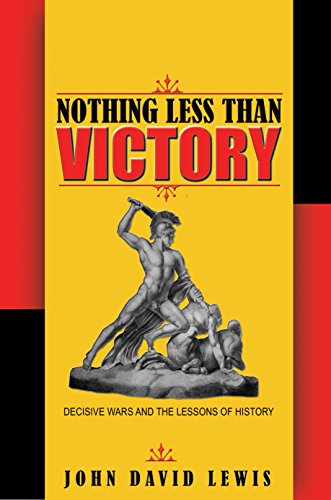
Synopsis
How aggressive military strategies win wars, from ancient times to today
The goal of war is to defeat the enemy's will to fight. But how this can be accomplished is a thorny issue. Nothing Less than Victory provocatively shows that aggressive, strategic military offenses can win wars and establish lasting peace, while defensive maneuvers have often led to prolonged carnage, indecision, and stalemate. Taking an ambitious and sweeping look at six major wars, from antiquity to World War II, John David Lewis shows how victorious military commanders have achieved long-term peace by identifying the core of the enemy's ideological, political, and social support for a war, fiercely striking at this objective, and demanding that the enemy acknowledges its defeat.
Lewis examines the Greco-Persian and Theban wars, the Second Punic War, Aurelian's wars to reunify Rome, the American Civil War, and the Second World War. He considers successful examples of overwhelming force, such as the Greek mutilation of Xerxes' army and navy, the Theban-led invasion of the Spartan homeland, and Hannibal's attack against Italy―as well as failed tactics of defense, including Fabius's policy of delay, McClellan's retreat from Richmond, and Chamberlain's appeasement of Hitler. Lewis shows that a war's endurance rests in each side's reasoning, moral purpose, and commitment to fight, and why an effectively aimed, well-planned, and quickly executed offense can end a conflict and create the conditions needed for long-term peace.
Recognizing the human motivations behind military conflicts, Nothing Less than Victory makes a powerful case for offensive actions in pursuit of peace.
"synopsis" may belong to another edition of this title.
About the Author
John David Lewis is visiting associate professor of philosophy, politics, and economics at Duke University, and senior research scholar in history and classics at the Social Philosophy and Policy Center at Bowling Green State University. He is the author of Solon the Thinker: Political Thought in Archaic Athens and Early Greek Lawgivers.
From the Back Cover
"John David Lewis offers a superb appraisal of how ancient and modern wars start and finish. This chronicle of some 2,500 years of Western history is replete with a philosophical analysis of why nations fight, win--and lose. His insights and conclusions are original and fearless--as well as timely and welcome in the confused war-making of the present age."--Victor Davis Hanson, author ofCarnage and Culture
"This book's argument is powerful and provocative, and Lewis is a good storyteller and scholar. Ambitious, stimulating, and thoughtful, this book makes a strong case for the value of the strategic offensive, and engages with the kind of problems that everyone should be thinking about today."--Barry Strauss, author of The Spartacus War
From the Inside Flap
"John David Lewis offers a superb appraisal of how ancient and modern wars start and finish. This chronicle of some 2,500 years of Western history is replete with a philosophical analysis of why nations fight, win--and lose. His insights and conclusions are original and fearless--as well as timely and welcome in the confused war-making of the present age."--Victor Davis Hanson, author ofCarnage and Culture
"This book's argument is powerful and provocative, and Lewis is a good storyteller and scholar. Ambitious, stimulating, and thoughtful, this book makes a strong case for the value of the strategic offensive, and engages with the kind of problems that everyone should be thinking about today."--Barry Strauss, author of The Spartacus War
Reviews
Thanks to its recent experience of quagmires that drain into simmering truces, America has forgotten that triumph is the proper way to end a war, argues this brash study of military blowouts. Surveying six conflicts, from the Persian invasion of ancient Greece to WWII, historian Lewis (Early Greek Lawgivers) contends that lasting peace requires a shattering victory, a display of overwhelming force that expose[s] the physical and ideological bankruptcy of the losers and precipitates an immediate collapse in [their] will to fight. Lewis's analysis of war as a psychological struggle and clash of moral purposes is lucid and forceful; it's especially telling in his incisive account of Sherman's march through Georgia, and especially provocative in his defense of the atomic bombings of Japan. (To break the Japanese leaders out of their ideological blinders... American leaders needed to kill a lot of Japanese in a visibly shocking way.) He's less cogent when he tries to distill profound moral purposes from the murk of the Second Punic War or Roman emperor Aurelian's squabble with Queen Zenobia of Palmyra. Lewis's tight yoking of military success with moral superiority sometimes veers close to the notion that might makes right. (Mar.)
Copyright © Reed Business Information, a division of Reed Elsevier Inc. All rights reserved.
"About this title" may belong to another edition of this title.
Search results for Nothing Less than Victory: Decisive Wars and the Lessons...

Stock Image
Nothing Less than Victory: Decisive Wars and the Lessons of History
Published by
Princeton University Press, 2010
ISBN 10: 0691135185
ISBN 13: 9780691135182
Used
Hardcover
Seller: World of Books (was SecondSale), Montgomery, IL, U.S.A.
Seller rating 5 out of 5 stars

Condition: Very Good. Item in very good condition! Textbooks may not include supplemental items i.e. CDs, access codes etc. Seller Inventory # 00109698479
Stock Image
Nothing Less than Victory: Decisive Wars and the Lessons of History
Published by
Princeton University Press, 2010
ISBN 10: 0691135185
ISBN 13: 9780691135182
Used
Hardcover
Seller: ThriftBooks-Dallas, Dallas, TX, U.S.A.
Seller rating 5 out of 5 stars
Hardcover. Condition: Fair. No Jacket. Missing dust jacket; Readable copy. Pages may have considerable notes/highlighting. ~ ThriftBooks: Read More, Spend Less. Seller Inventory # G0691135185I5N01
Stock Image
Nothing Less than Victory: Decisive Wars and the Lessons of History
Published by
Princeton University Press, 2010
ISBN 10: 0691135185
ISBN 13: 9780691135182
Used
Hardcover
Seller: ThriftBooks-Atlanta, AUSTELL, GA, U.S.A.
Seller rating 5 out of 5 stars
Hardcover. Condition: Very Good. No Jacket. May have limited writing in cover pages. Pages are unmarked. ~ ThriftBooks: Read More, Spend Less. Seller Inventory # G0691135185I4N00
Stock Image
Nothing Less than Victory: Decisive Wars and the Lessons of History
Published by
Princeton University Press, 2010
ISBN 10: 0691135185
ISBN 13: 9780691135182
Used
Hardcover
Seller: ThriftBooks-Atlanta, AUSTELL, GA, U.S.A.
Seller rating 5 out of 5 stars
Hardcover. Condition: Good. No Jacket. Pages can have notes/highlighting. Spine may show signs of wear. ~ ThriftBooks: Read More, Spend Less. Seller Inventory # G0691135185I3N00
Stock Image
Nothing Less than Victory: Decisive Wars and the Lessons of History
Published by
Princeton University Press, 2010
ISBN 10: 0691135185
ISBN 13: 9780691135182
Used
Hardcover
Seller: ThriftBooks-Dallas, Dallas, TX, U.S.A.
Seller rating 5 out of 5 stars
Hardcover. Condition: Very Good. No Jacket. May have limited writing in cover pages. Pages are unmarked. ~ ThriftBooks: Read More, Spend Less. Seller Inventory # G0691135185I4N00
Stock Image
Nothing Less than Victory: Decisive Wars and the Lessons of History
Published by
Princeton University Press, 2010
ISBN 10: 0691135185
ISBN 13: 9780691135182
Used
Hardcover
Seller: HPB-Red, Dallas, TX, U.S.A.
Seller rating 5 out of 5 stars
hardcover. Condition: Good. Connecting readers with great books since 1972! Used textbooks may not include companion materials such as access codes, etc. May have some wear or writing/highlighting. We ship orders daily and Customer Service is our top priority! Seller Inventory # S_471812748
Seller Image
Nothing Less than Victory: Decisive Wars and the Lessons of History
Published by
Princeton University Press, 2010
ISBN 10: 0691135185
ISBN 13: 9780691135182
Used
Hardcover
Seller: Goodwill of Greater Milwaukee and Chicago, Racine, WI, U.S.A.
Seller rating 5 out of 5 stars
Condition: good. Book is considered to be in good or better condition. The actual cover image may not match the stock photo. Hard cover books may show signs of wear on the spine, cover or dust jacket. Paperback book may show signs of wear on spine or cover as well as having a slight bend, curve or creasing to it. Book should have minimal to no writing inside and no highlighting. Pages should be free of tears or creasing. Stickers should not be present on cover or elsewhere, and any CD or DVD expected with the book is included. Book is not a former library copy. Seller Inventory # SEWV.0691135185.G
Stock Image
Nothing Less than Victory: Decisive Wars and the Lessons of History
Published by
Princeton University Press, 2010
ISBN 10: 0691135185
ISBN 13: 9780691135182
Used
Hardcover
Seller: Half Price Books Inc., Dallas, TX, U.S.A.
Seller rating 5 out of 5 stars
Hardcover. Condition: Very Good. Connecting readers with great books since 1972! Used books may not include companion materials, and may have some shelf wear or limited writing. We ship orders daily and Customer Service is our top priority! Seller Inventory # S_466126418
Stock Image
Nothing Less Than Victory : Decisive Wars and the Lessons of History
Published by
Princeton University Press, 2010
ISBN 10: 0691135185
ISBN 13: 9780691135182
Used
Hardcover
Seller: Better World Books, Mishawaka, IN, U.S.A.
Seller rating 5 out of 5 stars
Condition: Very Good. Former library copy. Pages intact with possible writing/highlighting. Binding strong with minor wear. Dust jackets/supplements may not be included. Includes library markings. Stock photo provided. Product includes identifying sticker. Better World Books: Buy Books. Do Good. Seller Inventory # 6015057-6
Seller Image
Nothing Less than Victory: Decisive Wars and the Lessons of History
Published by
Princeton University Press, 2010
ISBN 10: 0691135185
ISBN 13: 9780691135182
Used
Hardcover
Seller: Goodwill of Central and Coastal Virginia, Richmond, VA, U.S.A.
Seller rating 4 out of 5 stars

Condition: acceptable. Seller Inventory # CCVV.0691135185.A