
Items related to Roe V. Wade: The Abortion Rights Controversy in American...
Roe V. Wade: The Abortion Rights Controversy in American History (Landmark Law Cases and American Society) - Hardcover
Book 6 of 86: Landmark Law Cases and American Society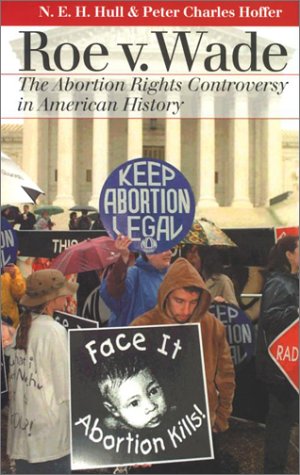
Synopsis
An historical analysis of the abortion debate retraces the key events, legal issues, and social consequences of this contentious issue since the landmark 1973 Supreme Court case.
"synopsis" may belong to another edition of this title.
About the Author
N. E. H. Hull is Distinguished Professor of Law and a member of the graduate faculty in history at Rutgers University-Camden.
Peter Charls Hoffer is Research Professor of History at the University of Georgia. They are authors of twelve books between them.
From the Back Cover
"Much more than a compact account of the Supreme Court's basic abortion decisions, Hull and Hoffer's work ranges widely to locate the constitutional and political controversies over abortion in the context of social movements and women's history. An astute and balanced guide to a much-debated subject."--Mark V. Tushnet, author of Abortion: Constitutional Issues
"Hull and Hoffer move from big-picture issues to key case details without ever losing sight of the very human side of American law and politics. Their book is a wonderful resource for students of all ages looking for basic information and important insights into one of the truly landmark law cases in our nation's history."--Sarah Weddington, author of A Question of Choice
Reviews
Studies of abortion issues are common, but mostly partisan. With a deliberately (and rather successfully) even hand, law professor Hull and history professor Hoffer (coauthors of Impeachment in America) set out to answer one central question: how did abortion become illegal in America? Before Anthony Comstock's 1870s "anti-vice" campaigns, government was relatively uninvolved with women's pregnancies, which were seen as private. Our modern Congress, on the other hand, tries to legislate what doctors can tell pregnant women and even attempts to micromanage the actual abortion procedure by trying to outlaw certain techniques. By examining the roles of as many players as possible religious authorities, politicians, judges, doctors, activists, lawyers, etc. Hull and Hoffer piece together the story and explain the relevant legal workings. In another context, constitutional language might seem too dull, but with the abortion issue at center stage for so many Americans, this very scholarly work is also a page-turner. Legal terms (undue burden, class action suits, injunctions) are cleanly explained in a few concise sentences when they first appear. To orient the uninitiated, the authors interweave brief biographies of key figures (e.g., Thurgood Marshall and Antonin Scalia). No footnotes interrupt the flow: anything readers need to know is worked into the narrative. Important sources are reviewed in an excellent bibliographic essay at the end of the book. The most recent addition to the lively Landmark Law Cases and American Society series, this remarkable volume should be popular with law scholars and lay readers alike.
Copyright 2001 Cahners Business Information, Inc.
Hull (law and history, Rutgers Univ.) and Hoffer (history, Univ. of Georgia) here explain how abortion in the United States came to be criminalized in the 19th century, decriminalized in the 20th century's Roe v. Wade case (1973), and the subject of court and legislative battles ever since. They also offer clear and detailed discussions of the court decisions and legislative efforts that promoted or impeded abortion rights, including the strategies of lawyers and backgrounds of parties and judges. Also discussed are how many social forces feminist, paternalist, misogynist, racist, and others have affected abortion law. This study considers many fascinating aspects of abortion in the United States, including the connection between eugenics and banning abortion and the relationship between the contraceptive-rights and abortion-rights movements. The authors conclude with a bibliographic essay and a chronology of events. While there are hundreds of books on various aspects of abortion in society, this one does an unusually good job of covering the full legal history from Colonial times to 2001. It is crammed with information but remains very readable and a good source for student papers. Highly recommended for high school, academic, and public libraries. Mary Jane Brustman, SUNY at Albany Libs.
Copyright 2001 Reed Business Information, Inc.
Major events in history are seldom simple: they echo the past and reverberate into the future in unexpected ways. This book offers examples of this complexity. Hull and coauthor Peter Charles Hoffer edit University Press of Kansas' Landmark Law Cases series; Hull teaches law and history at Rutgers University-Camden, and Hoffer is a University of Georgia historian. Their Roe v. Wade study begins with three chapters on U.S. abortion history: its nineteenth-century criminalization; the effect of improving birth-control methods in the twentieth century; and state-level legal changes in the 1960s. The authors then analyze the decision itself and trace the continuing battles of the next three decades, including the landmark Web ster and Casey decisions. The book closes with thoughtful discussion of what this "never-ending story" reveals about American values and recent U.S. history. Mary Carroll
Copyright © American Library Association. All rights reserved
"About this title" may belong to another edition of this title.
Search results for Roe V. Wade: The Abortion Rights Controversy in American...

Stock Image
Roe V. Wade: The Abortion Rights Controversy in American History
Published by
University Press of Kansas, 2001
ISBN 10: 0700611428
ISBN 13: 9780700611423
Used
Hardcover
Seller: World of Books (was SecondSale), Montgomery, IL, U.S.A.
Seller rating 5 out of 5 stars

Hardback. Condition: Good. The issue of abortion has sharply divided America. The bitter debate over ""Roe v. Wade"" - in the courts, legislatures, press and streets - has grown ever more ferocious since the Supreme Court's landmark decision in 1973. For years pro-choicers have applauded ""Roe"" as a guarantee of women's rights, while pro-lifers have condemned it as the work of an activist and atheistic Court. Now it looms at the centre of a growing political storm, as a new president, and old Court, and a divided Congress reconsider ""Roe""'s status in the wake of the controversial 2000 elections. Giving equal attention to both sides of the conflict, the authors trace and analyze the core debates, examine the case's unique history, clarify the jurisprudence behind the Court's ruling, and gauge its impact on American society. Court attempted to steer a middle course by rejecting both abortion on demand and the absolute right to life and yet, in the end, wound up igniting a firestorm of protest instead. The book examines the complete social and legal context of the case. Hull and Hoffer review more than a century of abortion practice (and abuse), common-law views on abortion, 19th-century criminalization measures, and the rapid changes in science, public mores and civil rights that finally brought the issue before the Supreme Court. They also trace abortion law through the 20th century, reprise the 1965 case of ""Griswold v. Connecticut"", in which the Supreme Court overturned a state law against contraceptives, and reexamine the highly publicized attempts to reverse ""Roe"" in ""Webster v. Reproductive Services"" (1989) and ""Casey v. Planned Parenthood"" (1992). All of the key actors are here: Norma McCorvey, the ""Jane Roe"" who never actually had the abortion she originally sought; attorney Sarah Weddington, who challenged Texas law by drawing on her own abortion experience; lobbyists on both sides of the question; and each of the Supreme Court justices. This is a book that can inform and enlighten those on either side of the debate, as well as all of those in between. Seller Inventory # 00105003408
Stock Image
Roe V. Wade : The Abortion Rights Controversy in American History: Face it Abortion Kills!
Published by
University Press of Kansas, 2001
ISBN 10: 0700611428
ISBN 13: 9780700611423
Used
Hardcover
Seller: Better World Books, Mishawaka, IN, U.S.A.
Seller rating 5 out of 5 stars
Condition: Good. Former library copy. Pages intact with minimal writing/highlighting. The binding may be loose and creased. Dust jackets/supplements are not included. Includes library markings. Stock photo provided. Product includes identifying sticker. Better World Books: Buy Books. Do Good. Seller Inventory # 4800640-75
Stock Image
Roe V. Wade : The Abortion Rights Controversy in American History: Face it Abortion Kills!
Published by
University Press of Kansas, 2001
ISBN 10: 0700611428
ISBN 13: 9780700611423
Used
Hardcover
Seller: Better World Books, Mishawaka, IN, U.S.A.
Seller rating 5 out of 5 stars
Condition: Very Good. Former library copy. Pages intact with possible writing/highlighting. Binding strong with minor wear. Dust jackets/supplements may not be included. Includes library markings. Stock photo provided. Product includes identifying sticker. Better World Books: Buy Books. Do Good. Seller Inventory # 4172778-20
Stock Image
Roe V. Wade: The Abortion Rights Controversy in American History (Landmark Law Cases and American Society)
Seller: ThriftBooks-Dallas, Dallas, TX, U.S.A.
Seller rating 5 out of 5 stars
Hardcover. Condition: Good. No Jacket. Former library book; Pages can have notes/highlighting. Spine may show signs of wear. ~ ThriftBooks: Read More, Spend Less. Seller Inventory # G0700611428I3N10
Stock Image
Roe V. Wade: The Abortion Rights Controversy in American History (Landmark Law Cases and American Society)
Seller: ThriftBooks-Phoenix, Phoenix, AZ, U.S.A.
Seller rating 5 out of 5 stars
Hardcover. Condition: Good. No Jacket. Former library book; Pages can have notes/highlighting. Spine may show signs of wear. ~ ThriftBooks: Read More, Spend Less. Seller Inventory # G0700611428I3N10
Stock Image
Roe V. Wade: The Abortion Rights Controversy in American History (Landmark Law Cases and American Society)
Seller: HPB-Red, Dallas, TX, U.S.A.
Seller rating 5 out of 5 stars
hardcover. Condition: Acceptable. Connecting readers with great books since 1972. Used textbooks may not include companion materials such as access codes, etc. May have condition issues including wear and notes/highlighting. We ship orders daily and Customer Service is our top priority! Seller Inventory # S_435294727
Stock Image
Roe V. Wade: The Abortion Rights Controversy in American History
Published by
University Press of Kansas, 2001
ISBN 10: 0700611428
ISBN 13: 9780700611423
Used
Hardcover
Seller: World of Books Inc, Montgomery, IL, U.S.A.
Seller rating 4 out of 5 stars

Hardback. Condition: Good. The issue of abortion has sharply divided America. The bitter debate over ""Roe v. Wade"" - in the courts, legislatures, press and streets - has grown ever more ferocious since the Supreme Court's landmark decision in 1973. For years pro-choicers have applauded ""Roe"" as a guarantee of women's rights, while pro-lifers have condemned it as the work of an activist and atheistic Court. Now it looms at the centre of a growing political storm, as a new president, and old Court, and a divided Congress reconsider ""Roe""'s status in the wake of the controversial 2000 elections. Giving equal attention to both sides of the conflict, the authors trace and analyze the core debates, examine the case's unique history, clarify the jurisprudence behind the Court's ruling, and gauge its impact on American society. Court attempted to steer a middle course by rejecting both abortion on demand and the absolute right to life and yet, in the end, wound up igniting a firestorm of protest instead. The book examines the complete social and legal context of the case. Hull and Hoffer review more than a century of abortion practice (and abuse), common-law views on abortion, 19th-century criminalization measures, and the rapid changes in science, public mores and civil rights that finally brought the issue before the Supreme Court. They also trace abortion law through the 20th century, reprise the 1965 case of ""Griswold v. Connecticut"", in which the Supreme Court overturned a state law against contraceptives, and reexamine the highly publicized attempts to reverse ""Roe"" in ""Webster v. Reproductive Services"" (1989) and ""Casey v. Planned Parenthood"" (1992). All of the key actors are here: Norma McCorvey, the ""Jane Roe"" who never actually had the abortion she originally sought; attorney Sarah Weddington, who challenged Texas law by drawing on her own abortion experience; lobbyists on both sides of the question; and each of the Supreme Court justices. This is a book that can inform and enlighten those on either side of the debate, as well as all of those in between. Seller Inventory # CIN0700611428G
Seller Image
Roe V. Wade: The Abortion Rights Controversy in American History (Landmark Law Cases and American Society)
Seller: -OnTimeBooks-, Phoenix, AZ, U.S.A.
Seller rating 5 out of 5 stars
Condition: good. A copy that has been read, remains in good condition. All pages are intact, and the cover is intact. The spine and cover show signs of wear. Pages can include notes and highlighting and show signs of wear, and the copy can include "From the library of" labels or previous owner inscriptions. 100% GUARANTEE! Shipped with delivery confirmation, if you're not satisfied with purchase please return item! Ships via media mail. Seller Inventory # OTV.0700611428.G
Stock Image
Roe V. Wade: The Abortion Rights Controversy in American History
Published by
University Press of Kansas, Lawrence, Kansas, 2001
ISBN 10: 0700611428
ISBN 13: 9780700611423
Used
Hardcover
Seller: Mount Angel Abbey Library, St. Benedict, OR, U.S.A.
Seller rating 5 out of 5 stars
Cloth. Condition: Good. Dust Jacket Condition: Good--. 315 pages, clean text. Library labels removed from spine and inside cover. Other than library stamps, the book is in excellent condition. Partial contents: Abortion Becomes a Crime, 1800-1900; Abortion and Birth Control, 1900-1965; From Repression to Reform, the Road to Roe, 1960-1970. --- We are a Benedictine Monastery Seminary library; thank you for your support. Stamped Bookplate. Seller Inventory # 023534
Stock Image
Roe V. Wade: The Abortion Rights Controversy in American History (Landmark Law Cases and American Society)
Seller: SHIMEDIA, Brooklyn, NY, U.S.A.
Seller rating 4 out of 5 stars
Condition: New. Satisfaction Guaranteed or your money back. Seller Inventory # 0700611428