
Items related to The Biographer's Tale
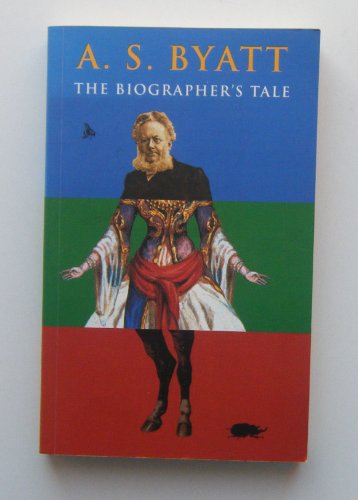
Synopsis
A.S. Byatt chronicles the life of the mind with the immediacy other novelists bring to the physical world. So when the graduate-student hero of The Biographer's Tale announces that he needs "a life full of things ," we take his words with a grain of salt. Yes, Phineas G. Nanson has renounced the "cross-referenced abstractions" of life as a postmodern literary theorist, and vows to ground himself in what he warily calls the "facts" (the quotation marks are definitely in order). Yet he first forays into empiricism by reading a three-volume life of the Victorian traveler, writer, and diplomat Elmer Bole--then immediately undertakes a biography of Bole's biographer, Scholes Destry-Scholes. Things , as Nanson discovers, can prove just as slippery as ideas. His research quickly leapfrogs beyond the biographer to his other scientist Carl Linnaeus, playwright Henrik Ibsen, and eugenicist Francis Galton, all of whom Destry-Scholes chronicled in three unpublished, unfinished, and, as it turns out, well-embroidered accounts. Meanwhile, our hero continues his forays into the real world. He takes a part-time job with a pair of gay travel agents, who arrange some very specialized vacations, and meets up with a Swedish bee taxonomist named Fulla, who wants to save the world. He also unearths a perplexing series of Destry-Scholes's index cards, full of sketches, facts, quotations, and unattributed lines of verse. These he attempts to shuffle into some kind of order, even as the enigmatic figure of the biographer himself seems to appear and disappear from view. There are echoes here of Byatt's Booker Prize-winning Possession , another detective story for the MLA set. Yet The Biographer's Tale is an altogether odder--and chillier--sort of book. It is, in fact, almost terrifyingly learned, and wears its research about as lightly as a pair of Fulla's Ecco sandals. The mystery here is nothing less than the nature of mind, so it's no criticism to say that her characters have little life outside the ideas they represent. What's surprising is that the result is so readable, even beautiful at times. Here, for instance, is Nanson on truth and There are a very few human truths and infinite variations on them. I was about to write that there are very few truths about the world, but the truth about that is that we don't know what we are not biologically fitted to know, it may be full of all sorts of shining and tearing things, geometries, chemistries, physics we have no access to and never can have. Reading and writing extend--not infinitely, but violently, but giddily--the variations we can perceive on the truths we thus discover. The index cards themselves can be painful to read (remember the ersatz Victorian poetry in Possession ?). But persevere, dear reader--meaning emerges through the play of one esoteric piece of information against another, just as it does in real life. Byatt extends her philosophical variations as far as she giddily can, and in The Biographer's Tale , she has constructed an elaborate, glittering labyrinth at the center of which lie surprisingly simple truths. --Mary Park
"synopsis" may belong to another edition of this title.
Search results for The Biographer's Tale

Stock Image
The Biographer's Tale
Published by
Chatto & Windus, London, 2000
ISBN 10: 0701171456
ISBN 13: 9780701171452
Used
Hardcover
First Edition
Seller: A Good Read, Toronto, ON, Canada
Seller rating 4 out of 5 stars

Hardcover. Condition: Near Fine. Dust Jacket Condition: Near Fine. First Edition. A Good Read ships from Toronto and Niagara Falls, NY - customers outside of North America please allow two to three weeks for delivery. ; Remainder mark on bottom edge. First impression.; 8vo - over 7¾" - 9¾" Tall. Seller Inventory # 46709
Buy Used
US$ 7.99
US$ 11.00 shipping
Ships from Canada to U.S.A.
Ships from Canada to U.S.A.
Quantity: 1 available
Seller Image
The Biographer's Tale
Published by
Vintage Book, 2000
ISBN 10: 0701171456
ISBN 13: 9780701171452
Used
Soft cover
First Edition
Seller: Studio Books and Music, CAMBRIDGE, United Kingdom
Seller rating 5 out of 5 stars

Soft cover. Condition: Fine. 1st Edition. Uncorrected proof in unread condition. Slight tanning to the textblock. Seller Inventory # ABE-1779035667362
Buy Used
US$ 27.54
US$ 33.42 shipping
Ships from United Kingdom to U.S.A.
Ships from United Kingdom to U.S.A.
Quantity: 1 available