
Items related to Shakespearean Gothic (Gothic Literary Studies)
Synopsis
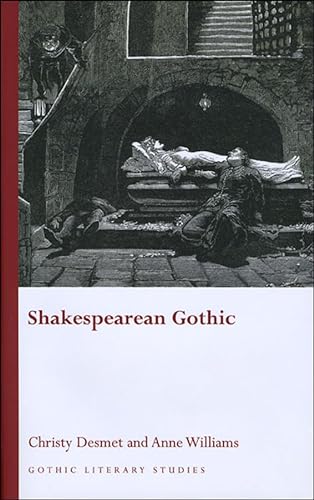
As evidenced by the vampires, werewolves, and other frights overrunning the best-seller lists, the Gothic remains immensely popular. This collection of essays traces the roots of the Gothic to an unexpected source: eighteenth-century interpretations of Shakespeare. Through close attention to literary, cultural, and historical detail, the contributors demonstrate that even as Shakespeare was being established as the supreme British writer, he was also being cited as justification for early Gothic writers’ abandonment of literary decorum and their interest in the supernatural.
"synopsis" may belong to another edition of this title.
About the Author
Christy Desmet is associate professor of English at the University of Georgia. Anne Williams is professor of English at the University of Georgia.
Excerpt. © Reprinted by permission. All rights reserved.
Shakespearean Gothic
By Christy Desmet, Anne WilliamsUniversity of Wales Press
Copyright © 2009 The Contributors
All rights reserved.
ISBN: 978-0-7083-2092-1All rights reserved.
Contents
Acknowledgements,
List of Illustrations,
List of Contributors,
Introduction,
PART I: GOTHIC APPROPRIATIONS OF 'SHAKESPEARE',
1 Reading Walpole Reading Shakespeare Anne Williams,
2 Ann Radcliffe, 'The Shakespeare of Romance Writers' Rictor Norton,
3 The Curse of Shakespeare Jeffrey Kahan,
PART II: REWRITING SHAKESPEARE'S PLAYS AND CHARACTERS,
4 Shakespearean Shadows' Parodic Haunting of Thomas Love Peacock's Nightmare Abbey and Jane Austen's Northanger Abbey Marjean D. Purinton and Marliss C. Desens,
5 Fatherly and Daughterly Pursuits: Mary Shelley's Matilda and Shakespeare's King Lear Carolyn A. Weber,
6 Into the Madman's Dream: the Gothic Abduction of Romeo and Juliet Yael Shapira,
7 Gothic Cordelias: the Afterlife of King Lear and the Construction of Femininity Diane Long Hoeveler,
PART III: SHAKESPEARE AS GOTHIC WRITER,
8 'We are not safe': History, Fear and the Gothic in Richard III Jessica Walker,
9 Remembering Ophelia: Ellen Terry and the Shakespearizing of Dracula Christy Desmet,
10 'Rites of Memory': the Heart of Kenneth Branagh's Hamlet Susan Allen Ford,
Afterword: Shakespearean Gothic Frederick Burwick,
Bibliography,
CHAPTER 1
Reading Walpole Reading Shakespeare
ANNE WILLIAMS
* * *
Walpole's Gothic, both literary and architectural, is a thing of shreds and patches. The Castle of Otranto was inspired by the fragment of a nightmare concerning a 'gigantic hand in armour', and chapter 1 begins with the fall of an enormous helmet into the castle's courtyard. Walpole pieced together his story from patches of history, folk tale, kidnapped romance, medieval superstition and Shakespearean allusions. Strawberry Hill, the villa that Walpole constructed over nearly forty years, is a pastiche of Gothic designs, imitated (in wood or papier mâché) as adornments for fireplaces, ceilings and library shelves – to say nothing of battlements and turrets made of lathe and plaster. Walpole's prolific writings appear in an equally heterogeneous range of genres. His body of work, in short, seems as disjointed as the armour of Alphonso the Good.
Yet the works of the 1760s reveal an unexpected kinship. Walpole published The Castle of Otranto in 1764, and in February 1768 Historic Doubts on the Life and Reign of King Richard the Third. Six months later, he printed at Strawberry Hill fifty copies of The Mysterious Mother, a tragedy in blank verse. These works mark the climax of Walpole's creative activity. With the exception of the Beauclerc Tower (1776), built to house illustrations of the play, Walpole's original work was essentially finished by the end of the 1760s. Despite their seeming diversity, however, these works share one important characteristic: they are all 'Shakespearean'. Walpole appropriated, rewrote and impersonated his precursor. I propose that under the aegis of Shakespeare, Walpole finally lived up to the Horatian motto he had chosen for his library ceiling – 'fari quae sentiat: he says what he feels'.
Walpole plays Shakespeare
[Horace Walpole's] features were covered by masks within masks ... He played innumerable parts and over-acted them all.
Thomas Babington Macaulay
The Castle of Otranto and The Mysterious Mother are overtly fictional, though Walpole repeatedly teases us about their relation to r
"About this title" may belong to another edition of this title.
Search results for Shakespearean Gothic (Gothic Literary Studies)

Seller Image
Shakespearean Gothic
Published by
University of Wales Press, 2011
ISBN 10: 0708320929
ISBN 13: 9780708320921
Used
Softcover
Seller: GreatBookPrices, Columbia, MD, U.S.A.
Seller rating 5 out of 5 stars

Condition: As New. Unread book in perfect condition. Seller Inventory # 5504917
Stock Image
Shakespearean Gothic
Published by
Gwasg Prifysgol Cymru / University of Wales Press, 2009
ISBN 10: 0708320929
ISBN 13: 9780708320921
Used
Softcover
Seller: Better World Books, Mishawaka, IN, U.S.A.
Seller rating 5 out of 5 stars
Condition: Good. 2nd Edition. Former library copy. Pages intact with minimal writing/highlighting. The binding may be loose and creased. Dust jackets/supplements are not included. Includes library markings. Stock photo provided. Product includes identifying sticker. Better World Books: Buy Books. Do Good. Seller Inventory # 57587081-6
Seller Image
Shakespearean Gothic
Published by
University of Wales Press, 2011
ISBN 10: 0708320929
ISBN 13: 9780708320921
New
Softcover
Seller: GreatBookPrices, Columbia, MD, U.S.A.
Seller rating 5 out of 5 stars
Condition: New. Seller Inventory # 5504917-n
Seller Image
Shakespearean Gothic
Published by
University of Wales Press, GB, 2009
ISBN 10: 0708320929
ISBN 13: 9780708320921
New
Paperback
Seller: Rarewaves.com USA, London, LONDO, United Kingdom
Seller rating 5 out of 5 stars
Paperback. Condition: New. This collection of essays explores the thesis that Shakespeare as we know him today was born in the eighteenth century, at the same time as the Gothic tradition, first named by Horace Walpole in 1764. The two are inextricable. Writers interested in pursuing 'Gothic' themes and forms (the supernatural events and generic hybrids decried by French neoclassicism) justified their aesthetic choices as following the example of their great - and emphatically English - precursor. They cited him in their epigraphs and appropriated his narratives. They echoed his language and imitated his dramatic devices. Like Shakespeare, they explored the ways in which familial ghosts may haunt the present. Like him, they mixed modes and genres: tragedy and comedy, verse and prose. Together, critics of Shakespeare and creators of the Gothic (often one and the same author) not only canonized England's secular saint and created a new literary mode; they collectively initiated a mode of subjectivity that remains with us today in both high and popular culture. Seller Inventory # LU-9780708320921
Buy New
US$ 32.78
Free Shipping
Ships from United Kingdom to U.S.A.
Ships from United Kingdom to U.S.A.
Quantity: 4 available
Stock Image
Shakespearean Gothic
Seller: PBShop.store US, Wood Dale, IL, U.S.A.
Seller rating 5 out of 5 stars
PAP. Condition: New. New Book. Shipped from UK. Established seller since 2000. Seller Inventory # CW-9780708320921
Stock Image
Shakespearean Gothic
Seller: PBShop.store UK, Fairford, GLOS, United Kingdom
Seller rating 5 out of 5 stars
PAP. Condition: New. New Book. Shipped from UK. Established seller since 2000. Seller Inventory # CW-9780708320921
Buy New
US$ 33.25
US$ 5.60 shipping
Ships from United Kingdom to U.S.A.
Ships from United Kingdom to U.S.A.
Quantity: 5 available
Stock Image
Shakespearean Gothic (Paperback)
Published by
University of Wales Press, Wales, 2009
ISBN 10: 0708320929
ISBN 13: 9780708320921
New
Paperback
Seller: Grand Eagle Retail, Bensenville, IL, U.S.A.
Seller rating 5 out of 5 stars
Paperback. Condition: new. Paperback. This collection of essays explores the thesis that Shakespeare as we know him today was born in the eighteenth century, at the same time as the Gothic tradition, first named by Horace Walpole in 1764. The two are inextricable. Writers interested in pursuing 'Gothic' themes and forms (the supernatural events and generic hybrids decried by French neoclassicism) justified their aesthetic choices as following the example of their great - and emphatically English - precursor. They cited him in their epigraphs and appropriated his narratives. They echoed his language and imitated his dramatic devices. Like Shakespeare, they explored the ways in which familial ghosts may haunt the present. Like him, they mixed modes and genres: tragedy and comedy, verse and prose. Together, critics of Shakespeare and creators of the Gothic (often one and the same author) not only canonized England's secular saint and created a new literary mode; they collectively initiated a mode of subjectivity that remains with us today in both high and popular culture. This book explores the paradox that the Gothic (today's werewolves, vampires, and horror movies) owe their origins (and their legitimacy) to eighteenth-century interpretations of Shakespeare. Shipping may be from multiple locations in the US or from the UK, depending on stock availability. Seller Inventory # 9780708320921
Stock Image
Shakespearian Gothic
Published by
University Of Wales Press, 2011
ISBN 10: 0708320929
ISBN 13: 9780708320921
New
Paperback
Seller: Revaluation Books, Exeter, United Kingdom
Seller rating 5 out of 5 stars
Paperback. Condition: Brand New. 192 pages. 8.40x5.40x1.00 inches. In Stock. Seller Inventory # __0708320929
Buy New
US$ 30.04
US$ 13.47 shipping
Ships from United Kingdom to U.S.A.
Ships from United Kingdom to U.S.A.
Quantity: 1 available
Stock Image
Shakespearean Gothic (Gothic Literary Studies)
Published by
University of Wales Press, 2011
ISBN 10: 0708320929
ISBN 13: 9780708320921
New
Softcover
Seller: Ria Christie Collections, Uxbridge, United Kingdom
Seller rating 5 out of 5 stars
Condition: New. In English. Seller Inventory # ria9780708320921_new
Buy New
US$ 34.09
US$ 15.21 shipping
Ships from United Kingdom to U.S.A.
Ships from United Kingdom to U.S.A.
Quantity: 8 available
Seller Image
Shakespearean Gothic
Published by
University of Wales Press, 2011
ISBN 10: 0708320929
ISBN 13: 9780708320921
New
Softcover
Seller: GreatBookPricesUK, Woodford Green, United Kingdom
Seller rating 5 out of 5 stars
Condition: New. Seller Inventory # 5504917-n
Buy New
US$ 31.36
US$ 20.21 shipping
Ships from United Kingdom to U.S.A.
Ships from United Kingdom to U.S.A.
Quantity: 17 available