
Items related to The First Five Pages : A Writer's Guide to Staying...
Synopsis
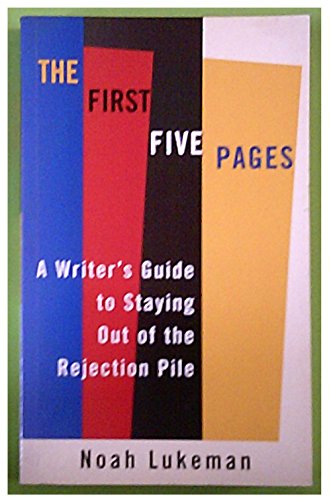
The First Five PagesEditors always tell novice writers that the first few pages of a manuscript are crucial in the publishing process -- and it's true. If an editor or agent (or reader) loses interest after a page or two, you've lost him or her completely, even if the middle of your novel is brilliant and the ending phenomenal. Noah Lukeman, an agent in Manhattan, has taken this advice and created a book that examines just what this means, and I have to tell you, it's one of the best I've read.I've written (and seen published) pretty close to a dozen novels in as many years -- some are still to be published and will be out shortly; others are already out of print after four years. But I wish I had read Lukeman's book, The First Five Pages , when I began writing fiction.I'm glad I did now. It has helped, immediately. I'm already embarrassed about some of the goofs I made in my writing -- and I've been revising recent prose with his advice in mind.First off, Lukeman is a literary agent who once was an editor, and his editorial eye is sharp. If every novelist and short story writer in this country had Lukeman as an editor, we'd have a lot more readable prose out there.HeMany writers spend the majority of their time devising their plot. What they don't seem to understand is that if their execution -- if their prose -- isn't up to par, their plot may not even be considered.This bears repeating, because in all the books I've read on writing, this is an element that is most often forgotten in the rush to come up with snappy ideas and sharp plot progressions. You can always send a hero on a journey, after all, but if no reader wants to follow him, you've wasted your time.In a tone that can be a bit professorial at times, Lukeman brings what prose is -- and how it reads to others -- into sharp focus. He deals with dialogue, style, and, most importantly, sound.Sound.How does prose sound ?It must have rhythm, its own kind of music, in order to draw the reader into the fictive dream. Lukeman's tips and pointers are genuinely helpful, and even important with regard to the sound of the prose itself.Lukeman also brings in on-target exercises for writers of prose and the wonderful advice for novelists to read poetry -- and often.Those first five pages are crucial, for all concerned. But forget the editor and agent and reader. They are important for you, the writer, because they determine the sharpness of your focus, the completeness of your vision, the confidence you, as a writer, need to plunge into a three- or four- or five-hundred-page story.The First Five Pages should be on every writer's shelf. This is the real thing.P#151;Douglas CleggDouglas Clegg is the author of numerous novels and stories, including The Halloween Man and the collection The Nightmare Chronicles . In addition, Clegg is the author of the world's first publisher-sponsored Internet email novel, Naomi .
"synopsis" may belong to another edition of this title.
Review
The difference between The First Five Pages and most books on writing is that the others are written by teachers and writers. This one comes from a literary agent--one whose clients include Pulitzer Prize nominees, New York Times bestselling authors, Pushcart Prize recipients, and American Book Award winners. Noah Lukeman is not trying to impart the finer points of writing well. He wants to teach you "how to identify and avoid bad writing," so that your manuscript doesn't come boomeranging back to you in that self-addressed, stamped envelope. Surprise: Agents and editors don't read manuscripts for fun; they are looking for reasons to reject them. Lukeman has arranged his book "in the order of what I look for when trying to dismiss a manuscript," starting with presentation and concluding with pacing and progression. Each chapter addresses a pitfall of poor writing--overabundance of adjectives and adverbs, tedious or unrealistic dialogue, and lack of subtlety to name just a few--by identifying the problem, presenting solutions, giving examples (one wishes these weren't quite so obvious), and offering writing exercises. It's a little bizarre to think about approaching your work as would an agent, but if you are serious about getting published, you may as well get used to it. Plus, Lukeman has plenty of solid advice worth listening to. Particularly fine are his exercises for removing and spicing up modifiers and his remedies for all kinds of faulty dialogue. --Jane Steinberg
About the Author
Noah Lukeman is a literary agent based in New York City whose clients include Pulitzer Prize nominees, New York Times bestselling authors, Pushcart Prize recipients and American Book Award winners. Prior to becoming an agent, he worked on the editorial side of several major publishing companies. He has been a guest speaker on the subjects of writing and publishing at forums conducted by numerous organizations, including the Writer's Voice, the American Society of Journalists and Authors and the Wallace Stegner writing program at Stanford University.
"About this title" may belong to another edition of this title.
Search results for The First Five Pages : A Writer's Guide to Staying...

Stock Image
The First Five Pages: A Writer's Guide to Staying Out of the Rejection Pile
Seller: AwesomeBooks, Wallingford, United Kingdom
Seller rating 5 out of 5 stars

Hardcover. Condition: Very Good. The First Five Pages: A Writer's Guide to Staying Out of the Rejection Pile This book is in very good condition and will be shipped within 24 hours of ordering. The cover may have some limited signs of wear but the pages are clean, intact and the spine remains undamaged. This book has clearly been well maintained and looked after thus far. Money back guarantee if you are not satisfied. See all our books here, order more than 1 book and get discounted shipping. Seller Inventory # 7719-9780709064848
Buy Used
US$ 4.47
US$ 5.45 shipping
Ships from United Kingdom to U.S.A.
Ships from United Kingdom to U.S.A.
Quantity: 2 available
Stock Image
The First Five Pages: A Writer's Guide to Staying Out of the Rejection Pile
Published by
The Crowood Press Ltd, United Kingdom, London, 2000
ISBN 10: 0709064845
ISBN 13: 9780709064848
Used
Paperback
Seller: WorldofBooks, Goring-By-Sea, WS, United Kingdom
Seller rating 5 out of 5 stars
Paperback. Condition: Very Good. Reveals the necessary elments of good writing, whether it be fiction, non-fiction, journalism or poetry. It also points out errors to be avoided. The book has been read, but is in excellent condition. Pages are intact and not marred by notes or highlighting. The spine remains undamaged. Seller Inventory # GOR002127683
Buy Used
US$ 2.86
US$ 7.41 shipping
Ships from United Kingdom to U.S.A.
Ships from United Kingdom to U.S.A.
Quantity: 1 available
Stock Image
The First Five Pages : A Writer's Guide to Staying Out of the Rejection Pile
Seller: Better World Books Ltd, Dunfermline, United Kingdom
Seller rating 5 out of 5 stars
Condition: Very Good. Former library copy. Pages intact with possible writing/highlighting. Binding strong with minor wear. Dust jackets/supplements may not be included. Includes library markings. Stock photo provided. Product includes identifying sticker. Better World Books: Buy Books. Do Good. Seller Inventory # GRP81122686
Buy Used
US$ 6.22
US$ 6.61 shipping
Ships from United Kingdom to U.S.A.
Ships from United Kingdom to U.S.A.
Quantity: 1 available
Stock Image
The First Five Pages : A Writer's Guide to Staying Out of the Rejection Pile
Seller: Better World Books Ltd, Dunfermline, United Kingdom
Seller rating 5 out of 5 stars
Condition: Good. Pages intact with minimal writing/highlighting. The binding may be loose and creased. Dust jackets/supplements are not included. Stock photo provided. Product includes identifying sticker. Better World Books: Buy Books. Do Good. Seller Inventory # 49054647-20
Buy Used
US$ 6.22
US$ 6.61 shipping
Ships from United Kingdom to U.S.A.
Ships from United Kingdom to U.S.A.
Quantity: 1 available
Stock Image
The First Five Pages: A Writers Guide to Staying Out of the Rejection Pile
Seller: Reuseabook, Gloucester, GLOS, United Kingdom
Seller rating 5 out of 5 stars
Hardcover. Condition: Used; Good. Dispatched, from the UK, within 48 hours of ordering. This book is in good condition but will show signs of previous ownership. Please expect some creasing to the spine and/or minor damage to the cover. Seller Inventory # CHL1651957
Buy Used
US$ 4.27
US$ 9.26 shipping
Ships from United Kingdom to U.S.A.
Ships from United Kingdom to U.S.A.
Quantity: 1 available
Stock Image
The First Five Pages: A Writer's Guide to Staying Out of the Rejection Pile
Seller: Bahamut Media, Reading, United Kingdom
Seller rating 4 out of 5 stars

Hardcover. Condition: Very Good. This book is in very good condition and will be shipped within 24 hours of ordering. The cover may have some limited signs of wear but the pages are clean, intact and the spine remains undamaged. This book has clearly been well maintained and looked after thus far. Money back guarantee if you are not satisfied. See all our books here, order more than 1 book and get discounted shipping. Seller Inventory # 6545-9780709064848
Buy Used
US$ 4.63
US$ 9.23 shipping
Ships from United Kingdom to U.S.A.
Ships from United Kingdom to U.S.A.
Quantity: 2 available
Stock Image
The first five pages A writer's guide to staying out of the rejection pile
Seller: Mooney's bookstore, Den Helder, Netherlands
Seller rating 4 out of 5 stars
Condition: Very Good. Seller Inventory # C363D76CD08101E
Buy Used
US$ 53.59
US$ 16.95 shipping
Ships from Netherlands to U.S.A.
Ships from Netherlands to U.S.A.
Quantity: 1 available