
Items related to The Language Instinct: the new science of language...
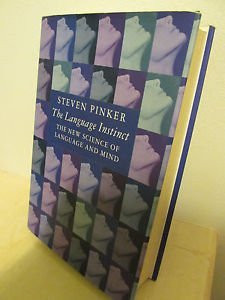
Synopsis
How did language evolve? How old is language? How do we all know how to speak so effortlessly? Why is structural grammatical language specifically human? In his illuminating book, Steven Pinker attacks these fundamental questions with intense curiosity, energetic wit and clarity. He discusses every facet of human language and uncovers its deepest mysteries. Language, to Pinker, is an instinct, and he cuts through the jargon of the science of linguistics to show us how and why. Complemented by Lalla Ward's superb and eloquent reading, this is an audio book about the power of communication and will enlighten all those curious to understand this human power. 'Dazzling ...Words can hardly do justice to the superlative range and liveliness of Pinker's investigations' Robert Winder, the "Independent". 'Pinker debunks with panache, cuts through the confusion of jargon, and tells a mean anecdote. He does for language what David Attenborough does for animals' John Gribbin, the "Sunday Times".
"synopsis" may belong to another edition of this title.
About the Author
Steven Pinker studied Experimental Psychology at McGill University, Montreal, and Harvard University. He has taught at Harvard, Stanford and the Massachusetts Institute of Technology (MIT). He is currently Professor of Psychology and Director of the Center for Cognitive Neuroscience at MIT and a Fellow of the American Association for the Advancement of Science. He has received research prizes from the National Academy of Sciences and the American Psychological Association. Lalla Ward trained as an actress and appeared most notably as Dr Who's (Tom Baker's) assistant and Ophelia to Derek Jacobi's Hamlet. She is married to Richard Dawkins, the driving force behind the Talking Science series, and travels round the world with him in a lecturing 'double act'. TBC
From the Back Cover
In this classic, the world's expert on language and mind lucidly explains everything you always wanted to know about language: how it works, how children learn it, how it changes, how the brain computes it, and how it evolved. With deft use of examples of humor and wordplay, Steven Pinker weaves our vast knowledge of language into a compelling story: language is a human instinct, wired into our brains by evolution. The Language Instinct received the William James Book Prize from the American Psychological Association and the Public Interest Award from the Linguistics Society of America. This edition includes an update on advances in the science of language since The Language Instinct was first published.
Reviews
Another in a series of books (Joel Davis's Mother Tongue, p. 1303; Ray Jackendorf's Patterns in the Mind, p. 1439) popularizing Chomsky's once controversial theories explaining the biological basis of language. Variously mellow, intense, and bemused--but never boring--Pinker (Director, Center for Cognitive Neuroscience/MIT), emphasizes Darwinian theory and defines language as a ``biological adaptation to communicate.'' While Pinker bases his argument on the innate nature of language, he situates language in that transitional area between instinct and learned behavior, between nature and culture. Starting with what he calls a ``grammar gene,'' Pinker describes the way primitives, children (his special interest), even the deaf evolve natural languages responding to the universal need to communicate. He refutes the ``comic history'' of linguistic determinism, the belief that language shapes thinking, undermining it with examples from music, mathematics, and kinship theory. Following his lively, user-friendly demonstration of even the most forbidding aspects of linguistics, and his discussion of vocabulary, how words are acquired, built, and used, he rises to a celebration of the ``harmony between the mind...and the texture of reality.'' This theme, the power and mystery of the human mind, permeates Pinker's engaging study, balanced with the more sober scientific belief that the mind is an ``adapted computational model'': ``To a scientist,'' he writes, ``the fundamental fact of human language is its sheer improbability.'' Among the many interesting though not sequential ideas: If language is innate, biologically based, then it can't be taught either to animals or computers. Pinker shows why adults have difficulty learning a foreign language, and he mediates coolly between rules and usage, between systematic and non-prescriptive grammar. Designed for a popular audience, this is in fact a hefty read full of wonder and wisdom. -- Copyright ©1993, Kirkus Associates, LP. All rights reserved.
A three-year-old toddler is "a grammatical genius"--master of most constructions, obeying adult rules of language. To Pinker, a Massachusetts Institute of Technology psycholinguist, the explanation for this miracle is that language is an instinct, an evolutionary adaptation that is partly "hard-wired" into the brain and partly learned. In this exciting synthesis--an entertaining, totally accessible study that will regale language lovers and challenge professionals in many disciplines--Pinker builds a bridge between "innatists" like MIT linguist Noam Chomsky, who hold that infants are biologically programmed for language, and "social interactionists" who contend that they acquire it largely from the environment. If Pinker is right, the origins of language go much further back than 30,000 years ago (the date most commonly given in textbooks)--perhaps to Homo habilis , who lived 2.5 million years ago, or even eons earlier. Peppered with mind-stretching language exercises, the narrative first unravels how babies learn to talk and how people make sense of speech. Professor and co-director of MIT's Center for Cognitive Science, Pinker demolishes linguistic determinism, which holds that differences among languages cause marked differences in the thoughts of their speakers. He then follows neurolinguists in their quest for language centers in the brain and for genes that might help build brain circuits controlling grammar and speech. Pinker also argues that claims for chimpanzees' acquisition of language (via symbols or American Sign Language) are vastly exaggerated and rest on skimpy data. Finally, he takes delightful swipes at "language mavens" like William Safire and Richard Lederer, accusing them of rigidity and of grossly underestimating the average person's language skills. Pinker's book is a beautiful hymn to the infinite creative potential of language. Newbridge Book Clubs main selection; BOMC and QPB alternates.
Copyright 1993 Reed Business Information, Inc.
Following fast on the heels of Joel Davis's Mother Tongue ( LJ 12/93) is another provocative and skillfully written book by an MIT professor who specializes in the language development of children. While Pinker covers some of the same ground as did Davis, he argues that an "innate grammatical machinery of the brain" exists, which allows children to "reinvent" language on their own. Basing his ideas on Noam Chomsky's Universal Grammar theory, Pinker describes language as a "discrete combinatorial system" that might easily have evolved via natural selection. Pinker steps on a few toes (language mavens beware!), but his work, while controversial, is well argued, challenging, often humorous, and always fascinating. Most public and academic libraries will want to add this title to their collections.
- Laurie Bartolini, Lincoln Lib., Springfield, Ill.
Copyright 1994 Reed Business Information, Inc.
Pinker, a respected cognitive scientist at MIT, has given the nonstudent a bridge into the interesting yet still controversial world of linguistics and cognitive science. Here, under a rather heavy Chomsky influence, Pinker discusses, among other things, how language evolved, how children acquire and develop language skills, and why the English language and its spelling aren't as nonlogical as such critics as George Bernard Shaw have claimed. Written for popular consumption, Pinker's discussions of such complicated arguments and theories as the various, disputable universal grammars and languages of thought, Quine's gavagai, and the world of morphemes and phonemes are all painless to read. Examples are clear and easy to understand; Pinker's humor and insight make this the perfect introduction to the world of cognitive science and language. Highly recommended for all academic libraries and for public libraries with solid psychology and philosophy collections. Caroline Andrew
"About this title" may belong to another edition of this title.
Search results for The Language Instinct: the new science of language...

Stock Image
The Language Instinct (The New Science of Language and Mind)
Published by
Penguin Books Ltd, United Kingdom, London, 1994
ISBN 10: 0713990996
ISBN 13: 9780713990997
Used
Paperback
Seller: WorldofBooks, Goring-By-Sea, WS, United Kingdom
Seller rating 5 out of 5 stars

Paperback. Condition: Very Good. Simply by making noises with our mouths, we can reliably cause precise new combinations of ideas to arise in each other's minds. The ability comes so naturally that we are apt to forget what a miracle it is. Pursuing the ideas of Darwin and Chomsky, Steven Pinker offers a look at why we use language and where this ability comes from. Rather than being an acquired cultural artefact, it is vigorously argued that language is a biological adaptation to communicate information and as such is a system of great richness and beauty. Using examples of the way language is used in daily life from the mouths of children to the pontifications of politicians, Pinker explores this system and our instinct to use it. The book has been read, but is in excellent condition. Pages are intact and not marred by notes or highlighting. The spine remains undamaged. Seller Inventory # GOR001872504
Buy Used
US$ 2.62
US$ 7.50 shipping
Ships from United Kingdom to U.S.A.
Ships from United Kingdom to U.S.A.
Quantity: 2 available
Stock Image
The Language Instinct: the new science of language and mind
Seller: WorldofBooks, Goring-By-Sea, WS, United Kingdom
Seller rating 5 out of 5 stars
Hardback. Condition: Fair. A readable copy of the book which may include some defects such as highlighting and notes. Cover and pages may be creased and show discolouration. Seller Inventory # GOR002867568
Buy Used
US$ 2.62
US$ 7.50 shipping
Ships from United Kingdom to U.S.A.
Ships from United Kingdom to U.S.A.
Quantity: 1 available
Stock Image
The Language Instinct (The New Science of Language and Mind)
Seller: AwesomeBooks, Wallingford, United Kingdom
Seller rating 5 out of 5 stars
Hardcover. Condition: Very Good. The Language Instinct (The New Science of Language and Mind) This book is in very good condition and will be shipped within 24 hours of ordering. The cover may have some limited signs of wear but the pages are clean, intact and the spine remains undamaged. This book has clearly been well maintained and looked after thus far. Money back guarantee if you are not satisfied. See all our books here, order more than 1 book and get discounted shipping. Seller Inventory # 7719-9780713990997
Buy Used
US$ 4.61
US$ 5.52 shipping
Ships from United Kingdom to U.S.A.
Ships from United Kingdom to U.S.A.
Quantity: 2 available
Stock Image
The Language Instinct: the new science of language and mind
Seller: HPB-Red, Dallas, TX, U.S.A.
Seller rating 5 out of 5 stars
hardcover. Condition: Good. Connecting readers with great books since 1972! Used textbooks may not include companion materials such as access codes, etc. May have some wear or writing/highlighting. We ship orders daily and Customer Service is our top priority! Seller Inventory # S_436810971
Stock Image
Language Instinct
Published by
Penguin Books, Limited, 1994
ISBN 10: 0713990996
ISBN 13: 9780713990997
Used
Hardcover
First Edition
Seller: Better World Books Ltd, Dunfermline, United Kingdom
Seller rating 5 out of 5 stars
Condition: Good. 1st. Pages intact with minimal writing/highlighting. The binding may be loose and creased. Dust jackets/supplements are not included. Stock photo provided. Product includes identifying sticker. Better World Books: Buy Books. Do Good. Seller Inventory # 39792680-20
Buy Used
US$ 6.26
US$ 6.69 shipping
Ships from United Kingdom to U.S.A.
Ships from United Kingdom to U.S.A.
Quantity: 2 available
Stock Image
The Language Instinct (The New Science of Language and Mind)
Seller: Bahamut Media, Reading, United Kingdom
Seller rating 4 out of 5 stars

Hardcover. Condition: Very Good. This book is in very good condition and will be shipped within 24 hours of ordering. The cover may have some limited signs of wear but the pages are clean, intact and the spine remains undamaged. This book has clearly been well maintained and looked after thus far. Money back guarantee if you are not satisfied. See all our books here, order more than 1 book and get discounted shipping. Seller Inventory # 6545-9780713990997
Buy Used
US$ 6.12
US$ 9.35 shipping
Ships from United Kingdom to U.S.A.
Ships from United Kingdom to U.S.A.
Quantity: 2 available
Stock Image
The Language Instinct (The New Science of Language and Mind)
Seller: Anybook.com, Lincoln, United Kingdom
Seller rating 5 out of 5 stars
Condition: Good. This is an ex-library book and may have the usual library/used-book markings inside.This book has hardback covers. In good all round condition. Dust jacket in good condition. Please note the Image in this listing is a stock photo and may not match the covers of the actual item,1050grams, ISBN:9780713990997. Seller Inventory # 8237405
Buy Used
US$ 3.45
US$ 18.08 shipping
Ships from United Kingdom to U.S.A.
Ships from United Kingdom to U.S.A.
Quantity: 1 available
Stock Image
The Language Instinct (The New Science of Language and Mind)
Seller: Anybook.com, Lincoln, United Kingdom
Seller rating 5 out of 5 stars
Condition: Poor. This is an ex-library book and may have the usual library/used-book markings inside.This book has hardback covers. Book contains pen, pencil & highlighter markings. In poor condition, suitable as a reading copy. Dust jacket in good condition. Please note the Image in this listing is a stock photo and may not match the covers of the actual item,1050grams, ISBN:9780713990997. Seller Inventory # 5837068
Buy Used
US$ 3.45
US$ 18.08 shipping
Ships from United Kingdom to U.S.A.
Ships from United Kingdom to U.S.A.
Quantity: 1 available
Seller Image
The Language Instinct
Seller: Hamelyn, Madrid, M, Spain
Seller rating 5 out of 5 stars
Condition: Very Good. : En 'El Instinto del Lenguaje', Steven Pinker explora la fascinante capacidad humana para el lenguaje, argumentando que es una habilidad innata, un 'instinto'. Con claridad y humor, Pinker desentraña los misterios de cómo adquirimos y utilizamos el lenguaje, examinando su evolución, estructura y función en la mente humana. Este libro ofrece una visión profunda y accesible de la ciencia del lenguaje y la mente, ideal para cualquier persona interesada en comprender la naturaleza del lenguaje y su impacto en nuestra cognición.Pinker aborda preguntas fundamentales como la evolución del lenguaje, su antigüedad y la facilidad con la que los humanos lo dominamos. Explora por qué el lenguaje gramatical estructural es exclusivamente humano, desmitificando la jerga lingüística y revelando el poder de la comunicación. Este libro es una exploración iluminadora del lenguaje como una capacidad humana esencial. EAN: 9780713990997 Tipo: Libros Categoría: Filosofía|Ciencias Título: The Language Instinct Autor: Steven Pinker Editorial: William Morrow Idioma: en Páginas: 494 Formato: tapa dura. Seller Inventory # Happ-2026-10-15-f11eb832
Buy Used
US$ 14.26
US$ 10.03 shipping
Ships from Spain to U.S.A.
Ships from Spain to U.S.A.
Quantity: 1 available
Stock Image
The Language Instinct (The New Science of Language and Mind)
Seller: HALCYON BOOKS, LONDON, United Kingdom
Seller rating 5 out of 5 stars
Hardcover. Condition: Very Good. NEW EU 3 EURO CHARGE FOR IMPORTS IS INCLUDED IN OUR SHIPPING PRICE. ALL ITEMS ARE DISPATCHED FROM THE UK, ALL OVERSEAS ORDERS SENT BY TRACKABLE AIR MAIL. IF YOU ARE LOCATED OUTSIDE THE UK PLEASE ASK US FOR A POSTAGE QUOTE FOR MULTI VOLUME SETS BEFORE ORDERING. Seller Inventory # mon0000677031
Buy Used
US$ 8.97
US$ 24.10 shipping
Ships from United Kingdom to U.S.A.
Ships from United Kingdom to U.S.A.
Quantity: 1 available