
Items related to Imagining Numbers: (Particularly The Square Root Of...
Synopsis
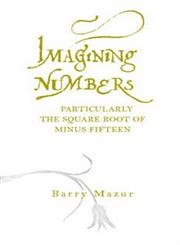
Barry Mazur invites lovers of poetry to make a leap into mathematics. Through discussions of the role of the imagination and imagery in both poetry and mathematics, Mazur reviews the writings of the early mathematical explorers and reveals the early bafflement of these Renaissance thinkers faced with imaginary numbers. Then he shows us, step-by-step, how to begin imagining these strange mathematical objects ourselves.
"synopsis" may belong to another edition of this title.
About the Author
Barry Mazur does his mathematics at Harvard University and lives in Cambridge, Massachussetts, with the writer Grace Dane Mazur.
Excerpt. © Reprinted by permission. All rights reserved.
PREFACE
1, 2, 3, . . . The "counting numbers" are part of us. We know them forward and backward. Babies as young as five months old, psychologists claim, are sensitive to the difference between 1 + 1 and 2 - 1. We sing numbers, counting up the days of Christmas and counting down to the poignant monotheism of "One is one and all alone and evermore shall be so."
Our ancestors have added to this repertoire and reckoned with zero and the negative numbers, which were sometimes referred to as fictions (fictae) before they gained familiarity.
All these together constitute what we call the whole numbers, . . . , -2, -1, 0, +1, +2, . . .
More formally, they are called integers, from the Latin adjective meaning "whole, untouched, unharmed."
"Whole," "untouched"; their very name hints that integers can be touched, or fractionated. Indeed they can be, and when they are, we get the larger array of numbers that are fractions, ratios of whole numbers.
Fractions, as their notation vividly displays, also stand for proportions (think of 1/2 = 2/4 as "one is to two as two is to four and for actions (think of 1/2 as "halving," ready to cut in half anything that follows it). To bring fractions into line, we express them as decimals (1/2 = 0.5000000 . . . ). The modem world gives us much experience with decimals to a high degree of accuracy -- to "many decimal places"; mathematics, as always, goes all the way, happy to deal with numbers with complete accuracy -- to infinitely many decimal places. Numbers represented by infinitely many decimal places, whether they are fractions or not, are called real numbers.
But the telltale adjective real suggests two things: that these numbers are somehow real to us and that, in contrast, there are unreal numbers in the offing. These are the imaginary numbers.
The imaginary numbers are well named, for there is some imaginative work to do to make them as much a part of us as the real numbers we use all the time to measure for bookshelves.
This book began as a letter to my friend Michel Chaouli. The two of us had been musing about whether or not one could "feel" the workings of the imagination in its various labors. Michel had also mentioned that he wanted to "imagine imaginary numbers." That very (rainy) evening, I tried to work up an explanation of the idea of these numbers, still in the mood of our conversation.
The text of my letter was the welcome excuse for continued conversation with a number of friends, many of whom were humanists interested in understanding what it means to imagine the square root of negative numbers. The successive revisions and expansions of my letter were shaped by their questions, comments, critiques, and insights. This book, then, is written for people who have no training in mathematics and who may not have actively thought about mathematics since high school, or even during it, but who may wish to experience an act of mathematical imagining and to consider how such an experience compares with the imaginative work involved in reading and understanding a phrase in a poem. Of course, poetry and mathematics are far apart. All the more glorious, then, for people at home in the imaginative life of poetry to use their insight and sensibility to witness the imagination at work in mathematics.
Although no particular mathematical knowledge is necessary, pencil and paper are good to have at hand, to make a few calculations (multiplying small numbers, mostly). The operation of multiplication itself is something we will be looking at. There are three standard ways of denoting the act of multiplication: by a cross ×, by a centered dot ·, or, when there is no ambiguity, by simple juxtaposition of the objects to be multiplied. Which notation we use reflects where we wish to direct our attention: the equation
2 x 3 = 6
emphasizes the act of multiplying 2 times 3, whereas
2 · 3 = 6
focuses on the result, 6, of that operation. Nevertheless, despite this difference in nuance, both equations, 2 x 3 = 6 and 2 · 3 = 6, are saying the same thing. When we deal with an unknown quantity X, here are three equivalent ways of denoting 5 times that unknown quantity:
5 × X = 5·X= 5X.
Again, we write 5 × X if we want to emphasize the act of multiplying and 5·X or 5X if we want to emphasize the result; and that last variant notation, juxtaposition, is used for visual conciseness.
Copyright © 2003 Barry Mazur
"About this title" may belong to another edition of this title.
Search results for Imagining Numbers: (Particularly The Square Root Of...

Stock Image
Imagining Numbers (Particularly the Square Root of Minus Fifteen)
Seller: Better World Books Ltd, Dunfermline, United Kingdom
Seller rating 5 out of 5 stars

Condition: Good. Pages intact with minimal writing/highlighting. The binding may be loose and creased. Dust jackets/supplements are not included. Stock photo provided. Product includes identifying sticker. Better World Books: Buy Books. Do Good. Seller Inventory # 41709822-20
Buy Used
US$ 6.26
US$ 6.62 shipping
Ships from United Kingdom to U.S.A.
Ships from United Kingdom to U.S.A.
Quantity: 2 available
Stock Image
Imagining Numbers (Particularly the Square Root of Minus Fifteen)
Seller: Better World Books Ltd, Dunfermline, United Kingdom
Seller rating 5 out of 5 stars
Condition: Good. Former library copy. Pages intact with minimal writing/highlighting. The binding may be loose and creased. Dust jackets/supplements are not included. Includes library markings. Stock photo provided. Product includes identifying sticker. Better World Books: Buy Books. Do Good. Seller Inventory # 16812544-20
Buy Used
US$ 6.26
US$ 6.62 shipping
Ships from United Kingdom to U.S.A.
Ships from United Kingdom to U.S.A.
Quantity: 1 available
Stock Image
Imagining Numbers (Particularly the Square Root of Minus Fifteen)
Seller: Better World Books, Mishawaka, IN, U.S.A.
Seller rating 5 out of 5 stars
Condition: Very Good. Pages intact with possible writing/highlighting. Binding strong with minor wear. Dust jackets/supplements may not be included. Stock photo provided. Product includes identifying sticker. Better World Books: Buy Books. Do Good. Seller Inventory # 68081217-6
Stock Image
Imagining Numbers: (Particularly The Square Root Of Minus Fifteen)
Seller: WorldofBooks, Goring-By-Sea, WS, United Kingdom
Seller rating 5 out of 5 stars
Hardback. Condition: Very Good. The book has been read, but is in excellent condition. Pages are intact and not marred by notes or highlighting. The spine remains undamaged. Seller Inventory # GOR001468630
Buy Used
US$ 9.76
US$ 7.42 shipping
Ships from United Kingdom to U.S.A.
Ships from United Kingdom to U.S.A.
Quantity: 3 available
Stock Image
Imagining Numbers: (Particularly the Square Root of Minus Fifteen)
Seller: AwesomeBooks, Wallingford, United Kingdom
Seller rating 5 out of 5 stars
Hardcover. Condition: Very Good. Imagining Numbers: (Particularly the Square Root of Minus Fifteen) This book is in very good condition and will be shipped within 24 hours of ordering. The cover may have some limited signs of wear but the pages are clean, intact and the spine remains undamaged. This book has clearly been well maintained and looked after thus far. Money back guarantee if you are not satisfied. See all our books here, order more than 1 book and get discounted shipping. . Seller Inventory # 7719-9780713996302
Buy Used
US$ 11.76
US$ 5.46 shipping
Ships from United Kingdom to U.S.A.
Ships from United Kingdom to U.S.A.
Quantity: 1 available
Stock Image
Imagining Numbers: (Particularly the Square Root of Minus Fifteen)
Seller: Bahamut Media, Reading, United Kingdom
Seller rating 5 out of 5 stars
Hardcover. Condition: Very Good. Shipped within 24 hours from our UK warehouse. Clean, undamaged book with no damage to pages and minimal wear to the cover. Spine still tight, in very good condition. Remember if you are not happy, you are covered by our 100% money back guarantee. Seller Inventory # 6545-9780713996302
Buy Used
US$ 11.76
US$ 9.25 shipping
Ships from United Kingdom to U.S.A.
Ships from United Kingdom to U.S.A.
Quantity: 1 available
Stock Image
Imagining Numbers: (Particularly the Square Root of Minus Fifteen)
Published by
Allen Lane, 2003
ISBN 10: 0713996307
ISBN 13: 9780713996302
Used
Hardcover
First Edition
Seller: HALCYON BOOKS, LONDON, United Kingdom
Seller rating 5 out of 5 stars
Hardcover. Condition: Very Good. Dust Jacket Condition: Very good. First Edition. A clean, tight copy throughout with minimal wear. No markings. NEW EU 3 EURO CHARGE FOR IMPORTS IS INCLUDED IN OUR SHIPPING PRICE. ALL ITEMS ARE DISPATCHED FROM THE UK, ALL OVERSEAS ORDERS SENT BY TRACKABLE AIR MAIL. IF YOU ARE LOCATED OUTSIDE THE UK PLEASE ASK US FOR A POSTAGE QUOTE FOR MULTI VOLUME SETS BEFORE ORDERING. Seller Inventory # mon0000560597
Buy Used
US$ 3.42
US$ 23.84 shipping
Ships from United Kingdom to U.S.A.
Ships from United Kingdom to U.S.A.
Quantity: 1 available
Stock Image
Imagining Numbers: Particularly the Square Root of Minus Fifteen
Seller: Greener Books, London, United Kingdom
Seller rating 4 out of 5 stars

Hardcover. Condition: Used; Very Good. **SHIPPED FROM UK** We believe you will be completely satisfied with our quick and reliable service. All orders are dispatched as swiftly as possible! Buy with confidence! Greener Books. Seller Inventory # 4591305
Buy Used
US$ 5.01
US$ 26.49 shipping
Ships from United Kingdom to U.S.A.
Ships from United Kingdom to U.S.A.
Quantity: 2 available
Stock Image
Imagining Numbers
Published by
Allen Lane, London, 2003
ISBN 10: 0713996307
ISBN 13: 9780713996302
Used
Hardcover
First Edition
Seller: WEST WESSEX BOOKS, Taunton, SOMER, United Kingdom
Seller rating 5 out of 5 stars
Hardcover. Condition: Very Good. Dust Jacket Condition: Very Good. 1st Edition. 270pp.This absorbing book lies in the grand tradition of explanations of what mathematical imagination is. A lovely copy. as new really. Size: 8vo - over 7¾" - 9¾" tall. Book. Seller Inventory # 6517
Buy Used
US$ 9.55
US$ 23.84 shipping
Ships from United Kingdom to U.S.A.
Ships from United Kingdom to U.S.A.
Quantity: 1 available
Seller Image
Imagining numbers: (particularly the square root of minus fifteen)
Published by
Allen Lane, 2003
ISBN 10: 0713996307
ISBN 13: 9780713996302
Used
Hardcover
First Edition
Seller: Cotswold Internet Books, Cheltenham, United Kingdom
Seller rating 5 out of 5 stars
First Edition. 2003 1st edition, tightly bound in blue cloth with gilt lettering to spine. Dust jacket not price-clipped; a clean, tidy copy. Used - Very Good. VG hardback in VG dust jacket. Seller Inventory # BOOKS315831I
Buy Used
US$ 30.70
US$ 18.54 shipping
Ships from United Kingdom to U.S.A.
Ships from United Kingdom to U.S.A.
Quantity: 1 available