Items related to The Revenge of Gaia: Why the Earth Is Fighting Back...
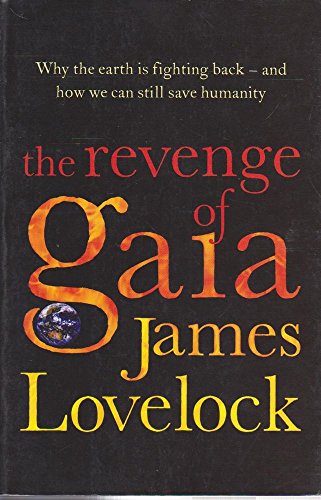
The Revenge of Gaia: Why the Earth Is Fighting Back - and How We Can Still Save Humanity - Softcover
Synopsis
For millennia, humankind has exploited the Earth without counting the cost. Now, as the world warms and weather patterns dramatically change, the Earth is beginning to fight back. James Lovelock, one of the giants of environmental thinking, argues passionately and poetically that, although global warming is now inevitable, we are not yet too late to save at least part of human civilization. This short book, written at the age of eighty-six after a lifetime engaged in the science of the earth, is his testament.
"synopsis" may belong to another edition of this title.
About the Author
James Lovelock is the author of more than 200 scientific papers and the originator of the Gaia Hypothesis (now Gaia Theory). He has written three books on the subject: Gaia: a new look at life on Earth; The Ages of Gaia; Gaia: the practical science of planetary medicine; and an autobiography, Homage to Gaia. He has received many honorary degrees as well as being made Companion of Honour by the Queen in 2003. He has held posts at numerous universities both in the UK and the US and since 1994 has been an Honorary Visiting Fellow of Green College, University of Oxford.
From Publishers Weekly
Starred Review. The end is all but nigh for Mother Earth's inhabitants unless drastic measures are soon taken: that's the rueful prognostication delivered by Lovelock (Gaia: A New Look at Life on Earth), intuitive originator of the theory that the world is a self-regulating system that, over the eons, has been able to sustain an equilibrium between hot and cold so as to support life. Now, propelled by global warming, Lovelock says, a tipping point has almost been reached beyond which the Earth will not recover sufficiently to sustain human life comfortably. Lovelock dismisses biomass fuels, wind farms, solar energy and fuel cell innovations as technologies unlikely to mitigate greenhouse gases in time to save the planet. Instead he sees nuclear energy as the only energy source that can meet our needs in time to prevent catastrophe. Chernobyl was a calamity, he notes, but nuclear power's danger is "insignificant compared with the real threat of intolerable and lethal heatwaves" and rising sea levels that could "threaten every coastal city of the world." Lovelock's pro-nuke enthusiasm, unexpected from one of the mid-20th century's most ardent environmental thinkers, is the well-reasoned core of this urgent call for braking at the brink of global catastrophe. (Aug.)
Copyright © Reed Business Information, a division of Reed Elsevier Inc. All rights reserved.
"About this title" may belong to another edition of this title.
- PublisherAllen Lane
- Publication date2006
- ISBN 10 0713999268
- ISBN 13 9780713999266
- BindingPaperback
- Number of pages192
- Rating
Other Popular Editions of the Same Title

Top Search Results from the AbeBooks Marketplace

Stock Image
The Revenge of Gaia: Why the Earth Is Fighting Back - and How We Can Still Save Humanity
Seller: Project HOME Books, Philadelphia, PA, U.S.A.
Seller rating 5 out of 5 stars

Condition: Good. Used - Good. Seller Inventory # AJ03-000048
Quantity: 1 available
Stock Image
The Revenge Of Gaia
Published by
Allen Lane for Penguin Books, London 2006, 2006
ISBN 10: 0713999268
ISBN 13: 9780713999266
Used
Softcover
Seller: THE CROSS Art + Books, Sydney, NSW, Australia
Seller rating 3 out of 5 stars

21.0 x 14.0cms, 178pp, very good paperback with French flaps. Written when Lovelock was 86, this short book is his testament that it is/was not too late to save at least part of civilisation. Seller Inventory # 131863
Quantity: 1 available
Stock Image
The Revenge of Gaia - Why the Earth Is Fighting Back - And How We Can Still Save Mankind
Seller: Barclay Books, York, WA, Australia
Seller rating 5 out of 5 stars
Paperback. Lovelock's unique authority and original perspective sets this book apart from other books on environmental change. He speaks as a planetary physician with more than forty years experience of thinking about how to respond to the earth s needs as a living organism. Illustrated with examples drawn from his experiences around the world, Lovelock draws many radical conclusions, most controversially a passionate advocacy of nuclear energy. This, he argues, is not only a secure, safe and reliable source of energy, but also the only way to counter the lethal heat waves and rising sea levels that will increasingly threaten civilizations. Lovelock argues that the only way for humankind to come to terms with Gaia now, and have a chance of surviving, is to embrace science and technology, not reject them. This is his passionate manifesto of how to do that and so lessen our impact on the Earth before it is too late. First published 2006. 2006. A trade paperback copy in fine, unread condition. Seller Inventory # 16638522
Quantity: 1 available
Stock Image
The Revenge of Gaia: Why the Earth is Fighting Back - And How We Can Still Save Humanity.
Published by
Allen Lane / Penguin Books, Melbourne, 2006
ISBN 10: 0713999268
ISBN 13: 9780713999266
Used
Softcover
Seller: BOOKHOME SYDNEY, Annandale Sydney, NSW, Australia
Seller rating 5 out of 5 stars
Australian ed. Paperback trade (with flaps), very good condition, colour photos centre spread, few figures, pages toned as usual, minor edgewear. 177 pp. The key insight of Lovelock's Gaia Theory is that the entire Earth functions as a single living super-organism. That organism is now sick. It is running a fever because of increased atmospheric greenhouse gases. Earth will adjust to these stresses, but the human race faces a severe test. It is already too late to prevent the global climate from flipping into a new equilibrium that will threaten civilization. But we can do much to save humanity. In the tradition of "Silent Spring," this is a call to address a major threat to our collective future. Seller Inventory # 17771
Quantity: 1 available