
Items related to Ripples in the Cosmos: A view behind the scenes of...
Synopsis
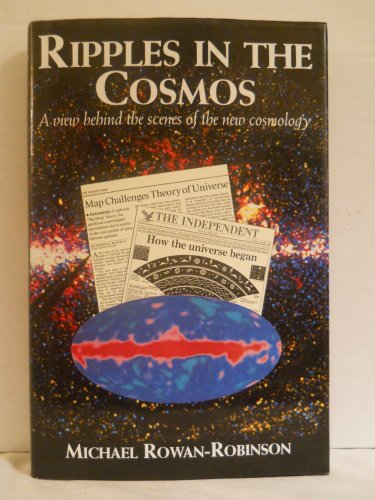
On April 23, 1992 a major science story appeared in newspaper headlines around the world. The announcement of the discovery of small-scale fluctuations in the cosmic microwave radiation, ripples in the cosmos, was a bolt from the blue, taking most of the world's cosmologists by surprise. Then came the first reactions: 'the discovery of the century, perhaps of all time' (Stephen Hawking), 'the Holy Grail of cosmology', 'English does not have enough superlatives', and 'a certain Nobel Prize.' What are the ripples? Why are they of such fundamental importance? What do they tell us about the beginning of the universe? And was the hype reported in the media justified? In this immensely readable book, distinguished cosmologist Michael Rowan-Robinson sets the discovery in its wider context, that of the search for an explanation of how galaxies, clusters of galaxies and even larger structures formed in a universe which was initially of almost perfect uniformity. This puzzle has been at the heart of the cosmological debate for the past decade. Using telescopes in orbit around the earth, working at wavelengths invisible to the human eye, astronomers have recently taken two enormous steps forward in their search for an explanation of the evolution of structure, their discoveries making front-page news. The first was the mapping of the distribution of galaxies by the Infrared Astronomical Satellite (IRAS); the second, the detection of the ripples by the Cosmic Background Explorers (COBE). Here is an insider's account of these momentous discoveries: Michael Rowan-Robinson was a leading participant with IRAS, one of the most successful space astronomy missions of all time. It is a story packed with anecdote and drama, culminating in a series of spectacular cosmological discoveries. These include the explanation of the rapid motion of our galaxy through space; the demise of the hypothetical 'Great Attractor'; the demonstration that the universe is filled with an exotic form of dark matter, and the detection--by the author and his colleagues--of the most luminous galaxy in the universe. Professor Rowan-Robinson goes on to describe how the IRAS discoveries and the COBE ripples are connected, and how this has helped to solve the problem of how structure, and hence we ourselves, evolved in the universe. Ripples in the Cosmos is far more than an exciting--and personal-- story of modern cosmology. Michael Rowan-Robinson asks fundamental questions about the very nature of science, and how it works. His surprising answers will intrigue general readers and scientists alike.
"synopsis" may belong to another edition of this title.
About the Author
Michael Rowan-Robinson, Professor of Astrophysics, Imperial College, London.
Reviews
The 1983 launch of the Infrared Astronomical Satellite (IRAS) by NASA and British and Dutch government consortiums was a nearly perfect model of collaborative international science. The IRAS mission, to make a complete radiowave map of "nearby" galaxies, was nearly overshadowed by the headline-making discovery by the Cosmic Background Explorer satellite (COBE) of "ripples" in background microwave radiation . Redressing that imbalance here, renowned cosmologist Rowan-Robinson, who was on the British data analysis team, offers vignettes of the personalities, the machines and the perseverance that powered the project. Unnecessary lectures about the goal of science and a precis of the Big Bang theory bracket the compelling story of IRAS--to the effect of gift-wrapping the Mona Lisa. In Rowan-Robinson's telling, the IRAS story is great space-age science likely to inspire future astronomers. Illustrations.
Copyright 1993 Reed Business Information, Inc.
Although not a superstar like Hoyle or Hawking, this astronomer is an important member of the cadre that looks for the things the theorists think up. Besides describing his own addition to observational astronomy--the first finding of a galaxy aborning--Rowan-Robinson summarizes the two revolutionary advances of cosmography, namely, Hubble's discovery of galactic recession, and the relic radiation confirming a singular big bang. He tells of his "only and very minor contribution to pure mathematics" and what doing big science with NASA is like. This makes a good companion to recent tomes on the subatomic end of the physical realm (for example, Weinberg's Dreams of a Final Theory and Lindley's End of Physics ). Gilbert Taylor
"About this title" may belong to another edition of this title.
Search results for Ripples in the Cosmos: A view behind the scenes of...

Stock Image
Ripples in the Cosmos: A view behind the scenes of the new cosmology
Published by
Oxford University Press, 1998
ISBN 10: 0716745038
ISBN 13: 9780716745037
Used
Hardcover
Seller: Half Price Books Inc., Dallas, TX, U.S.A.
Seller rating 5 out of 5 stars

Hardcover. Condition: Very Good. Connecting readers with great books since 1972! Used books may not include companion materials, and may have some shelf wear or limited writing. We ship orders daily and Customer Service is our top priority! Seller Inventory # S_354312383
Stock Image
Ripples in the Cosmos: A view behind the scenes of the new cosmology
Published by
Oxford University Press, 1998
ISBN 10: 0716745038
ISBN 13: 9780716745037
Used
Hardcover
Seller: HPB-Diamond, Dallas, TX, U.S.A.
Seller rating 5 out of 5 stars
hardcover. Condition: Very Good. Connecting readers with great books since 1972! Used books may not include companion materials, and may have some shelf wear or limited writing. We ship orders daily and Customer Service is our top priority! Seller Inventory # S_452269710
Seller Image
Ripples in the Cosmos: a View Behind the Scenes of the New Cosmology
Published by
Oxford Univ Pr, Cary, North Carolina, U.S.A., 1998
ISBN 10: 0716745038
ISBN 13: 9780716745037
Used
Hardcover
Seller: fourleafclover books, St. Louis, MO, U.S.A.
Seller rating 5 out of 5 stars
Hardcover. Condition: As New. Dust Jacket Condition: Near Fine. 234 pgs. Illustrated. Seller Inventory # 021327
Stock Image
Ripples in the Cosmos: View Behind the Scenes of the New Cosmology
Seller: AwesomeBooks, Wallingford, United Kingdom
Seller rating 5 out of 5 stars
Hardcover. Condition: Very Good. Ripples in the Cosmos: View Behind the Scenes of the New Cosmology This book is in very good condition and will be shipped within 24 hours of ordering. The cover may have some limited signs of wear but the pages are clean, intact and the spine remains undamaged. This book has clearly been well maintained and looked after thus far. Money back guarantee if you are not satisfied. See all our books here, order more than 1 book and get discounted shipping. Seller Inventory # 7719-9780716745037
Buy Used
US$ 5.42
US$ 5.45 shipping
Ships from United Kingdom to U.S.A.
Ships from United Kingdom to U.S.A.
Quantity: 2 available
Stock Image
Ripples in the Cosmos: A View Behind the Scenes of the New Cosmology
Published by
Oxford University Press / W. H. Freeman, 1993
ISBN 10: 0716745038
ISBN 13: 9780716745037
Used
Hardcover
Seller: gigabooks, Spokane, WA, U.S.A.
Seller rating 5 out of 5 stars
Hardcover. Condition: Very Good. Dust Jacket Condition: Very Good. Hard Cover -- VG/VG -- Book and dust jacket are clean and bright -- 224 pages with index and illustrations. Seller Inventory # 316863
Stock Image
Ripples in the Cosmos: View Behind the Scenes of the New Cosmology
Published by
Macmillan Learning, United States, New York, 1998
ISBN 10: 0716745038
ISBN 13: 9780716745037
Used
Paperback
Seller: WorldofBooks, Goring-By-Sea, WS, United Kingdom
Seller rating 5 out of 5 stars
Paperback. Condition: Very Good. The book has been read, but is in excellent condition. Pages are intact and not marred by notes or highlighting. The spine remains undamaged. Seller Inventory # GOR005151732
Buy Used
US$ 3.81
US$ 7.41 shipping
Ships from United Kingdom to U.S.A.
Ships from United Kingdom to U.S.A.
Quantity: 2 available
Stock Image
Ripples in the Cosmos : A View Behind the Scenes of the New Cosmology
Published by
Oxford University Press, Incorporated, 1998
ISBN 10: 0716745038
ISBN 13: 9780716745037
Used
Hardcover
Seller: Better World Books Ltd, Dunfermline, United Kingdom
Seller rating 5 out of 5 stars
Condition: Very Good. Former library copy. Pages intact with possible writing/highlighting. Binding strong with minor wear. Dust jackets/supplements may not be included. Includes library markings. Stock photo provided. Product includes identifying sticker. Better World Books: Buy Books. Do Good. Seller Inventory # 55135824-20
Buy Used
US$ 6.22
US$ 6.61 shipping
Ships from United Kingdom to U.S.A.
Ships from United Kingdom to U.S.A.
Quantity: 1 available
Stock Image
Ripples in the Cosmos: A view behind the scenes of the new cosmology
Published by
Oxford University Press, USA, New York
ISBN 10: 0716745038
ISBN 13: 9780716745037
New
Hardcover
First Edition
Seller: Alien Bindings, BALTIMORE, MD, U.S.A.
Seller rating 4 out of 5 stars

Hardcover. Condition: New. Dust Jacket Condition: New. First Edition. Brand New with crisp dust jacket. The covers look great. The binding is tight. The interior pages are clean and unmarked. Electronic delivery tracking will be issued free of charge. Seller Inventory # 09626
Stock Image
Ripples In The Cosmos A View Behind The Scenes Of The New Cosmology
Published by
W. H. Freeman & Company, New York, NY, 1993
ISBN 10: 0716745038
ISBN 13: 9780716745037
Used
Hardcover
First Edition
Seller: Willis Monie-Books, ABAA, Cooperstown, NY, U.S.A.
Seller rating 5 out of 5 stars
Hardcover. Condition: Very Good. Dust Jacket Condition: Very Good. First Edition. Seller Inventory # 58442
Stock Image
Ripples in the Cosmos: A view behind the scenes of the new cosmology
Seller: Basement Seller 101, Cincinnati, OH, U.S.A.
Seller rating 5 out of 5 stars
hardcover. Condition: New. Seller Inventory # 260707096