
Items related to Augustus : The Life of Rome's First Emperor
Synopsis
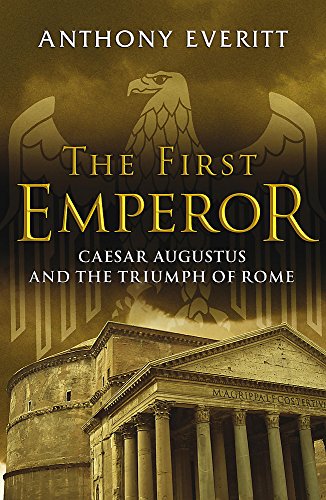
The First Emperor. Caesar Augustus and the Triumph of Rome:
"synopsis" may belong to another edition of this title.
About the Author
Anthony Everitt, visiting professor in the visual and performing arts at Nottingham Trent University, has written extensively on European culture, has contributed to The Guardian and Financial Times, and is the author of Cicero. He once served as secretary general of the Arts Council of Great Britain. Everitt lives near Colchester, England’s first recorded town, founded by the Romans.
Excerpt. © Reprinted by permission. All rights reserved.
Chapter 1
SCENES FROM A PROVINCIAL CHILDHOOD
63–48 b.c.
Velletri is a compact hill town about twenty-five miles southeast of Rome. It lies at the southern edge of the Alban Hills, overlooking a wide plain and distant mountains. The walk from the railway station to the center is a steep, hot climb.
Little remains of ancient Velitrae, but signs of the Renaissance are to be found everywhere. In the main square stands an old fountain with battered lions spouting water. The streets leading off the piazza are roughly parallel and are gridded, echoing the original pattern of the old Roman vici. At the town’s highest point, where the citadel must have been, a sixteenth-century palazzo communale, which combines the functions of town hall and museum, was built on the foundations of a Roman building.
Here, on a stone platform, the modern life-size statue in bronze of a man in his late teens gazes blankly from empty eye sockets into the far distance, contemplating the life that has yet to unfold. This is Gaius Octavius, Rome’s future ruler Augustus: for Velitrae was his hometown and Velletri is proud to celebrate his memory.
Gaius would recognize the lay of the land, the rise and fall of streets and alleys, perhaps the layout, certainly the views. Now as then, this is a provincial place, which seems farther from the capital city than it really is. Change has always come slowly. The community leaves a powerful impression of being self-contained and a little isolated. Even today, elderly locals squint blackly at strangers.
A certain dour feeling for tradition, a suspicion of newfangled ways, a belief in propriety, have always been typical of provincial life in towns such as Velitrae, and it would be hard to imagine a more conventional family than that into which Gaius Octavius was born in 63 b.c.
Every Roman boy received a praenomen, or forename, such as Marcus, Lucius, Sextus—or Gaius. Then came his clan name, or nomen, such as Octavius. Some but not all Romans also had a cognomen, which signified a family subset of a clan. Successful generals were sometimes awarded a hereditary agnomen; for example, Publius Cornelius Scipio added Africanus to his existing names, in honor of his victory over Hannibal in north Africa. By contrast, girls were only known, inconveniently, by the feminine version of their nomen; so Gaius’ two sisters were both known as Octavia.
An important feature of the infant Gaius’ inheritance was that, although like most Italians the Octavii held Roman citizenship, they were not of “Roman” stock. Velitrae was an outpost on the borders of Latium, home of the Latin tribes that, centuries before, had been among the first conquests of the aggressive little settlement beside a ford on the river Tiber.
Two hundred years before Gaius’ birth, Rome finally united the tribes and communities of central and southern Italy through a network of imposed treaties. The men of these lands provided the backbone of the legions and were eventually, as late as the eighties b.c., incorporated into the Republic as full citizens. The little boy grew up with a clear impression of the contribution that Rome’s onetime opponents were making to its imperial greatness, a contribution not always fully recognized by the chauvinists in the capital. In a real sense, the Roman empire would be better called the Italian empire.
The Octavii were a well-respected local family of considerable means. A Vicus Octavius, or Octavius Street, ran through Velitrae’s center (just as a Via Ottavia does today), past an altar consecrated by a long-ago ancestor.
The family seems to have been in trade, a sure sign that it was not of aristocratic status. Gaius’ paternal great-grandfather fought in Sicily as a military tribune (a senior officer in a legion, or regiment) during the second war against the great merchant state of Carthage in northern Africa (218 to 201 b.c.). Carthage’s comprehensive defeat was the first indication to the Mediterranean world that a new military power had arrived on the scene. Gaius’ grandfather, who lived to an advanced age, was well-off, but had no ambitions for a career in national politics, being apparently content to hold local political office.
Later hostile gossip claimed that the great-grandfather was an ex-slave who, having won his freedom, made a living as a rope maker in the neighborhood of Thurii, a town in Italy’s deep south. It was also rumored that the grandfather was a money changer, with “coin-stained hands.” Friendly propagandists took a different tack and invented a fictitious link with a blue-blooded Roman clan of the same name.
When he came to write his memoirs many years afterward, Gaius merely noted that he “came from a rich old equestrian family.” The equites, or knights, were the affluent middle class, occupying a political level below that of the nobility and members of the ruling Senate, but often overlapping with them socially. To qualify for equestrian status, they needed to own property worth more than 400,000 sesterces, and were not actively engaged in government. They were usually wealthy businessmen or landed gentry who preferred to avoid the expense and dangers of a political career. Many were contracted by the state to collect taxes on its behalf from the provinces. By the time of the boy’s father, also named Gaius Octavius, the family had become seriously rich, and probably far exceeded the equestrian minimum.
The father Octavius, an ambitious man, decided to pursue a career in politics at Rome with a view to making his way, if he could, to the top. This was an extremely difficult project. The Roman constitution was a complicated contraption of checks and balances, and the odds were stacked against an outsider—a novus homo, or “new man”—from winning a position of authority.
Rome became a republic in 509 b.c., after driving out its king and abolishing the monarchy. The next two centuries saw a long struggle for power between a group of noble families, patricians, and ordinary citizens, plebeians, who were excluded from public office.
The outcome was an apparent victory for the people, but the old aristocracy, supplemented by rich plebeian nobles, still controlled the state. What looked in many ways like a democracy was, in fact, an oligarchy modified by elections.
The Roman constitution was the fruit of many compromises and developed into a complicated mix of laws and unwritten understandings. Power was widely distributed and there were multiple sources of decision-making.
Roman citizens (only men, for women did not have the vote) attended public meetings called assemblies, where they passed laws and elected politicians to govern the Republic. These leaders doubled as generals in time of war. Although in theory any citizen could stand for public office, candidates usually came from a small group of very rich, noble families.
If successful, politicians passed through a set sequence of different jobs, a process called the cursus honorum or honors race. The first step on the ladder, taken at the age of thirty or above (in practice, younger men were often elected), was to become one of a number of quaestors; this post entailed supervising the collection of taxes and making payments, either for the consuls in Rome or for provincial governors. Then, if he wished, a man could be elected one of four aediles, who were responsible for the administration of the city of Rome. During festivals they staged public entertainments at their own expense, so deep pockets were needed. The next position, that of praetor, was compulsory. Praetors were senior officers of state, responsible for presiding as judges in the law courts and, when required, to lead an army in the field.
At the top of the pyramid were two consuls, who were heads of government with supreme authority; they were primarily army commanders and conveners of the Senate and assemblies.
Consuls and praetors held imperium, officially sanctioned absolute power, although they were constrained in three important ways. First, they held office only for one year. Second, there were always two or more officeholders at the same level. Those of equal rank were allowed to veto anything that their colleagues or junior officeholders decided. Finally, if they broke the law, officeholders could face criminal charges once they were out of office.
On top of that, ten tribunes of the people were elected, whose task was to make sure that officeholders did nothing to harm ordinary Romans (patricians were not allowed to be tribunes). They could propose laws to the Senate and the people and were empowered to convene citizens’ assemblies. The tribunes held power only within the city limits, where they could veto any officeholder’s decisions, including another tribune’s.
The power of the assemblies was limited. They approved laws—but only those that were laid before them. Speakers supported or opposed a proposed measure, but open debate was forbidden; all that citizens were allowed to do was vote. There were different kinds of assembly, each with its own rules: in the assembly that elected praetors and consuls, for example, the voting system was weighted in favor of property owners in the belief that they would act with care because they had the most to lose if any mistakes were made.
The Roman constitution made it so easy to stop decisions from being made that it is rather surprising that anything at all got done. The Romans realized that sometimes it might be necessary to override the constitution. In a grave emergency, for a maximum of six months, a dictator was appointed who held sole power and could act as he saw fit.
The Roman Senate was mainly recruited from officeholders. By Octavius’ day, a quaestor automatically became a lifelong member, and he and his family joined Rome’s nobility (if he was not already a member of it). Senators were prohibited b...
"About this title" may belong to another edition of this title.
Search results for Augustus : The Life of Rome's First Emperor

Stock Image
The First Emperor : Caesar Augustus and the Triumph of Rome
Seller: Better World Books Ltd, Dunfermline, United Kingdom
Seller rating 5 out of 5 stars

Condition: Very Good. Former library copy. Pages intact with possible writing/highlighting. Binding strong with minor wear. Dust jackets/supplements may not be included. Includes library markings. Stock photo provided. Product includes identifying sticker. Better World Books: Buy Books. Do Good. Seller Inventory # GRP79330937
Buy Used
US$ 6.27
US$ 6.68 shipping
Ships from United Kingdom to U.S.A.
Ships from United Kingdom to U.S.A.
Quantity: 1 available
Stock Image
The First Emperor: Caesar Augustus and the Triumph of Rome
Seller: WorldofBooks, Goring-By-Sea, WS, United Kingdom
Seller rating 5 out of 5 stars
Hardback. Condition: Very Good. The book has been read, but is in excellent condition. Pages are intact and not marred by notes or highlighting. The spine remains undamaged. Seller Inventory # GOR002099346
Buy Used
US$ 6.06
US$ 7.49 shipping
Ships from United Kingdom to U.S.A.
Ships from United Kingdom to U.S.A.
Quantity: 6 available
Stock Image
Augustus : The Life of Rome's First Emperor
Seller: WorldofBooks, Goring-By-Sea, WS, United Kingdom
Seller rating 5 out of 5 stars
Hardback. Condition: Good. The book has been read but remains in clean condition. All pages are intact and the cover is intact. Some minor wear to the spine. Seller Inventory # GOR003051344
Buy Used
US$ 6.06
US$ 7.49 shipping
Ships from United Kingdom to U.S.A.
Ships from United Kingdom to U.S.A.
Quantity: 1 available
Seller Image
The First Emperor: Caesar Augustus and the Triumph of Rome
Seller: WeBuyBooks, Rossendale, LANCS, United Kingdom
Seller rating 5 out of 5 stars
hardcover. Condition: Very Good. Most items will be dispatched the same or the next working day. A copy that has been read, but is in excellent condition. Pages are intact and not marred by notes or highlighting. The spine remains undamaged. Seller Inventory # rev6999148313
Buy Used
US$ 3.54
US$ 11.92 shipping
Ships from United Kingdom to U.S.A.
Ships from United Kingdom to U.S.A.
Quantity: 2 available
Stock Image
The First Emperor: Caesar Augustus and the Triumph of Rome
Seller: Brit Books, Milton Keynes, United Kingdom
Seller rating 4 out of 5 stars

Hardcover. Condition: Used; Very Good. ***Simply Brit*** Welcome to our online used book store, where affordability meets great quality. Dive into a world of captivating reads without breaking the bank. We take pride in offering a wide selection of used books, from classics to hidden gems, ensuring there is something for every literary palate. All orders are shipped within 24 hours and our lightning fast-delivery within 48 hours coupled with our prompt customer service ensures a smooth journey from ordering to delivery. Discover the joy of reading with us, your trusted source for affordable books that do not compromise on quality. Seller Inventory # 4047211
Buy Used
US$ 6.63
US$ 21.38 shipping
Ships from United Kingdom to U.S.A.
Ships from United Kingdom to U.S.A.
Quantity: 1 available
Stock Image
The First Emperor: Caesar Augustus and the Triumph of Rome
Published by
John Murray, 2006
ISBN 10: 0719554942
ISBN 13: 9780719554940
Used
Hardcover
First Edition
Seller: Invicta Books P.B.F.A., Builth Wells, POWYS, United Kingdom
Seller rating 4 out of 5 stars
Hardcover. Condition: Very Good. Dust Jacket Condition: Near Fine. 1st Edition. some very light foxing to the top edge of the pages, illustrated, 399 pages. Seller Inventory # 022851
Buy Used
US$ 11.71
US$ 33.42 shipping
Ships from United Kingdom to U.S.A.
Ships from United Kingdom to U.S.A.
Quantity: 1 available
Seller Image
The First Emperor
Published by
John Murray, London, 2006
ISBN 10: 0719554942
ISBN 13: 9780719554940
Used
Hardcover
First Edition
Seller: The Deva Bookshop, Holt, United Kingdom
Seller rating 5 out of 5 stars
Hardcover. Condition: As New. Dust Jacket Condition: As New. 2006, 1st edition 2nd impression. As New book in As New dustjacket. Unread, no inscriptions or other markings. DJ is not price clipped (£25). Unsold ex-bookshop stock. Seller Inventory # 206143
Buy Used
US$ 20.65
US$ 24.73 shipping
Ships from United Kingdom to U.S.A.
Ships from United Kingdom to U.S.A.
Quantity: 1 available
Stock Image
The First Emperor, Caesar Augustus and the Triumph of Rome
Published by
John Murray / Hodder Headline, London, 2006
ISBN 10: 0719554942
ISBN 13: 9780719554940
Used
Hardcover
First Edition
Seller: The Print Room, Cockernhoe nr Luton, United Kingdom
Seller rating 5 out of 5 stars
Hardcover. Condition: Near Fine. Dust Jacket Condition: Near Fine. Jacket by Edward Bettison (illustrator). 1st Edition. First edition, second impression with '2' on copyright page. Some slight edge wear to top and bottom of jacket and spine, corners slightly bruised, slight lean. Not price clipped (£25.00), no inscriptions, internally clean and tight, overall a vg+ copy. 399pp, illustrated. Caesar Augustus is one of the most fascinating figures in history. Plucked as teenager from provincial obscurity by his great uncle Gaius Julius Caesar who adopted him posthumously in his will, Augustus transformed the chaotic civil war torn Republic into an orderly imperial autocracy. His consolidation of the Roman empire arguably laid the foundations of Europe. Although a sickly young man with a tendency to fall seriously ill at moments of crisis, Augustus taught himself to be brave and was intelligent, painstaking and patient. He worked extraordinarily hard, and, within a generation, had rebuilt Rome, transforming it into a splendid metropolis and centre for civil government and the arts. In this dynamic and engaging biography Anthony Everitt uncovers the deeply human character of this extraordinary man. It is also an exhilarating portrait of Roman social customs and politics. Seller Inventory # 008674
Buy Used
US$ 13.77
US$ 33.42 shipping
Ships from United Kingdom to U.S.A.
Ships from United Kingdom to U.S.A.
Quantity: 1 available
Stock Image
The First Emperor: Caesar Augustus and the Triumph of Rome
Published by
John Murray, 2006
ISBN 10: 0719554942
ISBN 13: 9780719554940
Used
Hardcover
First Edition
Seller: Neil Carver Books, SOUTHPORT, United Kingdom
Seller rating 4 out of 5 stars
Hardcover. Condition: As New. Dust Jacket Condition: As New. 1st Edition. First British edition and an immaculate copy. Seller Inventory # 002176
Buy Used
US$ 20.65
US$ 46.79 shipping
Ships from United Kingdom to U.S.A.
Ships from United Kingdom to U.S.A.
Quantity: 1 available