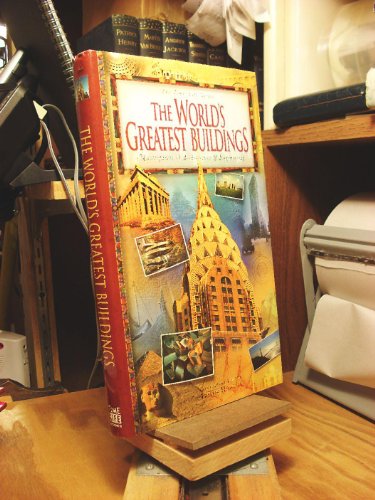
The World's Greatest Buildings: Masterpieces of Architecture & Engineering (Time-Life Guides) - Hardcover
Synopsis
Highlights places of worship, centers of power, and monuments and memorials considered to be among the 100 architectural masterpieces, describing their design, history, function, materials, and dimensions.
"synopsis" may belong to another edition of this title.
Excerpt. © Reprinted by permission. All rights reserved.
Chapter 1: Places of Worship Since ancient times, the Pantheon s sense of space and seeming simplicity of design have induced awe in all those who stand under its great dome. Despite depredations and alterations over 2,000 years, it s among the most complete and best preserved of all the ancient Roman monuments. Built by the Emperor Hadrian between AD 118 AND 125, the Pantheon covered a temple erected by one of the Emperor Augustus s generals, Marcus Agrippa, in 27 BC. The artistic Hadrian seems to have been a modest man with a sense of history: He had Agrippa s name inscribed above the columns of the entrance portico, vowing, with touching filial loyalty, to dedicate his own name to one monument only-that of his adoptive father, Trajan. The exterior, fronted by a portico eight columns wide and three deep, barely hints at the exposure within. A central block contains the huge, bronze covered doors, flanked by niches, leading into the immense rotunda. The dome is a half-sphere, its 144-feet (44.3m) diameter precisely equal to its floor-to-summit height. The oculus ( open eye ) at its center provides an unexpected view of Rome s changing skies, and a natural light source.
"About this title" may belong to another edition of this title.
Search results for The World's Greatest Buildings: Masterpieces of Architecture...

Stock Image
The World's Greatest Buildings
Seller: World of Books (was SecondSale), Montgomery, IL, U.S.A.
Seller rating 5 out of 5 stars

Condition: Very Good. Item in very good condition! Textbooks may not include supplemental items i.e. CDs, access codes etc. Seller Inventory # 00096742197
Stock Image
The World's Greatest Buildings
Seller: World of Books (was SecondSale), Montgomery, IL, U.S.A.
Seller rating 5 out of 5 stars
Condition: Good. Item in good condition. Textbooks may not include supplemental items i.e. CDs, access codes etc. Seller Inventory # 00084571181
Stock Image
The World's Greatest Buildings: Masterpieces of Architecture & Engineering (Time-Life Guides)
Published by
Time Life Education (edition ), 2000
ISBN 10: 0737000821
ISBN 13: 9780737000825
Used
Hardcover
Seller: BooksRun, Philadelphia, PA, U.S.A.
Seller rating 5 out of 5 stars
Hardcover. Condition: Good. It's a preowned item in good condition and includes all the pages. It may have some general signs of wear and tear, such as markings, highlighting, slight damage to the cover, minimal wear to the binding, etc., but they will not affect the overall reading experience. Seller Inventory # 0737000821-11-1
Seller Image
The World's Greatest Buildings: Masterpieces of Architecture & Engineering (Time-Life Guides)
Seller: Zoom Books East, Glendale Heights, IL, U.S.A.
Seller rating 5 out of 5 stars
Condition: very_good. Book is in very good condition and may include minimal underlining highlighting. The book can also include "From the library of" labels. May not contain miscellaneous items toys, dvds, etc. . We offer 100% money back guarantee and 24 7 customer service. Seller Inventory # ZEV.0737000821.VG
Stock Image
The World's Greatest Buildings: Masterpieces of Architecture & Engineering (Time-Life Guides)
Seller: Once Upon A Time Books, Siloam Springs, AR, U.S.A.
Seller rating 4 out of 5 stars

hardcover. Condition: Acceptable. This is a used book. It may contain highlighting/underlining and/or the book may show heavier signs of wear . It may also be ex-library or without dustjacket. This is a used book. It may contain highlighting/underlining and/or the book may show heavier signs of wear . It may also be ex-library or without dustjacket. Seller Inventory # mon0003197117
Stock Image
The World's Greatest Buildings: Masterpieces of Architecture & Engineering (Time-Life Guides)
Seller: ThriftBooks-Dallas, Dallas, TX, U.S.A.
Seller rating 5 out of 5 stars
Hardcover. Condition: Very Good. No Jacket. Former library book; May have limited writing in cover pages. Pages are unmarked. ~ ThriftBooks: Read More, Spend Less. Seller Inventory # G0737000821I4N10
Stock Image
The World's Greatest Buildings: Masterpieces of Architecture & Engineering (Time-Life Guides)
Seller: ThriftBooks-Atlanta, AUSTELL, GA, U.S.A.
Seller rating 5 out of 5 stars
Hardcover. Condition: Very Good. No Jacket. May have limited writing in cover pages. Pages are unmarked. ~ ThriftBooks: Read More, Spend Less. Seller Inventory # G0737000821I4N00
Stock Image
The World's Greatest Buildings: Masterpieces of Architecture & Engineering (Time-Life Guides)
Seller: Wonder Book, Frederick, MD, U.S.A.
Seller rating 5 out of 5 stars
Condition: Good. Good condition. Good dust jacket. A copy that has been read but remains intact. May contain markings such as bookplates, stamps, limited notes and highlighting, or a few light stains. Seller Inventory # X08C-00759
Stock Image
The World's Greatest Buildings: Masterpieces of Architecture & Engineering (Time-Life Guides)
Seller: Wonder Book, Frederick, MD, U.S.A.
Seller rating 5 out of 5 stars
Condition: Very Good. Very Good condition. Very Good dust jacket. A copy that may have a few cosmetic defects. May also contain light spine creasing or a few markings such as an owner's name, short gifter's inscription or light stamp. Seller Inventory # O09B-03322
Stock Image
The World's Greatest Buildings: Masterpieces of Architecture & Engineering (Time-Life Guides)
Seller: HPB-Ruby, Dallas, TX, U.S.A.
Seller rating 5 out of 5 stars
hardcover. Condition: Very Good. Connecting readers with great books since 1972! Used books may not include companion materials, and may have some shelf wear or limited writing. We ship orders daily and Customer Service is our top priority! Seller Inventory # S_444865778