
Items related to The Eternal Trail: A Tracker Looks At Evolution
Synopsis
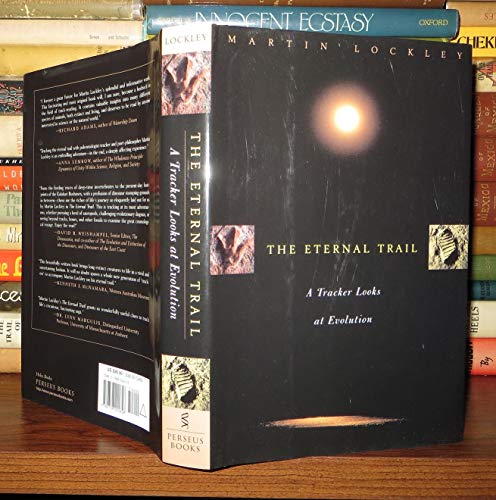
Were Jurassic dinosaurs social creatures? Is the legendary Bigfoot merely a myth? Can you determine the shape of a ram's horns from its footprints? Paleontologist Martin Lockley answers these questions and many more in this highly original chronology of tracking and track-making. From the earliest fossilized prints left by a millipede on a volcanic island to Neil Armstrong's footprint, forever embedded in the lunar dust, Lockley reinterprets the story of evolution, recorded over millions of years in the strata and substrata of our planet and its environs. In the process, he offers a new, holistic approach to tracking—one that highlights the self-organizing principles at work in the natural world—and demonstrates how the science of tracking is giving us new insights into the biology, behavior, and evolutionary history of a diverse array of extinct animals. Filled with fascinating anecdotes and surprising discoveries, The Eternal Trail initiates us into the art and science of tracking, while offering a poetic reflection on the continuity of life.
"synopsis" may belong to another edition of this title.
About the Author
Martin Lockley is Professor of Geology and Paleontology at the University of Colorado. He is also head of the University's Dinosaur Trackers Research Group and Curator of the University's fossil footprint collection. Lockley has led tracking expeditions all over the globe and is a popular speaker and recipient of the Chancellors Lecturer Award. His books include Tracking Dinosaurs: A New Look at an Ancient World and Dinosaur Tracks and Traces.
Reviews
Lockley's eternal trail includes the visible tracks of animals through time. They help mightily to trace the steps in the evolution of life on Earth, and that is Lockley's central story. But he has a vision of the trail as part of a grander scheme, "the evolution of the universe." And so he follows the trail through three distinct phases: "the physiosphere--the world of rocks and atmospheres; the biosphere--the integrated web of plant and animal life; and finally, the 'noosphere'--the name given to the phenomenon of superorganic mind by such luminaries as the great paleontologist-philosopher-priest Pierre Teilhard de Chardin ... and the biologist-philosopher Julian Huxley." Lockley is professor of geology and paleontology at the University of Colorado at Denver. His account of tracks and what they tell about evolution is informative and well illustrated. Opinions may vary about his view of the eternal trail's relation to the evolution of the cosmos, but it makes for stimulating reading.
Lockley (Tracking Dinosaurs, not reviewed) takes an informed, latitudinarian look at fossil footprints, spoor, and other traces left by passing animals, including humans, to see what they can tell us about everything from science to spirituality. Tracks are everywhere and always have been, from the exquisite traceries of subatomic particles to Voyager landing on Mars. Lockley reads tracks as others read lottery tickets: that is, with an eye out for latent, talismanic portents. He nods frequently in the direction of intuition and the inherent mysticism in his work and is tickled when he can make a sensible stab at how a creature behaved from its footprint. Although he covers animals back to the trilobites, he has a particular fascination with the dinosaur freeways, those miles-long paths where the terrible lizards strode side by side, perhaps discussing roadkill or lepidopterology, but a teeming, gregarious fellowship however you look at it. Tracks may be the physical manifestation of a more philosophical walkabout, a way to read the organism ``soul to skin,'' but Lockley is ever aware that they are also dents in the ground that say much about physiological and morphological characteristics, about the polarity of orientation and manifold coupled cycles (like toes getting shorter as limbs get longer), about what the thing looked like. Worked into the narrative are the high priests of tracking (Edward Hitchcock, Pierre Teilhard de Chardin, Dolf Seilacher) and those beautiful moments when orthodoxy is subverted, as well as less beautiful moments, such as the folly of the creation/evolution debate with its ``narrow institutionalized and political perspectives.'' And Lockley subtly delineates little teleological moments, as in the ``coherent reiteration of morphogenetic patterns throughout the evolutionary cycles of entire groups,'' in which ``dozens of morphological pathways swirl and intertwine within and between groups.'' He closes, stunningly, on an evil tracelandmines, a legacy of our shattered communion with the earth. An adroit chronology of the art of tracking and the revelations that trail in its wake. (illustrations) -- Copyright ©1999, Kirkus Associates, LP. All rights reserved.
Dinosaur footprints and other fossilized tracks are "the sheet music of the biosphere," writes University of Colorado geologist Lockley (Tracking Dinosaurs) in this uneven mix of science and mysticism. Lockley's professional expertise lies in interpreting fossilized traces and tracks; the best parts of this volume ably describe the process of drawing inferences from prints, fossil and otherwise. Were the odd tracks in South Korean rocks left by baby brontosaurs? Do Bigfoot's alleged tracks prove him (a) not a hoax and (b) a recently extinct giant ape? Lockley, guardedly, answers "yes" to all three questions. He also provides modest insight into the world's small community of trackersAthose scientists who study footprints. But readers expecting a short, reliable course in fossils and feet might be taken aback by the author's embrace of non-scientific beliefs. For Lockley, biological evolution has a spiritual goal, "hands and feet are the mirrors of the soul," and "we might infer from their foot shape that ancient Celts were more intuitive and mystical, whereas Saxons [were] more practical and down to earth." Lockley's overall thesis amounts to a decidedly non-Darwinian view of life: he believes that a "cyclic pattern of ascending and descending forces... characterize the growth cycle of all individuals, species, and larger groups," a pattern that points human beings toward "cosmic consciousness." Arguing for more research into palm-reading, he asks, "Why should minuscule genes tell us more about ourselves than our entire hands?" (Ask any geneticist.) Some readers will welcome Lockley's sincere (and well-footnoted) attempts to link his special skills to his spiritual hopes; others will deplore his refusal to distinguish between testable and untestable hypotheses, "biosphere and noosphere," paleontology, anthropology and religion. (Sept.)
Copyright 1999 Reed Business Information, Inc.
University of Colorado professor Lockley, an undisputed international expert on paleoichnology (the study of fossil tracks), presents a truly astonishing array of fossil track facts and lore: dinosaur tracks mistaken for human tracks by creationists; tracks attributed to the Virgin Mary's mule; tracks found in the paving stones of a Brazilian village and saved by a clever paleontologist masquerading as a city worker; a Mark Twain satire attributing ground sloth tracks to the Nevada Territorial Legislature; tracks that imply dinosaur herding, migration, and predation; and footprints on the moon. All of this pours forth in an enthusiastic though oddly New Age catalog; Lockley seems unusually credulous for a respected scientist. He expresses belief in palmistry, Bigfoot, and an unconventional conception of evolution. Thus, while Lockley's tracking science is impeccable and his writing engaging, his flights of fancy make this book less suitable than his previous works for students, who may not be able to sort out science from pseudoscience.AAmy Brunvand, Univ. of Utah Lib., Salt Lake City
Copyright 1999 Reed Business Information, Inc.
Paleontologist Lockley studies fossilized footprints (ichnology), the petrified record of which extends back a half billion years. Lockley, informing readers of the great strides his field has made in matching footprints to species, stretches the point further to infer the extinct animal's shape and behavior from its prints. And that line guides his enthusiastic chronology of life since the Cambrian explosion, when sea critters like trilobites began to leave their imprints. Lockley divides geologic time into "acts" and stage manages the entrances of traces left by their characters: foot-wide tracks of gigantic millipedes of the Carboniferous period, patterns left by the reptiles of the Mesozoic era, one a trackway showing herd behavior in dinosaurs, for example, and on through time to the Laetoli trackway of bipedal hominids to boot prints left on the moon. Lockley's work might have benefited from a heavier editorial hand, excising digressions (one, into yin and yang ethereality), yet he presents a wealth of observations about the contributions ichnology makes to paleontology. Gilbert Taylor
"About this title" may belong to another edition of this title.
Search results for The Eternal Trail: A Tracker Looks At Evolution

Stock Image
The Eternal Trail: A Tracker Looks at Evolution
Published by
INGRAM PUBLISHER SERVICES US, 1999
ISBN 10: 0738201650
ISBN 13: 9780738201658
Used
Hardcover
Seller: World of Books (was SecondSale), Montgomery, IL, U.S.A.
Seller rating 5 out of 5 stars

Hardback. Condition: Good. This chronology of tracks and track-making ranges from the earliest fossilized footprints of a millipede on a volcanic island to Neil Armstrong's footprint in the lunar dust. The author demonstrates how tracking can give insights into the evolutionary history of many animals. Seller Inventory # 00100376621
Seller Image
The Eternal Trail: A Tracker Looks At Evolution
Seller: Bay State Book Company, North Smithfield, RI, U.S.A.
Seller rating 5 out of 5 stars
Condition: good. The book is in good condition with all pages and cover intact, including the dust jacket if originally issued. The spine may show light wear. Pages may contain some notes or highlighting, and there might be a "From the library of" label. Boxed set packaging, shrink wrap, or included media like CDs may be missing. Seller Inventory # BSM.1EO7H
Stock Image
Eternal Trail : A Tracker Looks at Evolution
Seller: Better World Books, Mishawaka, IN, U.S.A.
Seller rating 5 out of 5 stars
Condition: Good. illustrated edition. Former library copy. Pages intact with minimal writing/highlighting. The binding may be loose and creased. Dust jackets/supplements are not included. Includes library markings. Stock photo provided. Product includes identifying sticker. Better World Books: Buy Books. Do Good. Seller Inventory # 797953-6
Stock Image
The Eternal Trail: A Tracker Looks At Evolution
Seller: ThriftBooks-Atlanta, AUSTELL, GA, U.S.A.
Seller rating 5 out of 5 stars
Hardcover. Condition: Very Good. No Jacket. May have limited writing in cover pages. Pages are unmarked. ~ ThriftBooks: Read More, Spend Less. Seller Inventory # G0738201650I4N00
Stock Image
The Eternal Trail: A Tracker Looks At Evolution
Seller: HPB-Ruby, Dallas, TX, U.S.A.
Seller rating 5 out of 5 stars
hardcover. Condition: Very Good. Connecting readers with great books since 1972! Used books may not include companion materials, and may have some shelf wear or limited writing. We ship orders daily and Customer Service is our top priority! Seller Inventory # S_461374592
Stock Image
The Eternal Trail: A Tracker Looks at Evolution
Published by
INGRAM PUBLISHER SERVICES US, 1999
ISBN 10: 0738201650
ISBN 13: 9780738201658
Used
Hardcover
Seller: World of Books Inc, Montgomery, IL, U.S.A.
Seller rating 4 out of 5 stars

Hardback. Condition: Good. This chronology of tracks and track-making ranges from the earliest fossilized footprints of a millipede on a volcanic island to Neil Armstrong's footprint in the lunar dust. The author demonstrates how tracking can give insights into the evolutionary history of many animals. Seller Inventory # CIN0738201650G
Stock Image
The Eternal Trail: A Tracker Looks at Evolution
Published by
Perseus Books, Reading, MA, 1999
ISBN 10: 0738201650
ISBN 13: 9780738201658
Used
Hardcover
First Edition
Seller: BookEnds Bookstore & Curiosities, Ojai, CA, U.S.A.
Seller rating 5 out of 5 stars
Hardcover. Condition: Near Fine. Dust Jacket Condition: Very Good. 1st Edition. Hardcover brown boards with black spine and gilt lettering. Includes b/w illustrations, Notes and Index, 334 pages. The DJ is in Very Good condition with the exception of a crease on the front wrapper. Seller Inventory # 009126
Stock Image
The Eternal Trail
Seller: Library House Internet Sales, Grand Rapids, OH, U.S.A.
Seller rating 5 out of 5 stars
Hardcover. Condition: Good. Dust Jacket Condition: Good. Former library book. Mylar protector included. Solid binding. Please note the image in this listing is a stock photo and may not match the covers of the actual item. Ex-Library. Seller Inventory # 123547713
Stock Image
The Eternal Trail: A Tracker Looks At Evolution
Seller: A Squared Books (Don Dewhirst), South Lyon, MI, U.S.A.
Seller rating 5 out of 5 stars
Hardcover. Condition: Very Good. Dust Jacket Condition: Very Good. Paper covered boards with gold spine titles; top edge a little dusty; jacket has light edge wear; 8vo - over 7 3/4" to 9 3/4" tall; interior clean and unmarked; 334 pages. Seller Inventory # SKU1158716
Stock Image
The Eternal Trail A Tracker Looks At Evolution
Published by
Perseus Books 1999, 1999
ISBN 10: 0738201650
ISBN 13: 9780738201658
Used
Hardcover
First Edition
Seller: Tacoma Book Center, Tacoma, WA, U.S.A.
Seller rating 4 out of 5 stars
Hardback. First Printing. Tight Bright Attractive Copy With No Markings To The Book. Very Good to Near Fine Condition in a Very Good to Near Fine condition Dustjacket. ISBN 0-7382-0165-0. Seller Inventory # 83940