
Items related to Human Trials: Scientists, Investors, and Patients in...
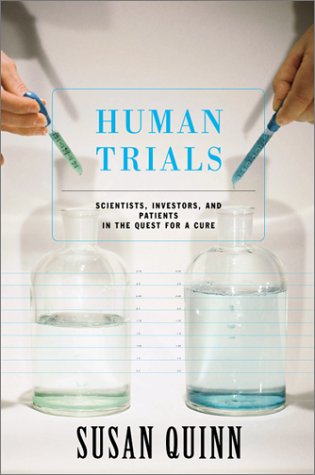
Synopsis
Over fifty million people suffer from some form of autoimmune disease-multiple sclerosis, arthritis, lupus, and other afflictions in which the body attacks itself-none of them with a lasting cure. Susan Quinn has investigated the worlds where new autoimmune drugs are being developed: the research labs, the drug-company boardrooms, and the clinics where patients become "subjects" in the search for new medicines and treatments. Her exciting story is one of real people: fiercely competing scientists, ambitious venture capitalists, and, above all, anxious, sick human beings. She takes the reader inside these otherwise closed worlds, into the lead investigator's diaries, the tense closed-door meetings with investors, and the hopeful or heart-rending encounters in doctor's offices. Hers is the archetypal story of all medical research: the roller-coaster trip from the lab bench to the medicine cabinet, in which only a very few new drugs and treatments survive. Susan Quinn, author of the acclaimed biography Marie Curie, catches the hopes, triumphs, and crushing failures, the greed and the idealism in these dramatic human trials.
"synopsis" may belong to another edition of this title.
About the Author
Susan Quinn is the author of two highly praised biographies, A Mind of Her Own: The Life of Karen Horney and Marie Curie. She lives in Brookline, Massachusetts.
Reviews
This book is not a mystery story, so I can tell you the ending: 56 percent of patients with multiple sclerosis had a response to placebo in a double-blind, randomized trial, and 56 percent had a response to oral myelin (Myloral). Did the treatment fail, or was it killed by an unusual ``placebo effect''? Susan Quinn unfolds the stories of scientists, investors, and patients, all of whom were seeking success. If you are unfamiliar with the literature on multiple sclerosis, the book does read like a mystery that is not solved until the last chapter. The story follows what is in some ways a typical process of drug development, but is based on the diary of Howard Weiner, the Harvard Medical School professor whose idea it was to move his theory of oral tolerance out of the laboratory and into clinical use. Most researchers want to publish their results quickly in order to share their ideas with colleagues, but business requirements often constrain the release of information to the public. Dr. Weiner took the entrepreneurial route by patenting his concepts for a private company while also retaining his research laboratory within academia. Everything associated with the company (AutoImmune) was fast-tracked, from fundraising to clinical trials to expanding the company's staff.
The events demonstrate the usefulness of a principle that I learned 30 years ago: the champion should not be the decision maker. New ventures should be turned over to a dispassionate board that is able to weigh all potential risks and rewards the way an institutional review board independently assesses the risks and benefits of study protocols. The blurring of distinctions between academic, grant-supported research and industry-supported research has altered the drug-development process. If you are sitting on a brilliant scientific breakthrough that may be clinically useful, this book will sober your gleam. If you are an investor who would consider backing a biotechnology venture, this book will reinforce the importance of the risks. If you are a patient hoping that experimental treatments will bloom into miraculous cures, this book will dampen your expectations.
The book includes reasonable overviews of the placebo effect, issues in protocol design, and the selection of the optimal dose for testing the efficacy of a drug. Readers who are familiar with clinical trials will enjoy the candid comments that are made in the book about what is always an arduous process. Brief biographies of several investigators demonstrate Quinn's knowledge about clinical practice and patient care in the fields of multiple sclerosis and rheumatoid arthritis in particular. She distills comments from investigators about the various problems they face. For instance, they dislike using an agency for centralized recruitment of patients because the staff that performs telephone screening uses a simplistic questionnaire and lacks clinical knowledge. In one vignette, a Harvard investigator complains about errors in research accounts, providing an example of the lack of institutional support that results in a loss of time for patient care. One physician describes the pressure on doctors to perform as profit centers for the medical practice group. Quinn argues clearly that nonacademic clinicians can be excellent clinical trial investigators, noting that independent centers can recruit many more patients than the big-name academic centers where investigators are conducting multiple competing trials. But regardless of their affiliation, ``aging scientists, like athletes,'' Quinn notes, ``perform until they are no longer able to compete.'' Fortunately, brain power lasts longer than biceps power.
In the case of the Myloral study, everyone involved in the testing watched other treatments for multiple sclerosis pass through the regulatory approval process while they struggled. Thanks to Dr. Weiner's diary and interviews with many of the other protagonists, we have insight into each major decision made by the company. Readers can weigh the pros and cons of each action, deciding for themselves whether those involved moved too quickly, put business before science, or were justified at every step. Readers are taken through the planning and results of three large clinical trials in multiple sclerosis and rheumatoid arthritis, but no explanation is given for the high rate of response to placebo that affected the first multiple sclerosis trial. Unusual events occur in clinical trials, which is why two positive trials are usually required for regulatory approval. The problems that arose in the process of testing the clinical efficacy of oral tolerance were typical of those that occur at every major pharmaceutical company. The key to long-term success in industry is to know when to cut a drug-development program. In this case, the bleeding was profuse before the arm was amputated. Perhaps this was because it was Dr. Weiner's arm.
Joyce A. Cramer
Copyright © 2002 Massachusetts Medical Society. All rights reserved. The New England Journal of Medicine is a registered trademark of the MMS.
This book is to experimental drug trials what Randy Shilts's And the Band Played On was to the AIDS epidemic. In resonant journalistic prose, Quinn (A Mind of Her Own: The Life of Karen Horney; Marie Curie: A Life) manages to capture the day-by-day human drama of high-stakes drug testing on patients with multiple sclerosis and rheumatoid arthritis, everyday people who gamble with their lives to find a cure. Her case study of winner-take-all medicine is AutoImmune, a pharmaceutical company risking millions on one doctor's big idea, with a slim chance of exponential returns should a new drug be brought successfully to market. Quinn argues that failure is progress, in this field at least, where even crushing defeat can broaden understanding. This gives some idea of the extreme emotional highs and lows in this book. Quinn, whose work has appeared in the New York Times Magazine and Atlantic Monthly, knows how to tell this story: from the lab and the conference room; over coffee in the kitchen of an MS patient's modest split-level; in the clinic waiting room on any given weekday. AutoImmune's big idea, called oral tolerance, is similar to the ancient idea that feeding a small bit of a poison can build tolerance to that poison. In this case, the idea is to build up immunity by administering small doses of myelin and collagen, the proteins attacked in MS and rheumatoid arthritis, respectively There are plenty of make-or-break moments in this book, made all the more poignant by Quinn's considerable talents as a biographer, which lend depth of character to the doctors and patients who grace these pages. (June 1)Forecast: To draw national attention to Quinn's new book, Bloomberg News will be running a major article, including an interview with the author. Perseus has also scheduled author appearances at three key independent bookstores in the Boston area over the course of the summer. Good reviews and off-the-book-page coverage could generate respectable sales.
Copyright 2001 Cahners Business Information, Inc.
How are new drugs conceived and tested? Quinn (Marie Curie: A Life) attempts to answer that question as she follows the quest of Harvard neurologist Howard Weiner. Using observations from Weiner's personal journals along with interviews and videotapes of key events, Quinn portrays the personal hopes and frustrations that are part of the drug trial process. Weiner's team strives to produce safe, easy-to-ingest drugs for individuals with autoimmune diseases such as multiple sclerosis and rheumatoid arthritis. Quinn's absorbing book follows the formulation of the drugs from the basic biological theory to fund-raising efforts and, finally, the formulation and execution of the trials. The human aspects of the process are very evident as the reader is introduced to the researchers, investors, doctors, and, most importantly, patients involved in the trial. Lacking both an index and a bibliography, this volume is aimed at general readers. Recommended for public libraries. Tina Neville, Univ. of South Florida Lib., St. Petersburg
Copyright 2001 Reed Business Information, Inc.
Quinn tells the sober, cogently argued story of two failed searches, one for cures for multiple sclerosis (MS), the other for cures for rheumatoid arthritis (RA). Clinician, researcher, and Harvard Medical School professor Howard Weiner has been trying to develop oral tolerance, a simple, reasonably pleasant method of treatment to replace injections. A convinced optimist, he worked first with Myloral for MS, then with Colloral for RA. Trials of both ended indecisively. Complicating Weiner's work was the pressure of shareholders in his biotech company, AutoImmune, which at least once pushed him to take a wrong step in one of his projects. Quinn is especially good at describing relationships among investigators, patients, businesspeople, and financiers; she points out, among other things, the dangers of a physician getting too close to a drug company. Despite the failures it reports, this important study's attitude is that stated by Weiner: "The only failed experiment is the one you don't learn from." William Beatty
Copyright © American Library Association. All rights reserved
"About this title" may belong to another edition of this title.
Search results for Human Trials: Scientists, Investors, and Patients in...

Stock Image
Human Trials: Scientists, Investors, and Patients in the Quest for a Cure
Seller: World of Books (was SecondSale), Montgomery, IL, U.S.A.
Seller rating 5 out of 5 stars

Condition: Good. Item in good condition. Textbooks may not include supplemental items i.e. CDs, access codes etc. Seller Inventory # 00108574847
Stock Image
Human Trials: Scientists, Investors, and Patients in the Quest for a Cure
Seller: HPB-Ruby, Dallas, TX, U.S.A.
Seller rating 5 out of 5 stars
hardcover. Condition: Very Good. Connecting readers with great books since 1972! Used books may not include companion materials, and may have some shelf wear or limited writing. We ship orders daily and Customer Service is our top priority! Seller Inventory # S_477737041
Stock Image
Human Trials: Scientists, Investors, and Patients in the Quest for a Cure
Seller: ThriftBooks-Atlanta, AUSTELL, GA, U.S.A.
Seller rating 5 out of 5 stars
Hardcover. Condition: Very Good. No Jacket. May have limited writing in cover pages. Pages are unmarked. ~ ThriftBooks: Read More, Spend Less. Seller Inventory # G0738201820I4N00
Stock Image
Human Trials : Scientists, Investors, and Patients in the Quest for a Cure
Published by
Hachette Books, 2001
ISBN 10: 0738201820
ISBN 13: 9780738201825
Used
Hardcover
First Edition
Seller: Better World Books, Mishawaka, IN, U.S.A.
Seller rating 5 out of 5 stars
Condition: Good. First Edition. Former library copy. Pages intact with minimal writing/highlighting. The binding may be loose and creased. Dust jackets/supplements are not included. Includes library markings. Stock photo provided. Product includes identifying sticker. Better World Books: Buy Books. Do Good. Seller Inventory # 10904667-75
Stock Image
Human Trials : Scientists, Investors, and Patients in the Quest for a Cure
Published by
Hachette Books, 2001
ISBN 10: 0738201820
ISBN 13: 9780738201825
Used
Hardcover
First Edition
Seller: Better World Books: West, Reno, NV, U.S.A.
Seller rating 5 out of 5 stars
Condition: Good. First Edition. Former library copy. Pages intact with minimal writing/highlighting. The binding may be loose and creased. Dust jackets/supplements are not included. Includes library markings. Stock photo provided. Product includes identifying sticker. Better World Books: Buy Books. Do Good. Seller Inventory # 10904667-75
Stock Image
Human Trials. Scientists, Investors, and Patients in the Quest for a Cure
Published by
Perseus, Cambridge, Mass., 2001
ISBN 10: 0738201820
ISBN 13: 9780738201825
Used
Hardcover
Seller: Research Ink, Takoma Park, MD, U.S.A.
Seller rating 5 out of 5 stars
Hardback. Condition: Very Good. xi + 295 pp. dj. Rubber-stamped on front free endpaper. book. Seller Inventory # 32815
Stock Image
Human Trials : Scientists, Investors, & Patients in the Quest for a Cure
Published by
Perseus Books Group, New York, NY, 2001
ISBN 10: 0738201820
ISBN 13: 9780738201825
Used
Hardcover
First Edition
Seller: Daedalus Books, Portland, OR, U.S.A.
Seller rating 4 out of 5 stars

Hardcover. Condition: Fine. Dust Jacket Condition: Near Fine. First Edition. In print for 26.00.; 8vo - over 7¾" - 9¾" tall. Seller Inventory # 914396c
Stock Image
Human Trials: Scientists, Investors, and Patients in the Quest for a Cure
Published by
Perseus Publishing, Cambridge, MA, 2001
ISBN 10: 0738201820
ISBN 13: 9780738201825
Used
Hardcover
First Edition
Seller: Persephone's Books, Gastonia, NC, U.S.A.
Seller rating 5 out of 5 stars
Hardcover. Condition: Fine. Dust Jacket Condition: Fine. First Edition. xi, 295 pp. First printing. Seller Inventory # 020882
Stock Image
Human Trials : Scientists, Investors, and Patients in the Quest for a Cure
Published by
Perseus Publishing, Cambridge, MA, 2001
ISBN 10: 0738201820
ISBN 13: 9780738201825
Used
Hardcover
Seller: Willis Monie-Books, ABAA, Cooperstown, NY, U.S.A.
Seller rating 5 out of 5 stars
Hardcover. Condition: Very Good. Dust Jacket Condition: Very Good. First Printing. Seller Inventory # 57606
Stock Image
Human Trials: Scientists, Investors, and Patients in the Quest for a Cure
Seller: Anybook.com, Lincoln, United Kingdom
Seller rating 5 out of 5 stars
Condition: Good. This is an ex-library book and may have the usual library/used-book markings inside.This book has hardback covers. In good all round condition. Dust jacket in good condition. Please note the Image in this listing is a stock photo and may not match the covers of the actual item,600grams, ISBN:9780738201825. Seller Inventory # 9967688
Buy Used
US$ 10.25
US$ 17.38 shipping
Ships from United Kingdom to U.S.A.
Ships from United Kingdom to U.S.A.
Quantity: 1 available