
Items related to Code of the West: A Novel
Synopsis
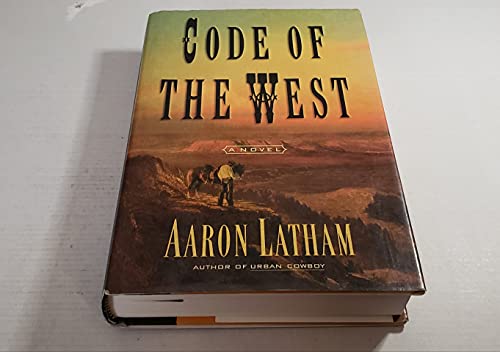
The author of Urban Cowboy and Perfect returns with an Arthurian love story set in the American Western frontier that follows the adventures of Jimmy Goodnight and his best friend, Jack Loving, who both fall in love with the same woman. 30,000 first printing.
"synopsis" may belong to another edition of this title.
About the Author
Aaron Latham is best known for his novels and screenplays, including Urban Cowboy and Perfect. He has been a regular contributor to such publications as Rolling Stone, Esquire, Talk, and The New York Times. He lives in New York with his wife, Lesley Stahl.
Reviews
In a captivating barnburner of romance, adventure and gruesome frontier justice, Latham takes the mythical legend of King Arthur and Camelot and dresses it in buckskin, sweat and cow manure to create a sweeping saga of three decades of Texas cowboy history. From the 1860s to the 1880s, Jimmy Goodnight runs the Home Ranch, a cattle empire hidden in a canyon paradise. One-eyed Jimmy is gifted; he's a natural leader of men and he's able to talk with animals. Ever since he pulled an ax out of an anvil at a county fair, the ax has been his weapon of choice, and Jimmy is mighty handy with it as he smashes thumbs and skulls to bring law and order to his empire. When Jimmy and his knightly cowboys rescue a young woman from a gang of outlaws, he is smitten by her beauty and charm. Revelie Sanborn marries the ax-wielding cattle baron, and they begin a short-lived life of bliss. Jimmy's best friend, Jack Loving (read Lancelot), takes advantage of incipient marital discord, and his betrayal begins a spiral of lust and murder that no one can stop. Throw in a bloodthirsty gang of foul-smelling outlaws; a violent cowboy rebellion; a bitter, long-lost son; and dark secrets from Jimmy's past; and this yarn picks up speed and intensity like a runaway herd of cattle. In melding ancient legends with our cowboy mythos (and a few real-life historical details), the narrative is far more sophisticated than a typical good vs. evil western; indeed, almost everyone has a mean streak, a powerful passion and a finger on the trigger. Latham, a versatile writer whose novels and screenplays (Urban Cowboy; Perfect) have earned him critical acclaim and an Oscar, carries off this rollicking tale with class and style. Agent, Sterling Lord.
Copyright 2001 Reed Business Information, Inc.
Few laws existed in late 1860s Texas, where settlers and natives fought brutal wars and outlaws took advantage of the weak. It is here that Latham, author of Urban Cowboy, brings to life the legend of King Arthur through his main character, Jimmy Goodnight. Taken by the Comanche Indians as a boy and recaptured by the whites, Goodnight returns to his Camelot: the beautiful red canyon of his shaman Comanche father. His adopted people are long gone, but with the help of his cowboys, Goodnight begins to build his dream. His Guinevere is a banker's daughter named Revelie, and he finds his Lancelot in a drifter cowboy named Loving. Finding his strength in love, Goodnight must face all of the trials of the legendary Arthur. Latham's fable is full of rich symbolism, and his writing (especially the use of short chapters) puts the reader at ease. Readers won't soon forget this new twist on an old story. Highly recommended. Loree Davis, Broward Cty. Libs., Pembroke Pines, FL
Copyright 2001 Reed Business Information, Inc.
It is not every writer who would attempt to meld the Celtic mythos of King Arthur with the American cowboy-and-Indian myth, but Latham (author of Urban Cowboy) not only dares to but he does so with glee. Characters are named with mocking reference to personality traits (Jack Loving is Lancelot and Jimmy Goodnight is Arthur). An ax is pulled from an anvil, and a motley band quests after cattle amid perfect canyon land. To meet a legend on equal footing is an ambitious goal for a novel, and at times this one succeeds and at other times it seems to be trying to fit into a borrowed coat. Nevertheless, Latham is both a lyrical and an economical writer, and his ability to bring Jimmy Goodnight fully to life even in the stolen chain mail of a much larger figure transforms this compulsively readable novel from a farce into a good western, full of wonderful moments, graphic violence, cliches, surprises, romance, and majesty. Neal Wyatt
Copyright © American Library Association. All rights reserved
Excerpt. © Reprinted by permission. All rights reserved.
Chapter 1
Late 1860s
Jimmy was seventeen years old and nervous before the dance. He was tall, skinny, and awkward. Looking out at the world through a single knothole, he saw an ugly sight in the mirror: his eye patch. He asked himself: If I was some girl, would I wanna dance with a patch like that there? His scowling reflection shook its head. But then he saw himself smile as he remembered how hard his cousin Rhoda had worked giving him dancing lessons. She had only come up to his waist. He had felt like a big old clumsy buffalo dancing with a graceful deer. After all that effort trying to learn to polka, he wondered if he would actually work up the nerve to ask a girl to polka with him. Maybe he should just ask Rhoda. But it might embarrass her, and who wants to be embarrassed? Besides, she might turn him down. He told his mind: Just shut up!
When everybody was ready, all dressed up in their Sunday-go-to-meeting clothes even though it wasn't Sunday, the whole family climbed aboard a wagon dragged along by two plodding plow horses. Aunt Orlena was dressed in a long grey dress and grey bonnet. Uncle Isaac wore his baggy black suit, which was beginning to turn brown, and a black string tie. Cousin Jeff had on a black suit, too, newer than his father's, but even baggier, bought with the expectation that he would grow into it someday. Little Rhoda and littler Naomi looked pretty in blue flour-sack dresses and pigtails. Jimmy, who didn't have a suit, was ashamed of his butternut homespun pants and shirt, but he was proud of his new bandanna, which was fire red.
Jimmy wished the team would pull faster and stir up a little breeze. It was hot on this July night in the middle of Texas. Everybody said this summer was shaping up to be the hottest and driest in memory. Even at this slow pace, the horses were lathered. They had worked hard all day in the field and must be tired. Now that he thought about it, Jimmy figured they had earned the right to plod slowly.
The wagon followed the road that led to the dreaded Weatherford schoolhouse, but Jimmy didn't mind because school was out for the summer. The closer they got, the more crowded the road grew, the more the little girls giggled, and the more nervous Jimmy became. When the wagon reached the school, the playground, which tonight would double as the dance floor, was already busy and noisy. Children were shouting and laughing, and the fiddles were tuning up. The sun was just setting, making even butternut look almost golden.
When Jimmy was getting out of the wagon, he tripped on something and almost fell on his face. He hated his own clumsiness. He hated the heavy clodhopper farmer's boots that weighed him down and made his feet feel like heavy hooves. How was he going to be able to dance? He longed for the lightness of his moccasins with the long fringe trailing out behind like a kite's tail. He could dance in those. But they were long --
No, Jimmy told himself, don't think about the past. It was too painful. Recalling his lost moccasins would just lead to remembering other losses, unbearable losses. Just think about here and now. But here and now was troubling, too. He couldn't dance. Not really. Not these dances.
Rhoda and Naomi ran off to be with other little girls. Cousin Jeff slouched off to look for his friends. Aunt Orlena and Uncle Isaac moved off to join the other adults who were busy talking about rainfall and crops. Jimmy kept the plow horses company. He didn't really fit with any group. He wasn't quite a member of the family, wasn't quite white in the eyes of many, wasn't quite right either, was too big for grade school and too dumb for high school. So he talked to the plow horses.
"O Great Goddogs, thank you for pulling the wagon," Jimmy said softly in the Comanche tongue. "I'm sorry you have to stand here. I know it must be boring, but at least there are two of you. You can keep each other company. There's just one of me."
Then Jimmy realized that several of the kids had noticed him talking to the horses. They were looking at him funny. Now they really thought he was crazy. He nervously started to put his hands in his pockets, but discovered that they were already there.
As the air darkened and cooled, Jimmy noticed individuals melting together into dark clumps. He saw girl clumps and boy clumps, big-kid clumps and little-kid clumps, farmer clumps and farmers' wives clumps. Then a clump of musicians started playing a tune, and the other clumps started breaking apart and reforming.
Drawn by the music, Jimmy moved closer to the musicians: two fiddlers were seated in leaned-back wooden chairs with cowboy hats perched on the backs of their heads. They looked to be in their twenties. A young woman about the same age played an upright piano. Jimmy wondered how she had gotten it from her living room to the playground. An old man probably in his seventies was playing a harmonica.
Jimmy rocked back and forth to the music, trying to work up the courage to ask somebody to dance. By the light of a full moon -- assisted by several lanterns hung from trees -- he studied the couples on the dirt dance floor. There were teenage couples and middle-age couples and old-age couples. And there were some mixed-age couples -- fathers dancing with daughters, grandmas dancing with grandsons. He tried to comprehend the dance steps, but he just got more and more confused. The swaying couples weren't dancing a polka -- he could tell that much -- but he didn't know what they were dancing. They seemed to move their feet very fast, the same way they had seemed to talk back before he learned to understand them. The dancers were beginning to kick up a good bit of dust, which the orange moon turned into gold dust. It gilded the swaying bodies and made them look like dancing statues. Jimmy thought the dancers looked so pretty that he longed to join them, but longing was as far as he got. Frightened by the strange dance steps, he soon returned to the horses.
Still, Jimmy's gaze kept reverting again and again to a brown-haired girl in a yellow calico dress which had some sort of design on it. He couldn't quite make out the pattern in the darkness. He had seen her at school, had seen her at services at the Hard-Shell Baptist Church, had nodded to her and even said hello to her a couple of times. Like most of the girls, she was a farmer's daughter, but he thought she was prettier than the others. He remembered that her name was Rachel.
"Should I ask her to dance?" he asked the horses in the "Human" tongue. "I mean if they ever play a polka." There wasn't a word for "polka" in the Human tongue so he said it in English. "What do you think?"
One of the horses flicked its tail and shifted its weight from one hind leg to the other.
"What's that supposed to mean?" he asked.
Jimmy told himself that he was not a "running-heart." He reminded himself that he had been on the warpath and so should not be afraid of something as harmless as a young girl at a dance.
The band moved from one tune to another. Listening closely, Jimmy thought he heard a polka. Watching closely, he thought he recognized polka steps being performed on the packed earth. He saw his cousin Jeff dancing what appeared to be a polka with a horse-faced girl. He hated the idea of Jeff being braver than he was, so he started walking.
As he made his way across the playground, Jimmy tripped again. He blamed his big boots. He blamed his unhappiness. Whatever was to blame, he was not graceful on his feet. He would have to be crazy to ask a pretty girl to dance. But then everybody already thought he was crazy, so what did he have to lose? He just hoped he wouldn't trip on the dance floor and fall on top of her. He reminded himself that he wasn't just awkward but also ugly. His hand went up and touched the patch over his ruined eye.
And then t
"About this title" may belong to another edition of this title.
Search results for Code of the West: A Novel

Seller Image
Code of the West: A Novel
Seller: Greenworld Books, Arlington, TX, U.S.A.
Seller rating 5 out of 5 stars

Condition: good. Fast Free Shipping â" Good condition. It may show normal signs of use, such as light writing, highlighting, or library markings, but all pages are intact and the book is fully readable. A solid, complete copy that's ready to enjoy. Seller Inventory # GWV.0743201175.G
Stock Image
Code of the West: A Novel
Seller: Once Upon A Time Books, Siloam Springs, AR, U.S.A.
Seller rating 4 out of 5 stars

hardcover. Condition: Acceptable. This is a used book. It may contain highlighting/underlining and/or the book may show heavier signs of wear . It may also be ex-library or without dustjacket. This is a used book. It may contain highlighting/underlining and/or the book may show heavier signs of wear . It may also be ex-library or without dustjacket. Seller Inventory # mon0000880114
Stock Image
Code of the West: A Novel
Seller: Wonder Book, Frederick, MD, U.S.A.
Seller rating 5 out of 5 stars
Condition: Good. Good condition. Good dust jacket. With remainder mark. A copy that has been read but remains intact. May contain markings such as bookplates, stamps, limited notes and highlighting, or a few light stains. Seller Inventory # I06D-01302
Stock Image
Code of the West
Published by
Simon & Schuster, Incorporated, 2001
ISBN 10: 0743201175
ISBN 13: 9780743201179
Used
Hardcover
First Edition
Seller: Better World Books, Mishawaka, IN, U.S.A.
Seller rating 5 out of 5 stars
Condition: Good. First Edition. Pages intact with minimal writing/highlighting. The binding may be loose and creased. Dust jackets/supplements are not included. Stock photo provided. Product includes identifying sticker. Better World Books: Buy Books. Do Good. Seller Inventory # 8401483-6
Stock Image
Code of the West
Published by
Simon & Schuster, Incorporated, 2001
ISBN 10: 0743201175
ISBN 13: 9780743201179
Used
Hardcover
First Edition
Seller: Better World Books, Mishawaka, IN, U.S.A.
Seller rating 5 out of 5 stars
Condition: Good. First Edition. Former library copy. Pages intact with minimal writing/highlighting. The binding may be loose and creased. Dust jackets/supplements are not included. Includes library markings. Stock photo provided. Product includes identifying sticker. Better World Books: Buy Books. Do Good. Seller Inventory # 18640375-75
Stock Image
Code of the West
Published by
Simon & Schuster, Incorporated, 2001
ISBN 10: 0743201175
ISBN 13: 9780743201179
Used
Hardcover
First Edition
Seller: Better World Books: West, Reno, NV, U.S.A.
Seller rating 5 out of 5 stars
Condition: Good. First Edition. Pages intact with minimal writing/highlighting. The binding may be loose and creased. Dust jackets/supplements are not included. Stock photo provided. Product includes identifying sticker. Better World Books: Buy Books. Do Good. Seller Inventory # 8401483-6
Stock Image
Code of the West: A Novel
Seller: HPB-Diamond, Dallas, TX, U.S.A.
Seller rating 5 out of 5 stars
hardcover. Condition: Very Good. Connecting readers with great books since 1972! Used books may not include companion materials, and may have some shelf wear or limited writing. We ship orders daily and Customer Service is our top priority! Seller Inventory # S_466476703
Stock Image
Code of the West: A Novel
Seller: HPB-Ruby, Dallas, TX, U.S.A.
Seller rating 5 out of 5 stars
hardcover. Condition: Very Good. Connecting readers with great books since 1972! Used books may not include companion materials, and may have some shelf wear or limited writing. We ship orders daily and Customer Service is our top priority! Seller Inventory # S_474006339
Stock Image
Code of the West: A Novel
Seller: HPB-Emerald, Dallas, TX, U.S.A.
Seller rating 5 out of 5 stars
hardcover. Condition: Very Good. Connecting readers with great books since 1972! Used books may not include companion materials, and may have some shelf wear or limited writing. We ship orders daily and Customer Service is our top priority! Seller Inventory # S_474574381
Stock Image
Code of the West: A Novel
Seller: ThriftBooks-Dallas, Dallas, TX, U.S.A.
Seller rating 5 out of 5 stars
Hardcover. Condition: As New. No Jacket. Pages are clean and are not marred by notes or folds of any kind. ~ ThriftBooks: Read More, Spend Less. Seller Inventory # G0743201175I2N00