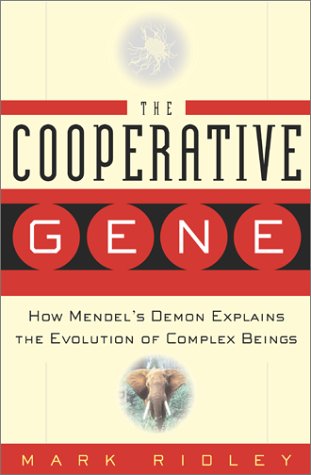
The Cooperative Gene: How Mendel's Demon Explains the Evolution of Complex Beings - Hardcover

Ridley, Mark

  • 3.96 out of 5 stars
    97 ratings by Goodreads
 
9780743201612: The Cooperative Gene: How Mendel's Demon Explains the Evolution of Complex Beings

Synopsis

For those who find the conventional gene-eat-gene account of evolution suspiciously similar to the ideology of capitalism, Ridley (zoology, U. of Oxford) points out that complex organisms could not have arisen unless many genes in the case of humans, about 30,000 learned how to work together. His main themes are mutational errors in the copying of DNA and how Mendelian inheritance is designed to prevent selfish genes from taking over. Annotation c. Book News, Inc., Portland, OR (booknews.com)

"synopsis" may belong to another edition of this title.

About the Author

Mark Ridley pursues his research in the Department of Zoology at the University of Oxford. Formerly an assistant professor at Emory University in Atlanta, Ridley has also served as a research fellow at St. Catherine's College, Cambridge, and at Linacre, Oriel, and New Colleges in Oxford, all in England. His previous publications include The Problems of Evolution, Animal Behavior, and the highly acclaimed student textbook Evolution. Ridley frequently contributes to The New York Times, The Sunday Times, Nature, New Scientist, and The Times Literary Supplement. He lives in Oxford, England.

Reviews

The field of genetics rarely makes for easy reading, but Ridley's anecdotal approach lightens the load, At times his writing conveys a sense of awe at the vast complexity of the universe, elevating his topic to appropriately sublime heights. His interest lies in the role that error has played in our four-trillion-year journey toward ever more complex forms, from single-celled eukaryotes to humans, and possibly beyond. Two kinds of genetic mistakes occur in reproduction, the author tells us, one accidental, the other intentional. The former results in copying errors similar to the way a simple message in a game of "telephone" can be drastically altered as it relays from player to player. The latter results from genes that harm the body by uncooperative and selfish acts. As Ridley, a biologist at Oxford University and a regular contributor to Scientific American, Nature and the New York Times, shows, both kinds of error threaten the existence of complex life, and sex provides the solution, by concentrating errors in particular offspring and leaving others virtually error-free. Perhaps not unexpectedly, though, sex poses problems of its own, because natural selection, if unchecked, would seem to favor the selfish gene, making the evolution of complex life impossible. The evolutionary balancing act is achieved through a manner of genetic inheritance first described by Gregor Mendel. The so-called Mendel's demon, a mechanism of inheritance with a random component, directs the laws of biology toward creativity rather than destruction. As the author puts it, "Somewhere between the bacteria and us perhaps at about the stage of simple worms God did have to start to play dice."

Copyright 2001 Cahners Business Information, Inc.


Ridley asks how living things vastly more complex than the simple life-forms that first populated Earth can arise. His answer is that they require mechanisms to deal with mistakes in the copying of DNA and a means of taming "selfish genes that harm the body by uncooperative and subversive acts." The main solution to the copying problem is sexual reproduction; the means of taming selfish genes is Mendelian inheritance, which ensures "the probabilistic rather than certain inheritance of genes." Ridley (a biologist in the zoology department of the University of Oxford) invokes a hypothetical "Mendel's demon" as the enforcer of chance inheritance; the demon "stands over each gene in a parent and decides whether it will be inherited in the next generation, and which other genes it will be passed on with." And, having laid out his argument, he intriguingly explores the possibility that "superhuman life forms" may someday arise.

Editors of Scientific American


Following its origin, single-celled life settled in for 3 billion years, until the Cambrian explosion of multicelled organisms some 570 million years ago. The mystery of just what touched off that explosion has fueled a burning scientific curiosity that has productively afflicted biologist Ridley, who here offers a genetic explanation for the rise of complexity. His main idea is that complexity contends with two big enemies: mistakes in copying DNA and "uncooperative" genes that harm the organism. Combining evolutionary reasoning and discoveries of molecular biology, Ridley describes how the enzymes of the cell proofread its replicated DNA. Those enzymes could support cells with a nucleus and other organelles, which primitive cells lack, but anything more complicated required something completely different, namely, sex. No one has convincingly accounted for how sex arose, but Ridley effectively describes how, by concentrating errors in one offspring that natural selection then eliminates, sexual reproduction genetically opened the door to complexity. Reasonably accessible, thanks to touches of levity, the book will nevertheless challenge many a recreational reader. Gilbert Taylor
Copyright © American Library Association. All rights reserved

Excerpt. © Reprinted by permission. All rights reserved.

Chapter One: Keeping Living Things Simple

The magnifying Dutchman

Life as we know it (or as most of us know it) is large and complex. Human beings are large and complex, and the familiar kinds of life around us -- on the farm, in the garden, around the house -- are similar in size and complexity to ourselves. Some familiar life forms may appear to be simple, but even they turn out on investigation to be complex. A butterfly, for example, may look relatively simple, but its internal anatomy is about as complicated as ours. The butterfly's behaviour is simpler than ours, but the way it grows up makes us look positively unimaginative. A butterfly is a metamorphosed caterpillar, and a caterpillar looks more like a worm than a fluttering, winged imago. A human adult in comparison is little more than an inflated human child. A butterfly has a good claim to be a complex form of life, like all the other life forms we can see around us.

The familiarity of complex life makes it tempting to take the complexity of life for granted. People have been asking why life exists for as long as they have asked questions at all. But it is only recently that people have started to ask why, given that life does exist, it should have evolved to be complex. I shall be looking in this chapter at four reasons why we should not take the complexity of life for granted. Indeed, taken together they almost suggest that it is the complexity of life, rather than the mere existence of life, that is the problem. The first reason is that the familiar creatures around us are a biased sample of all life. Most of the life forms that we share this planet with are tiny, and far simpler than even the simplest creatures we can see with the naked eye. We ultimately owe this discovery -- one of the greatest in all human knowledge -- to the invention of the microscope.

The light microscope in the late seventeenth century was an even less user-friendly instrument than it is now. It took someone with a unique set of optical and lens-grinding skills to realize its potential: the Dutchman Antoni van Leeuwenhoek (pronounced 'Laywenhook'). The great moment came in 1674, when van Leeuwenhoek visited an inland water, Berkelse Mere, two hours from Delft where he lived. In his words: I took up a little of it in a glass phial; and examining this water next day, I found floating therein divers earthy particles...Among these there were, besides, very many little animalcules, whereof some were roundish, while others, a bit bigger, consisted of an oval. On these last I saw two little legs near the head, and two little fins at the hindmost end of the body. Others were somewhat longer than an oval, and these were very slow a-moving, and few in number. These animalcules had divers colours, some being whitish and transparent; others with green and very glittering little scales; others again were green in the middle, and before and behind white; others yet were ashen grey. And the motion of most of these animalcules in the water was so swift, and so various, upwards, downwards, and round about, that 'twas wonderful to see.
The animalcules were probably what naturalists would now recognize as rotifers, ciliates, and Euglena. In the next quarter of a century van Leeuwenhoek opened up a new world, in which not only liquid water teemed with little animalcules, but liquid semen with wriggling sperm animalcules, and liquid blood with blood cells. Enlightened observers were delighted. Pope and Swift greeted the new world view in verse, Addison in prose. Certain theological adjustments did, it is true, become necessary; but good religious morals could be drawn. We could be more certain (Addison reasoned) of an ascending hierarchy (angels, gods, and so on) above our sensory capabilities, now that van Leeuwenhoek had revealed the previously unsensed ranks below us. James Thomson was more squeamish. He was grateful to 'the kind art of forming heaven', which had tuned the human sensory system outside the range of these disgusting microbes: ...for if the worlds
In worlds inclosed should on his senses burst,
From cates ambrosial, and the nectar'd bowl,
He would abhorrent turn... You begin to see why W. C. Fields abstained from water.

Louis Pasteur's germ theory multiplied the worlds in worlds enclosed still further in the nineteenth century. The main germs that Pasteur discovered were bacteria. A bacterium is a single cell, and the cell is usually small: much smaller than the little animalcules described by van Leeuwenhoek. Pasteur often had to work indirectly rather than by direct microscopic observation, but his results were still convincing. Only a few eccentrics refused to be (in Bruno Latour's phrase) Pasteurized. Félix-Archimède Pouchet, professor of physiology at Toulouse, explained in 1865 that Pasteur's 'theory of germs is a ridiculous fiction. How do you think that these germs in the air can be numerous enough to develop into all these organic infusions? If that were true, they would be numerous enough to form a thick fog, as dense as iron.' But what would he have made of the next century of microbial research? The microbe hunters who followed Pasteur bagged one bacterium after another. Then came the viruses which are much smaller still. A bacterium is a single cell, and usually so small that you can see it in a light microscope only if you know what you are looking for. But viruses consist of only a few molecules, and are far smaller. They are invisible using a light microscope. They were first suspected in 1883 and definitively isolated in 1935. By that time the electron microscope had been invented (in 1932) and even viruses could be directly observed.

New kinds of microbes continue to be discovered -- we shall meet the Archaea, for instance, later in this chapter -- but the most striking findings in recent years have been the sheer numbers of microbes, and the astonishing range of environments that they occupy. Viruses and bacteria not only float like an unseen fog in the air, but the soil and seawater are thick with them too. A litre of water, taken from near the sea surface, contains about ten thousand million viral particles and one thousand million bacterial cells. There are immense microbial communities deep in the Earth's crust, beneath the soil on land, and beneath the sediments at the bottom of the oceans. Bacteria lurk deep in oil wells and inhabit solid rock. Even life forms that do not look bacterial contain masses of bacteria. The average human large intestine has a lining of bacteria about 2 centimetres thick, though that is a relatively small amount compared with cows and termites. Our skin is crawling with bacteria. We carry about 1000 to 10,000 bacterial pets per square centimetre of skin, and more like a million per square centimetre in our groins and armpits. A human body is made of about a hundred million million (1014) human cells, together with 10-100 million million (1013-1014) bacterial cells. In a sense, up to half the cells of a human body are bacterial. A group of biologists at the University of Georgia recently estimated just how much of life on Earth is microbial. In terms of numbers of creatures, or numbers of cells, or genetic diversity, the overwhelming majority of life on our planet is single-celled or less, and invisible to us. Bacterial cells are small and their numbers alone might be misleading; but the microbial hegemony is hardly compromised if we use a measure that is independent of the size of the individual creatures. One good measure of the abundance of a life form is the amount of carbon tied up in it in the world today: it turns out that as much Earthly carbon is tied up in bacteria, and related microbes, as in plants. We should imagine, beside the visible biological world of green forests and gigantic trees, of coral reefs and golden prairies of agricultural crops which stretch as far as the eye can see, an invisible microbial world of equal biological mass. Microbiologists have drawn their own conclusions about what God was up to on the seventh day of creation.


Possible worlds

In the year 1600, a philosophical naturalist could hardly have imagined life without complexity. All known life was complex. By 1700 a few simple animalcules had been discovered, but they were still only natural history curiosities. If a philosophical naturalist had asked an existential question about simple and complex life, it would probably have been to question why the simple forms existed at all, rather than to question the large and complex majority. In the next three centuries, our scientific knowledge of simple life forms expanded so much that we now know that life on Earth is dominated by microbes. The large and complex life forms have not been reduced to a curiosity, but they no longer dominate our view of life. Biologists today are tending to ask why complex life exists at all. Why is not all life simple, consisting of single cells, or even molecules without cells?

It is difficult to know which features of life on Earth are inevitable, and which are more accidental. In the evolution of life, as in human history, what happened did happen -- and you cannot assess how likely some event was just by looking at it. A question such as whether the history of the twentieth century would have been different without Hitler is easier to ask than to answer, and certainly cannot be answered by observation alone. In fact Hitler lived and did what he did; that is all the evidence we have. Nevertheless, it makes sense that some historical, and evolutionary, events are more inevitable than others. Richard Dawkins has expressed the question in terms of what he calls 'Universal Darwinism'. If life has evolved elsewhere in the Universe, which features of life on Earth will also be found there? In this first chapter I am arguing that it is not at all inevitable that life there would be complex. I should not be surprised to find the planet populated with a similar mass of life as Earth, and with an equally long evolutionary history behind it, but with nothing more complex than single cells. Stephen Jay Gould expressed much the same idea when he asked whether life on Earth would turn out the same if we re-ran the tape of evolution. If evolution happened again, from the origin of life to now, would the planet look much like it is, or different? This is another way of asking how much of the course of evolution was inevitable, and how much accidental. In Gould's terms, if life on Earth re-evolved from its origin until now, I should not be surprised to see the Earth still covered with nothing more complex than bacteria after 4000 million years of evolution.


The meaning of life

How does the non-living matter in the world differ from the living matter? It was historically thought that some special 'vital' force acted to bring matter to life. The idea does survive in Romantic literature -- in Mary Shelley's Frankenstein, in the iridescent eel-like 'Lamia' of Keats, and the psychedelically bioluminescent sea of Coleridge -- but it has been scientifically dead for at least a century. Research moved on to a new kind of definition of life. Biologists in the nineteenth and twentieth centuries sought to define life in terms of attributes that are observable in all living things -- attributes such as movement, irritability or metabolism. There are various particular forms of this definition, varying according to the attributes that they identify. The interesting thing about this class of definitions, for our purposes, is that it almost builds complexity into the meaning of life. Attributes such as movement and metabolism are already complicated. However, this whole approach has also now been more or less rejected. One reason is the expanding knowledge of simple life forms, which has made it practically difficult to identify universal attributes of life on Earth. Viruses (or even simpler things called viroids) are the simplest known life forms at present and they have few attributes in common with us. The other reason is more philosophical. None of the attributes, such as movement, are really necessary for something to be alive. The attributes just happen to be present in all the life forms we are aware of. Maybe all life on Earth now, and in the past, has these attributes, but if something evolves in the future, descended from existing life but lacking one of the attributes used to define life, it would still be alive. The definition, not the life form, would be unbiological. We also know about only a minority of all the species that exist, and a species might easily be discovered that lacked one of the attributes used to define life. Again, that would be just too bad for the definition.

If we cannot define life by a vital force, and we cannot define it by universal attributes of known life forms, how can we define it? A better approach is to ignore the attributes of the living creatures we know about and concentrate on the conditions that create life. Life owes its existence to natural selection, and one possible definition of life is anything that can evolve by natural selection. This definition gives us a rather different perspective on the complexity of life, as we can see if we think through the process of natural selection, in order to identify the abstract conditions needed for it to operate.

Natural selection is at work all around us, in all species. When we try to eliminate a disease agent such as the human immunodeficiency virus (HIV) -- the agent of acquired immune deficiency syndrome (AIDS) -- by means of drugs, we set up a strong selection pressure in favour of viruses that can survive the drug. The viruses evolve drug resistance. They do so because the species contains more than one kind of individual: for example, there are some kinds of HIV that are resistant to drugs, and others that are sensitive. The resistant viruses are more likely to survive and reproduce themselves in the presence of the drug, and their numbers will go up in the next generation. This change in frequency, in which the better adjusted form increases in numbers relative to the other form, is evolution by natural selection.

Natural selection can favour drug resistance in viruses, pesticide resistance in pests, a new camouflage in moths, bigger or smaller beaks in birds, or a change from four-legged to two-legged locomotion in the ancestors of human beings. It can favour a change in any attribute of any living species. However, we need to look behind the individual examples to the abstract workings of the process. Natural selection acts whenever three conditions are met. There has to be variation: that is, more than one kind of individual in the species. The varieties have to differ in how well they survive and reproduce. And the offspring have to resemble their parents: a virus that is drug-resistant has to produce drug-resistant offspring viruses. Any system that satisfies these three conditions will evolve by natural selection. The third requirement -- inheritance -- is particularly important. If drug-resistant and drug-sensitive viruses were equally likely to produce drug-resistant offspring, evolution would not occur. The drug-resistant viruses might survive better in one generation, but without inheritance this would make no difference to the quantity of drug-resistant viruses in the next generation. Natural selection requires persistent action over the generations, in which one generation builds on the change of the previous generation: and this requires inheritance. If the drug-resistant viruses initially made up 1 per cent of the population, their advantage in the presence of the drug might cause them to increase from 1 per cent to 2 per cent by the time they come to breed. If drug resistance is inherited, 2 per cent would then be the starting point for the next generation, and in the next generation it might increase from 2 per cent to 4 per cent. After a number of generations, the whole species of HIV would have been transformed. But if drug resistance is not inherited, its frequency would never change from the original 1-2 per cent.

In life on Earth, parents resemble their offspring because genes -- sequences of DNA (deoxyribonucleic acid) -- are physically passed from parent to offspring. (We shall look some more at the workings of genes in Chapter 2.) An offspring virus is not much more than a physical copy of the parental virus's DNA. (HIV actually uses a related genetic molecule, called RNA (ribonucleic acid), rather than DNA. Other viruses use DNA. Viruses are equally able to evolve drug resistance whether they use RNA or DNA.) In a complex life form such as ourselves, the parental DNA is copied and passed on to the offspring via sperm and egg. The inheritance of genes is more complicated in us than in a virus, but inheritance still happens because genes are passed on. The genes are also part of the reason why one individual differs from another within each species. The DNA sequence of a gene may differ slightly between individuals, resulting in differences in the form of these individuals. The genes of some individuals might code for drug resistance, the genes of others for drug sensitivity; which gene becomes more common would depend on whether or not the environment contains drugs.

Natural selection will work on almost anything (such as the DNA or RNA of a virus) that can copy, or replicate, itself. In a population of things that can copy themselves, some versions will probably be able to copy themselves faster than others, and over time those that copy themselves fastest will come to make up most of the population. That is what is happening in a virus that evolves drug resistance: the viral DNA is copied, and DNA that codes for drug resistance is copied more effectively than the DNA that codes for drug sensitivity. Replication alone is not, strictly speaking, enough for natural selection to set to work -- the replicating entities also have to vary, and the offspring have to resemble their parents. But a system that can replicate itself will in practice usually satisfy the other conditions. Replication is the main condition for natural selection to operate, and for life to exist.

If life is defined as anything that can evolve by natural selection, what does the definition tell us about what life should look like? It implies simplicity to me. The game is just to copy things, no more. I doubt whether anyone who (unprejudiced by Earthly experience) were to think of inventing a live, replicating system would dream up fantastically complicated beings like us. He or she would invent a simple molecule, capable of copying itself in an environment that contained the simpler constituent chemicals that make up the self-copier molecule. The DNA molecule is of this kind, and a short DNA molecule (or something like one) copying itself over time, perhaps in the sea, is conceptually a much more obvious life form than a fat four-legged animal, with a physiological superstructure of eating and breathing, walking and talking. If the business of life is to copy genes, most of our physiology suggests a loss of focus during evolution; it is not clearly relevant to replication. A hen is only an egg's way of making another egg; the logic is fine, and (as Jean and Peter Medawar commented, after quoting the remark in the form 'a chicken is merely the egg's way of making another egg'), 'the only reasonable ground on which one could object to this statement is the pejorative use of "merely", for a chicken is a remarkable and breathtakingly ingenious way of making another egg.' Moreover, even an egg is more egg than DNA, and is an ingenious way of making more DNA. Eggs are huge. We can stay alive eating them. The DNA is a tiny proportion of the egg, the rest of the cumbrous thing having an organization of some complexity, with yolk, albumen, membranes and shell. Once you start to think about how simple something could theoretically be, and be alive, it can seem puzzling that so many of the Earthly life forms consist of fantastically complicated superstructures. Indeed, most of biology consists of studying the superstructures of life, rather than its replicating genetic basis. Open any biology textbook -- the college introductory texts now extend to more than a thousand pages -- and fewer than ten pages will be about DNA replication; the rest is about bodily machinery that ultimately exists to make that replication possible. It is as if students of literature spent 1 per cent of their time studying the ideas and the literary forms that writers create, and 99 per cent on compositors, typesetters, editors and paper manufacturers. The activities of biologists are nevertheless reasonable because of the way life is. Life has evolved complexity way beyond the business of genetic replication. The complicated superstructure interests us not least because when it goes wrong we get ill, but also because it is amazing in itself, as machinery. But why does it exist? Why is Earth not populated by naked, replicating molecules alone?


Test-tube simplicity

People have experimented with simple replicating molecular systems, and the results further dramatize the question. Into a test-tube you pour the raw materials needed for a replicating molecule to copy itself, and you seed the system with replicating molecules of a certain length. Saul Spiegelman and colleagues did some revealing experiments of this kind in the 1960s, at the University of Illinois. They used RNA, not DNA, as the replicating molecule. The initial RNA molecule was a virus called Qb, which is a chain of RNA. The RNA molecules, like DNA, are chains made up of units called nucleotides. There are four kinds of nucleotide in RNA, symbolized by the letters A, C, G and U. An RNA molecule can be imagined as a sequence of these four letters, something like...GCGUUA...(in DNA, another nucleotide called T is used instead of U). Spiegelman's experiments began with a replicating molecule that was slightly over 3000 letters long. It copied itself in the test-tubes, gradually using up the resources, and to keep the system going the experimenters would take a sample of RNA from time to time and transfer it to another test-tube with fresh resources. The experiment is an elemental set-up for evolution by natural selection. Evolution happens because natural selection favours the versions of the RNA molecule that can copy themselves most effectively. The version that is best at copying itself must inevitably increase in frequency over time.

What happened? Did the system evolve more complex molecules -- larger replicator molecules that could hog the resources, or suck them up more powerfully, or even eat the smaller replicator molecules? No -- what actually happened was that over the generations the replicating molecule shrank. The molecules at the start of the experiment were about 3000 letters long; by the end of the experiment they had shrunk to 550 letters, a sixth of the original length. Natural selection was favouring the molecules that could copy themselves fastest, and the 550-letter molecule was a stripped-down version of the original that could copy itself at maximum speed. The final molecule could copy itself fifteen times faster than the original molecule, six times from the shrinking and another two and a half times because it copied itself faster per unit of length: the letters in the molecule had evolved to match the raw materials better.

The 550-letter molecule may be close to the minimal length for Spiegelman's particular set-up. We cannot be sure, because it was still shrinking when the experiment stopped, but at a much lower rate than earlier on; most of the shrinking had taken place by halfway through the experiment. The future would probably see the molecule either settle down at a length of 550 letters, or shrink a bit more. What did not happen in the experiment, and presumably would not happen no matter how long the experiment were continued, was the evolution of complexity, or anything approaching it. The replicating molecule does not evolve greater length. Rather, it shrinks as it throws off information that has become unnecessary in the cosy conditions of the experimental test-tubes. It does not evolve in the direction of cells, colonies of cells, and monstrosities like you and me. Complexity is not needed and does not happen. Natural selection in Spiegelman's experiment is the survival not of the fattest, but of the thinnest: it is the survival of the simplest, not the most complex. So why did complexity happen in the evolution of real life? What is different about life on Earth from life in the microcosm of Spiegelman's experimental test-tubes?


The calendar of complexity

The dates of the main events in the history of complex life provide a further reason to suspect that the evolution of complexity was improbable. The argument depends on the dates of events that happened in the distant past. Biologists have since the 1980s enjoyed the possession of two independent methods to infer the dates of events in deep time: fossils and molecules. Sometimes the two methods agree; sometimes they do not. The relations between molecular and fossil research -- relations that vary from supportive love-in to academic gang-warfare -- are one of the great dramas of modern science.

Both methods are easy in principle. To find the date of human origins, for instance, we can look back to the time of the earliest human fossils; humans must have originated before then. Evidence of this kind shows that humans had split from their common ancestor with chimpanzees some time before three and a half million years ago (henceforth abbreviated mya). The other method uses molecular evidence. The DNA molecule seems to change during evolution at a fairly constant rate -- a fact (or approximate fact) that is referred to as the 'molecular clock.' The amount of difference between the DNA molecules of two species is therefore proportional to the time back to their common ancestor. Now imagine that we know two species had a common ancestor 10 mya and have accumulated ten differences in a region of their DNA. We can use this as a calibration point to infer the times of the common ancestors of other species pairs, once we have measured the molecular differences for them. If another pair of species have a hundred differences in that DNA region, we can infer they probably split from their common ancestor more like 100 mya. In the case of human origins, the common ancestor of humans and baboons was known to live about 30 mya. Molecular differences were measured between humans and baboons, and between humans and chimpanzees. This allowed a famous inference that humans originated -- that is, diverged from the common ancestor of humans and chimpanzees -- about 5 mya.

The fossil and molecular methods are both subject to error, sometimes to hefty error. The fossil record is incomplete, particularly for the periods in the distant past, before 550 mya, when many of the big events in the history of live complexity took place. The molecular clock can be an erratic device, and difficult to calibrate; it is also particularly subject to error for dates of more than 550 mya. But although the dates we shall look at are unlikely to be spot on, they are probably reasonable. It is also useful that we have more than one independent method, because our uncertainty is reduced when the two methods agree. Moreover, the main interest of the dates here is for what they tell us about the evolutionary inevitability of complex life, and for this argument the exact dates do not matter. As we shall see, the argument can hold up even if the dates it uses are out by quite a large amount.

We can begin with the origin of life. What is the date of the earliest fossil trace of life? The latest research is for two sites in Greenland; the rocks at both sites contain traces of life. The rocks of one of the sites are over 3700 million years old; those at the other are (more controversially) claimed to be 3800 million years old. The evidence of life consists of chemical traces in the rocks -- in particular, of forms of carbon that are probably only produced by living systems. We do not know what life forms produced these carbon traces, though they probably had metabolism of some kind, maybe even photosynthesis. Life at this stage may have been more complex than the very earliest life, which presumably consisted of crudely replicating molecules. It would have taken some time for life with metabolism to evolve from the original molecules, implying a date for the origin of life before 3700 mya. Even a date of 3700 mya is remarkably early. The Earth itself is about 4500 million years old and the planet would have been inhospitable to life for its first few hundred million years; the date is therefore unlikely to be pushed back much more. Life on Earth probably originated approximately 4000 mya. The next interesting date from the fossil record is for the origin of cells. If the life that is fossilized in the 3700-million-year-old Greenland rocks had metabolism, then it was probably already cellular, but the oldest direct evidence of fossil cells comes from Australian rocks called the Apex Chert, and they date back to 3500 mya. There are several finds of fossil cells from Australia at about this stage. Cells are small, and it is difficult to be sure that an apparent fossil cell really is a cell. Any one piece of evidence may prove bogus. However, the total quantity of evidence implies that life existed by this time, and it is generally accepted that cells probably evolved 3500-4000 mya.

What does the molecular clock tell us about the origin of life and of cells? As it turns out, molecular estimates for these early events are either impossible or so uncertain as to be useless. The earliest event anyone has tried to date with the molecular clock is the origin of cellular life. The research makes use of slowly evolving molecules, taken from the most distantly related forms of cellular life. There seem to be three deep divisions of cellular life. It used to be thought that there were two -- bacteria on the one hand, and all the rest (called Eukarya) on the other -- but the work of Carl Woese has added a third, the Archaea. The Archaea seems to be a wholly new group of microbes, rather than a subdivision of either of the two previously known divisions. Archaeans inhabit hot springs and other extreme environments. A molecular clock estimate of the origin of cellular life can use the difference between a bacterium and any animal or plant, or a bacterium and an archaean, or any animal or plant and an archaean. The most comprehensive recent study, using a number of molecules, has been done by Russell Doolittle and his colleagues at the University of California at San Diego. They give a figure of 'between 3 and 4 billion years ago' for the common ancestor of all modern cellular life. Other molecules also give figures in this range. Clearly these figures are rough -- almost laughably rough, with that 1000 million year range -- but at least the molecules do not contradict the fossil figure of some time before 3500 mya.

After the origin of cells we move on to the evolution of increasingly complex kinds of cell. The important distinction is between simpler 'prokaryotic' and complex 'eukaryotic' cells. The defining difference is that eukaryotic cells have a separate nucleus, a membrane-bound region inside the cell that contains the DNA. Prokaryotic cells have no nucleus and the DNA lies naked within the cell. The words 'prokaryotic' and 'eukaryotic' are etymologically derived from the Greek káryon for a nut, or kernel of a fruit, and by extension a nucleus (eu- good, pro- before). Eukaryotic cells probably evolved from prokaryotic ancestral cells. This transition was one of the great events -- perhaps, as we shall see, the great event -- in the history of live complexity, because all complex life on Earth is built of eukaryotic cells whereas prokaryotic creatures are all simple. ('Prokaryotes' means the group of all creatures that are built of prokaryotic cells; 'eukaryotes' means the group of all creatures built of eukaryotic cells. No life form contains a mixture of the two cell types.)

Most prokaryotes are microscopic, single-celled creatures. All bacteria are prokaryotic, and for most purposes in this book, 'prokaryote' and 'bacteria' are interchangeable because almost everything that is known about prokaryotes is known from bacteria. It is not really true, however, that all prokaryotes are bacteria: the Archaea are also prokaryotes; but little work has been done on them. We do at least know that they fit in with the general relation between cell type and complexity. All the known archaeans are simple, single-celled creatures, comparable in their complexity to bacteria.

The rest of cellular life is all eukaryotic. The eukaryotes include all kinds of life except the bacteria, Archaea, and non-cellular life such as viruses. Some eukaryotes are single-celled creatures: an amoeba is one eukaryotic cell, as are such ciliates as Paramecium, and some kinds of yeast. Practically all multicellular life -- and all macroscopic, visible kinds of life -- are built from eukaryotic cells. Corals, worms, insects, frogs, birds, us: every cell in every one of these is eukaryotic. Every cell has its DNA in a distinct nucleus (the only exceptions are cells that, like our red blood cells, lack DNA). Seaweeds, moss, conifers and flowering plants are all eukaryotes. These complex kinds of plant and animal life are not only macroscopic and multicellular: they also have individual development. Their bodies contain an internal architecture, with tissues and organs made up of various types of cell: blood cells are different from nerve, bone, muscle or skin cells. The body begins life as a single cell, when the sperm fertilizes the egg, and then develops into an adult with distinct body parts. A few prokaryotes are forms made up of more than one cell, but these are just a mass of similar cells; they do not show development from an egg to a structured adult. A prokaryotic cell is usually just a cell, and stays as the same kind of cell until it divides, buds or dies; a eukaryotic cell may start out as an egg and end up (after some cell divisions) as a brain cell. There are a few exceptional prokaryotes that have more than one type of cell. Anabaena, for example, is a common kind of bacterium in ponds and lakes, anwering plants are all eukaryotes. These complex kinds of plant and animal life are not only macroscopic and multicellular: they also have individual development. Their bodies contain an internal architecture, with tissues and organs made up of various types of cell: blood cells are different from nerve, bone, muscle or skin cells. The body begins life as a single cell, when the sperm fertilizes the egg, and then develops into an adult with distinct body parts. A few prokaryotes are forms made up of more than one cell, but these are just a mass of similar cells; they do not show development from an egg to a structured adult. A prokaryotic cell is usually just a cell, and stays as the same kind of cell until it divides, buds or dies; a eukaryotic cell may start out as an egg and end up (after some cell divisions) as a brain cell. There are a few exceptional prokaryotes that have more than one type of cell. Anabaena, for example, is a common kind of bacterium in ponds and lakes, and each individual Anabaena consists of a long chain of cells. Every tenth cell in the chain is a special kind of cell with a distinct biochemical skill: it can 'fix' nitrogen; the nine cells between perform photosynthesis. Anabaena, therefore, is both multicellular and has two cell types; but it is still simple compared with a plant or animal, and it is hardly misleading to say that all life forms that have development are eukaryotic. I also think it is hardly misleading to say that all multicellular life is eukaryotic, because the prokaryotic exceptions are so minor. Complex life on Earth is eukaryotic life. What do the fossil and molecular evidence tell us about when this crucial new kind of cell evolved?

The earliest cells to evolve were prokaryotic. The 3500-million-year-old fossils from Australia are probably prokaryotic cells. We have two main reasons to think so. One is that the fossils closely resemble prokaryotes that are alive today. W. J. Schopf has published pictures of the fossils next to similar modern forms, and the similarity is striking even before you allow for 3500 million years of decay. The similarity of the Australian fossils to modern live species illustrates one of the amazing stories of prokaryotic evolution: namely, unevolution -- they just seem to stay the same forever. More recent fossil cells are certainly prokaryotes because they are indistinguishable from known prokaryotes that are alive today. Schopf has also published wonderful pictures of some other prokaryotic fossils side by side with modern bacterial species. One species called Palaeolyngbya, an almost 1000-million-year-old fossil from Siberia, is pictured beside another species called Lyngbya, a modern bacterial citizen of Mexico. I cannot tell them apart. The line from Palaeolyngbya to Lyngbya has stuck to its simple knitting for 1000 million years, without any need to evolve to become more complex: and the cells that are apparently (if less certainly) fossilized in Australia may have done likewise for the grander period of 3500 million years.

The second piece of evidence is the size of the fossil cells. Prokaryotic cells tend to be smaller: the size range of bacteria is about 0.5-5 micrometres (a micrometre, symbol ?m, is one thousandth of a millimetre, and Cyano-bacteria, a group of prokaryotes that are common in early fossils, are in the 5-10 ?m range. Single-celled eukaryotes range from 5 ?m to as much as 2000 ?m; most animal and plant cells are in the 10-50 ?m range. There is overlap at around 5-10 ?m, but sizes are worth knowing about if you are trying to decide whether a fossil cell is prokaryotic or eukaryotic. (Some odd bacterial cells can be much larger. The largest known bacterial cells live in the guts of a species of surgeon fish that swims in the Red Sea: each cell can be 600 ?m long.) The 3500-million-year-old Australian fossil cells are about 1.5 mm, well inside the prokaryotic range. Eukaryotic cells evolved some time after that.


The nuclear revolution

The origin of the eukaryotic cell was probably not a single event with a single date, but a series of events spread over hundreds of millions of years. Eukaryotic cells differ from prokaryotic cells in too many respects for it to be likely that they evolved in a single event. I said that prokaryotic cells differ from eukaryotic cells in whether or not the DNA is enclosed in a nucleus, but this is just the formally defining difference from a long list of differences between the two kinds of cell. The insides of a eukaryotic cell are more complex than those of a prokaryotic cell. Eukaryotic cells contain several recognizable substructures called organelles: examples include lysosomes, centrioles and the two structures known as mitochondria (found in almost all eukaryotic cells) and chloroplasts (found in almost all plants). The organelles have vital functions: mitochondria are the organelles of respiration, cellular furnaces where sugar fuels are burned in oxygen to produce the energy currency of the body; chloroplasts are the organelles of photosynthesis, in which energy from sunlight is used to build sugars from water and carbon dioxide. During the origin of the eukaryotic cell, all these organelles had to evolve somehow. Most of them presumably evolved by the standard Darwinian process of modifying a simple precursor until the final structure has been built up. But the mitochondria and chloroplasts almost certainly evolved by a more sudden method. Both these kinds of organelle appear to be descended from free-living bacteria that became incorporated into a larger cell. The cells of modern animals are descended from a merger between two prokaryotic cells, one of which evolved into the mitochondria while the other formed the rest of the cell. The cells of plants have an additional merger in their ancestry, to produce the chloroplasts. Several evolutionary events lie behind the set of organelles in a eukaryotic cell.

The organelles are not the only differences between prokaryotic and eukaryotic cells. Another difference is in their outer covering. Bacteria have a rigid exterior, with a flexible membrane inside. The rigid wall was lost when eukaryotes evolved, and an internal set of props, called the cytoskeleton, evolved to support the cell instead. A eukaryotic cell is surrounded by a permeable lipid, more like a soap bubble than a rigid exterior wall. The eukaryotic cell membrane made it possible for the cell to engulf relatively large prey and digest them internally. Bacteria do not have internal digestion: they nourish themselves by absorbing nutrients from their surroundings; they either secrete enzymes onto large food items and absorb the digest, or absorb small nutrient molecules directly. The evolution of internal digestion, associated with the flexible outer surface membrane of eukaryotes, would have opened up new ways for the cell to make a living, and permitted the evolution of larger cell size. (Some eukaryotes have subsequently re-evolved rigid exteriors, but that is another matter.)

Eukaryotic cells are really into membranes. They have a maze of internal membranes, connecting the outer membrane with the insides of the cell and with the membrane that surrounds the nucleus. The internal membranes act as canals inside the cell, and also keep the molecular assembly lines in order. Molecular messages are sent to and from the DNA in the nucleus via the membrane system. The gates in the nuclear membrane are fantastically complicated structures called 'nuclear pores'. The nuclear pores are the most complex structures inside a cell, consisting of hundreds of molecules. They are presumably a bureaucrat's dream of a customs and immigration department, with each molecule that goes in or out of the nucleus being checked, and probed in its intimate orifices, and pushed about. Bacterial cells use more open government. The DNA lies in the cell and any molecule can reach it by diffusion. All these membranes required further events in the evolution of the eukaryotic cell.

Eukaryotic cells have a distinct method of cellular reproduction. The genes and other cellular components first double up inside the cell. A special machinery of cables forms inside the cell, and they mechanically pull the two sets of genes into the two opposite halves of the parent cell. A membrane then forms between the two halves and division is complete. Such is the normal process of cell division, called mitosis, for instance in a growing animal or plant. During sexual reproduction, eukaryotes use a related process of cell division called meiosis. Meiosis is the mechanism behind the kind of genetic inheritance -- the kind first discovered by Gregor Mendel in garden peas -- that is only found in eukaryotes. It is the biological mechanism of what I shall call Mendel's demon. No prokaryotes are known to use anything like mitosis or meiosis: they do not spin any machinery of gene-pulling cables. Dividing prokaryotic cells just split, or bud. The machinery of cell division will have required yet further stages in the origin of the eukaryotic cell.

The features of the eukaryotic cell, or some of those features, are the keys to the evolution of complex life on Earth. Ultimately we shall want to know the timing of each stage in the transition from prokaryotic to eukaryotic cells. One of the most important dates would be for the defining stage in the whole transition: the origin of the nucleus. But neither the fossil nor the molecular evidence has been able to tease apart the stages in the evolution of the eukaryotic cell. What we can do is use the molecular clock to date the beginning and the end of the whole process. Doolittle's team gave a figure of 2200 million years for the split between bacteria and eukaryotes; this is the early date, likely to be just before the whole evolution of the eukaryotic cell was begun. They gave a figure of 1500 million years for the common ancestor of the main modern eukaryotic groups; this is the late date, likely to be after the whole process was complete. Both figures are uncertain. In particular, the mergers that produced the mitochondria and chloroplasts can be a nuisance. Mergers have consequences not unlike attaching a second set of hands, pointing in an arbitrary direction, to a real clock face; it becomes difficult to tell the time. The 1500-2200 million-year figures are meant to be corrected for the merger confusion, but the correction may be imperfect.

And what about the fossils? Early fossil eukaryotic cells have been known for some time from the 1600-1000 mya period: but then in 1992 some fossil algal cells (algae are eukaryotes) turned up on the side of a mine pit in Michigan and the eukaryotic fossil record was pushed dramatically back, by 500 million years. It is not certain that the 2100-million-year-old Michigan fossils were eukaryotes. The fossils do not preserve the outlines of individual cells, and we cannot measure cell size for sure. But the fossils look identical to later corkscrew-shaped algae that are known to be single cells. If the Michigan fossils really are identical to the later forms, then we can infer that the fossils are of single cells and their sizes are huge. They are 1 cm (10,000 ?m) or so -- well into the eukaryote zone. In all, we can be reasonably confident that eukaryotic cells had evolved before 1600 mya, and probably before 2100 mya. An approximate figure of 2000 million years often used to be quoted from the fossil evidence, but that was before the 1992 publication about the Michigan corkscrews. We should now shift the approximate figure back a few hundred million years. The real date may be much earlier. In 1999, an Australian group argued for a date of more like 2700 mya. Their evidence consisted of chemical traces in the rocks -- traces of certain fats that may be produced only by eukaryotes. It is difficult to be sure how good a signature these fats provide of eukaryotic, as opposed to prokaryotic, life -- or of what stage of eukaryotic life. It would be premature to build any arguments on the evidence; but it is worth keeping in mind.

How well do the fossil and molecular evidence agree? We do not have a fossil date for the beginning of the evolution of the eukaryotic cell. The Michigan corkscrews were fully evolved eukaryotes (provided the interpretation of them as algae is correct), and imply that the eukaryotic cell had completely evolved by 2100 mya. That is older than the molecular date. The molecular clock suggests that the process started more like 2200 mya and did not end until some time before 1500 mya. However, both kinds of evidence are uncertain and both point to the same approximate figure, of about 2000 mya. We also have a third kind of evidence, pointing to the same approximate date. The atmospheric concentration of oxygen, which had been negligibly low since the origin of the planet 4500 mya, suddenly shot up in a spurt about 2000 mya. The connexion between the eukaryotes and the oxygen spurt is uncertain but is unlikely to be a coincidence. The increase may have followed the merger of chloroplasts into eukaryotic cells, which improved the power of photosynthesis. Mitochondria, in turn, probably evolved after the oxygen increase, because they are efficient only when they can burn fuel in oxygen. We therefore have three independent pointers, uncertain individually but fairly convincing in combination, and they all point to a date near 2000 mya for the origin of the eukaryotic cell.

So much for the eukaryotic cell. Our next step is the origin of multicellular life, or multicellular eukaryotic life to be exact. Fungi, plants and animals are three of the main groups of modern many-celled life. Fossils of multicellular life appear in serious amounts in the 'Cambrian explosion', about 540 mya; but there is a site in China that dates from about 580 mya and contains both multicellular animals and multicellular plants. (As I write, the German palaeontologist Dolf Seilacher and his colleagues have a controversial claim of 1000-million-year-old fossil traces of worms; but it is not yet reliable.) From fossil evidence, it is safe to conclude that multicellular eukaryotes, including animals, originated some time before 580 mya.

The molecular clock has also been used to date the origin of animals. Several studies agree at about 1000-1200 mya; the Doolittle team I mentioned before finds a more recent figure, 850 mya. A 1996 paper by Gregory Wray and colleagues is one of the most thorough pieces of work supporting a 1200 mya figure: but their date was actually for an event after the origin of the animal branch. The initial origin of animals would have been earlier still. I do not think these molecular dates badly contradict the fossil dates. The fossil forms living 550-600 mya show so much variety that they may well have been evolving apart for a few hundred million years. By 550 mya, we have fossil sponges, sea anemones, worms, arthropods -- and they would not have evolved geologically overnight. However, many people think the molecular and fossil dates are in conflict, and some of them distrust the molecular 1000-1200 mya date (or even 850 mya) and think that animals originated nearer the time of the first fossil animals, about 600 mya. That means we have two views about the origin of multicellular life as a whole and of animals in particular. The eukaryotic cell, we saw, originated over 2000 mya. If animals had evolved by 1200 mya, multicellular life must have originated between 2000 and 1200 mya -- perhaps about 1500 mya. If animals did not evolve until more like 600 mya then multicellular life originated between 2000 and 600 mya -- perhaps more recently than 1500 mya and in the 1500-1000 mya range.

Such are the main dates in the history of live complexity. They give an idea of when the events happened, rather than being exact figures. Perhaps the main thing to stress is that the knowledge is in the grey zone, where the evidence is so poor that we are on the edge of ignorance. Maybe we are peering into total darkness. We need more fossils and better molecular clocks. But the dates we have are not worthless, and I have summarized them in Table 1. I have added two more figures, for the origin of vertebrates and of humans, that will be useful later. (Vertebrates are the group that consists of fish, amphibians, reptiles, birds and mammals; they have backbones and brains that are related to ours.)


The Rockefeller and the shoeshine boy

The dates in Table 1 arguably tell us something about the probability of the evolutionary events, including the probability of complex life. On a human timescale we can infer how probable events are from how often they happen, or from how long it is since one last happened. The insurance industry uses probabilities in this sense. Motor accidents are highly probable; they happen every day, and the most recent one probably happened round about when you were reading the previous word to this. Natural disasters that do more than US $10 billion of damage are less probable; they are rare but not uncommon, happening every few years, maybe twice a decade -- the Kobe earthquake was the most recent as I write. Natural disasters are less probable than motor accidents. My understanding of probability here is that it refers to the number of causal preconditions needed and how likely they are to be together in the right place at the right time, given the way the world is. If one kind of event (such as motor accidents) requires three causal preconditions -- perhaps (a) one active motorist, (b) another active motorist or a tree, (c) carelessness -- and all three are abundant in the world and frequently found together, that event is probable. If another event requires 300 causal preconditions and some of these factors are rare in the world, or mutually incompatible most of the time, then the event is improbable. An event may be improbable because it requires many independent preconditions, or a few that are rare or rarely found together, or some compound of the quantity, frequency and coincidence of its preconditions.

A similar kind of reasoning can be used with evolutionary events. Life seems to have originated almost as soon as it could, implying that the origin of life is a very probable event given the way the world is -- or the way it was, 4000 mya. This is an important respect in which our modern view of evolution differs from the 1950s and 1960s. Biologists then liked to dramatize the improbability of the origin of life (and its difficulty as a research problem) by arguing that the origin of life was an evolutionary event of almost unrivalled difficulty. The origin of life, they argued, was so improbable that it may have been unique, requiring such a fluke, or conditions so peculiar, that it could never be repeated in the laboratory. Jacques Monod's famous book Chance and Necessity includes this argument. The argument is interestingly falsifiable, as Karl Popper remarked; it would be refuted if someone managed to resynthesize a living system. But the dates of the earliest fossil evidence of life have been staked further and further back since Monod's book, and they are now near the earliest possible limit. The old view has lost its appeal. Francis Crick, in his book Life Itself, did find a way to stick with the old view (he was betraying his years) in the face of the fossil evidence: he argued that life was introduced to Earth from space. That is another, reasonable interpretation of the evidence, but the inference that most people make from the dates is that the origin of life is easy. We are left only with the puzzle of why laboratory research has failed to recreate it. I suspect it will prove to be one of those problems that continues to look difficult all the time until someone sees how to do it, when it will immediately look easy. Before 1950, it appeared to be difficult to create the biochemical building blocks of life, such as amino acids, sugars and nucleotides, from elementary chemicals such as water, nitrogen and carbon dioxide. But then Stanley Miller found the experimental conditions that were needed, and the whole problem was relegated to a schoolroom exercise. Who would be surprised if the laboratory synthesis of a replicating molecular system underwent a similar fate in the next ten years.

The dates imply that the origin of life is easy. What about the origin of complex life? Here they hint at a different answer. Complex life, in the form of, say, multicellular creatures, did not evolve until 1000-1500 mya, and fish (the first vertebrates) did not evolve until 500 mya. Life existed exclusively in the relative simplicity of single cells, reproducing themselves down the generations, for 2000 million years, a longer period of Earth's his

"About this title" may belong to another edition of this title.

Other Popular Editions of the Same Title

9781439144046: Cooperative Gene

Featured Edition

ISBN 10:  1439144044 ISBN 13:  9781439144046
Publisher: Free Press, 2008
Softcover