
Items related to Piano Notes: The World of the Pianist
Synopsis
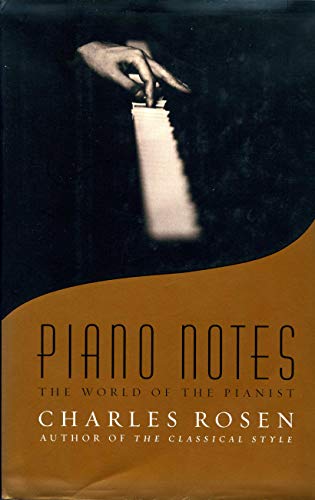
Charles Rosen is one of the world's most talented pianists -- and one of music's most astute commentators. Known as a performer of Bach, Beethoven, Stravinsky, and Elliott Carter, he has also written highly acclaimed criticism for sophisticated students and professionals. In Piano Notes, he writes for a broader audience about an old friend -- the piano itself. Drawing upon a lifetime of wisdom and the accumulated lore of many great performers of the past, Rosen shows why the instrument demands such a stark combination of mental and physical prowess. Readers will gather many little-known insights -- from how pianists vary their posture, to how splicings and microphone placements can ruin recordings, to how the history of composition was dominated by the piano for two centuries. Stories of many great musicians abound. Rosen reveals Nadia Boulanger's favorite way to avoid commenting on the performances of her friends ("You know what I think," spoken with utmost earnestness), why Glenn Gould's recordings suffer from "double-strike" touches, and how even Vladimir Horowitz became enamored of splicing multiple performances into a single recording. Rosen's explanation of the piano's physical pleasures, demands, and discontents will delight and instruct anyone who has ever sat at a keyboard, as well as everyone who loves to listen to the instrument. In the end, he strikes a contemplative note. Western music was built around the piano from the classical era until recently, and for a good part of that time the instrument was an essential acquisition for every middle-class household. Music making was part of the fabric of social life. Yet those days have ended. Fewer people learn the instrument today. The rise of recorded music has homogenized performance styles and greatly reduced the frequency of public concerts. Music will undoubtedly survive, but will the supremely physical experience of playing the piano ever be the same?
"synopsis" may belong to another edition of this title.
About the Author
Charles Rosen is a distinguished concert pianist and music critic. He has twice been nominated for the Grammy Award, and his landmark book, The Classical Style, won the National Book Award and has been reissued several times. Today he maintains an active performance schedule around the world, as well as writing for The New York Review of Books. He lives in New York City and Paris.
Reviews
"Music is not just sound or even significant sound.... There has to be a genuine love simply of the mechanics and difficulties of playing, a physical need for the contact with the keyboard," writes Rosen, a concert pianist, music critic and National Book Award winner (for 1970's The Classical Style: Haydn, Mozart, Beethoven). He explores those mechanics, difficulties and more in this thoughtful and wide-reaching blend of history, homage and memoir. In a slightly uptight but obviously learned manner, the author explains the various elements that the piano-playing experience entails, from a child's understanding of the fingering for a C major scale to an accomplished concert pianist's position on her stool. Rosen is mainly concerned with the physicalities of playing the instrument, and he takes readers from concert halls, discussing the order of pieces to be performed lest a pianist follow a work in E-flat major by one in D major to the recording studio, examining the facility with which one can splice piano music. Although nearly all of Rosen's examples are from the music of Bach, Debussy, Chopin, Mendelssohn, Schumann and other classical musicians which may alienate readers who play jazz or popular piano his musings are indeed modern; he ponders what will become of the "dinosaur"-like piano in the 22nd century and addresses the problems of performing in a country where piano concerts are only de rigueur in large cities. Filled with trivia and thought-provoking commentary, Rosen's book is a sometimes dense, but important, study of the physical factors involved in tickling the ivories.
Copyright 2002 Reed Business Information, Inc.
From a professional's point of view, pianist Rosen carefully links the physical act of playing and the aesthetics of the music it produces, with movements of the fingers, arms, feet, and torso that introduce dance and gesture into the interpretation of music. He comments on the role of technique, which becomes routine and sublimated to how a score is interpreted; a hall's acoustics, audience interruptions, and the particular instrument played all affect a performance, but the technique is truly unconscious. Competitions and contests tend to breed standard performances thought to please judges, he says, while private concerts lead to experimentation, and public concertizing produces consistent performances. In recordings, a pianist tends to strive instead for perfection because a record freezes a performance. Finally, Rosen comments on the styles and manners of performers he has witnessed. He truly sheds light on all aspects of piano performance, and piano-music lovers and players alike will benefit from his thought-provoking and appreciation-enhancing comments. Alan Hirsch
Copyright © American Library Association. All rights reserved
"About this title" may belong to another edition of this title.
Search results for Piano Notes: The World of the Pianist

Stock Image
Piano Notes: The World of the Pianist
Seller: More Than Words, Waltham, MA, U.S.A.
Seller rating 5 out of 5 stars

Condition: Good. . . All orders guaranteed and ship within 24 hours. Your purchase supports More Than Words, a nonprofit job training program for youth, empowering youth to take charge of their liv9781583333785 a business. Seller Inventory # BOS-D-13d-01468
Seller Image
Piano Notes: The World of the Pianist
Seller: Greenworld Books, Arlington, TX, U.S.A.
Seller rating 5 out of 5 stars
Condition: very_good. Fast Free Shipping â" Very Good condition book with a firm cover and clean pages. Shows normal use and some light wear or limited notes markings. A solid, nice copy to enjoy. Seller Inventory # GWV.0743203828.VG
Seller Image
Piano Notes: The World of the Pianist
Seller: ZBK Books, Carlstadt, NJ, U.S.A.
Seller rating 5 out of 5 stars
Condition: very_good. Fast & Free Shipping â" Very Good condition book with a firm cover and clean pages. Shows normal use and some light wear or limited notes markings. A solid, nice copy to enjoy. Seller Inventory # ZWV.0743203828.VG
Seller Image
Piano Notes: The World of the Pianist
Seller: Greenworld Books, Arlington, TX, U.S.A.
Seller rating 5 out of 5 stars
Condition: like_new. Fast Free Shipping â" Excellent condition book with clean cover and pages. Barely handled, with minimal wear. An outstanding copy, close to enjoy! Seller Inventory # GWV.0743203828.LN
Stock Image
Piano Notes: The World of the Pianist
Seller: World of Books (was SecondSale), Montgomery, IL, U.S.A.
Seller rating 5 out of 5 stars
Condition: Good. Item in good condition. Textbooks may not include supplemental items i.e. CDs, access codes etc. Seller Inventory # 00108738910
Stock Image
Piano Notes: The World of the Pianist
Seller: ThriftBooks-Dallas, Dallas, TX, U.S.A.
Seller rating 5 out of 5 stars
Hardcover. Condition: As New. No Jacket. Pages are clean and are not marred by notes or folds of any kind. ~ ThriftBooks: Read More, Spend Less. Seller Inventory # G0743203828I2N00
Stock Image
Piano Notes: The World of the Pianist
Seller: ThriftBooks-Atlanta, AUSTELL, GA, U.S.A.
Seller rating 5 out of 5 stars
Hardcover. Condition: Fair. No Jacket. Readable copy. Pages may have considerable notes/highlighting. ~ ThriftBooks: Read More, Spend Less. Seller Inventory # G0743203828I5N00
Stock Image
Piano Notes: The World of the Pianist
Seller: ThriftBooks-Atlanta, AUSTELL, GA, U.S.A.
Seller rating 5 out of 5 stars
Hardcover. Condition: Good. No Jacket. Pages can have notes/highlighting. Spine may show signs of wear. ~ ThriftBooks: Read More, Spend Less. Seller Inventory # G0743203828I3N00
Stock Image
Piano Notes: The World of the Pianist
Seller: ThriftBooks-Dallas, Dallas, TX, U.S.A.
Seller rating 5 out of 5 stars
Hardcover. Condition: Fair. No Jacket. Readable copy. Pages may have considerable notes/highlighting. ~ ThriftBooks: Read More, Spend Less. Seller Inventory # G0743203828I5N00
Stock Image
Piano Notes : The World of the Pianist
Published by
Simon & Schuster Australia, 2002
ISBN 10: 0743203828
ISBN 13: 9780743203821
Used
Hardcover
First Edition
Seller: Better World Books, Mishawaka, IN, U.S.A.
Seller rating 5 out of 5 stars
Condition: Good. 1ST. Former library copy. Pages intact with minimal writing/highlighting. The binding may be loose and creased. Dust jackets/supplements are not included. Includes library markings. Stock photo provided. Product includes identifying sticker. Better World Books: Buy Books. Do Good. Seller Inventory # 807396-6