
Items related to The Pawprints of History: Dogs and the Course of Human...
Synopsis
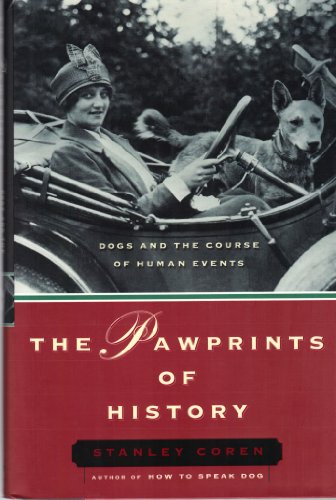
A professor of psychology shares a lifetime of dog stories, interspersing his own loving stories of canine companionship with a fascinating survey of the human/dog relationship through history. 40,000 first printing.
"synopsis" may belong to another edition of this title.
About the Author
Stanley Coren is a professor of psychology at the University of British Columbia and author of The Left-Hander Syndrome, The Intelligence of Dogs, Sleep Thieves, What Do Dogs Know?, Why We Love the Dogs We Do, and How to Speak Dog. He lives in Vancouver, British Columbia.
The book has been illustrated with lighthearted drawings by the highly talented artist, animator, and animation director Andy Bartlett, who also lives in Vancouver, British Columbia.
Reviews
Spiced with wit and mellowed with charm, Coren's anecdote-laden survey of canine-human interspecies history is a solid read. From stories about the diminutive 18th-century intellectual poet Alexander Pope and his protective Great Dane, Bounce, to Teddy Roosevelt's mixed breed, horseback-riding companion, Skip, Coren (How to Speak Dog) deftly draws the reader into both literary salons and political realms alike. The book ranges from ancient Egypt and medieval Japan to 19th-century Vienna and 21st-century Washington, D.C. Here are dogs of every breed as well as their owners, who include emperors, scoundrels, saints and artists: a Newfoundland named Robber offered Richard Wagner company while he was in Paris completing Rienzi and The Flying Dutchman. Coren recounts stirring sagas of dog heroism in everyday life as well as in wartime, from antiquity to the modern era (the Spanish conquistadors fortified their military with dogs, and "the cruellest of the Spanish leaders would use the dogs as a means of public execution. This was known as `dogging' "). The tales are well told and thoughtfully constructed, nicely balanced with solid historical research. Each chapter works nicely as a self-contained essay, and these vignettes build to tell an informative and entertaining story of canine camaraderie. Illus. not seen by PW.
Humans and canines have been living together for about 14,000 years. That's amazing enough, but Coren and Bartlett take it one step further, showing that the world we live in today might have been a very different place if it hadn't been for a few dogs in the right place at the right time. Take Napoleon, for instance. He hated dogs, but one day in 1815, as he was sailing away from the island of Elba, he fell into the icy water and probably would have drowned except for a plucky Newfoundland dog that plunged into the water and rescued him. Napoleon, of course, went on to reclaim his throne and wage bloody war against the British at Waterloo. This delightful chronicle offers a rich and surprising cavalcade of canines who touched the lives of such famous people as Richard Wagner, Alexander Pope, Alexander Graham Bell, Frederick the Great, and Sigmund Freud. These engaging, even touching stories will be a real treat for dog lovers, history buffs, and trivia addicts. David Pitt
Copyright © American Library Association. All rights reserved
Excerpt. © Reprinted by permission. All rights reserved.
Chapter One: Sentinels and Symbols
How many times has the fate of a man, or even a nation, hung from the collar of a dog? Had it not been for dogs, the last imperial house of China might not have fallen; Columbus's first attempts at colonizing the Americas not have been so successful; some of Wagner's operas might never have been written; the American Revolution might not have been fought; the freeing of the American slaves might have been delayed for decades; the way that we educate deaf children might be different; and great and well-loved books like Ivanhoe might never have been written.
Most people know and accept in a general way the fact that dogs have changed human history by fulfilling needed functions in human activities such as hunting, herding, exploration, or the waging of war. When it comes to political, social, or cultural history, however, few people would expect any evidence of canine influences. Yet there are many instances where the actions of a single dog changed the life of a single human, who in turn went on to shape human history. These seldom-told stories are the most fascinating.
Consider, for example, the case of Alexander Pope, the brilliant satirist who is considered by many to be the greatest English poet of the eighteenth century. One of the most quotable poets of all time, Pope is the source of such familiar epigrams as "A little learning is a dangerous thing," "To err is human, to forgive, divine," and "Fools rush in where angels fear to tread." Many of his poems, such as The Rape of the Lock and The Dunciad, as well as his Essay on Man and Essay on Criticism, are still popular classics and required reading for anyone seeking a degree in literature in most universities.
Pope was born in London in 1688. His interest in literature and writing was probably in part the result of his poor physique. While still quite young, Pope developed a form of tuberculosis that affects the spine. This condition stunted his growth; his full-grown height was only four feet six inches. In addition, Pope was condemned to suffer from headaches throughout his life, and he was abnormally sensitive to pain. His spinal condition made bending and physical exertions a source of agony. He often needed assistance to rise from his bed or chair and was obliged to have a servant help him dress and undress.
Nevertheless, Pope could be a charming social companion and host. Despite his lack of height, he had a handsome face and an attractive appearance so that people did not feel uncomfortable in his presence. At his large estate at Twickenham on the Thames (only a short distance from London), Pope entertained many celebrated guests, from poets and philosophers to high government officials, society belles, and even royalty. On any visit to him one might have met the likes of Jonathan Swift, the satirical author of Gulliver's Travels; Henry St. John the Viscount Bolingbroke, a statesman and orator who later became an author; Robert Harley, the first earl of Oxford, who would one day be the Lord Treasurer; and even Frederick, the Prince of Wales. Pope's many visitors would often convene in the great garden that he had carefully designed, and then the whole party would spend hours in sprightly conversation.
When he was not in a social setting, however, Pope's painful physical condition made him touchy and easily angered. Close associates would hear him rage at even the slightest perceived insult. His temper would often flare at a critic, then be redirected to whatever innocent target happened to be near -- frequently a servant. The resulting high level of turnover among his personal staff as employees quit or were fired made maintenance of a household routine difficult.
Pope had other personal quirks as well. Despite his personal wealth and his lavish entertainment of guests, for example, he was quite miserly in some of his personal habits. Thus he often would not buy writing paper, but rather write his poetry on old envelopes from his voluminous correspondence. He distrusted financial institutions, such as banks, and only did a minimal amount of business with them. Instead, he kept much of his wealth in a strongbox built into a wall of the mansion, wearing the key on a chain around his neck at all times.
Although he loved dogs all of his life, Pope's favorite was an unlikely choice, given his size and physical condition. It was a large Great Dane that he named Bounce. When Bounce and Pope stood facing each other, their eyes were nearly at the same level. Bounce, however, proved to be a fine companion. He was quiet and unobtrusive when his master worked, but was always present to greet company and to socialize when anyone showed him any attention. Prince Frederick was so impressed by Bounce's good manners and stately appearance that he expressed a desire to own a dog just like him. Pope was flattered, and some time later the prince returned from a visit to Twickenham carrying one of Bounce's puppies -- a gift from the poet. The puppy was installed at the royal kennel at Kew, which was the summer residence of the royal family. Shortly thereafter, Pope sent another gift, a collar for Frederick's dog with the following couplet engraved on it:
I am his Highness' dog, at Kew.
Pray tell me, sir, whose dog are you?
Although Bounce was generally friendly, he could be quite protective of his master. Since Jonathan Swift was now around sixty and had grown quite deaf, Pope had to raise his voice to communicate with him on his visits. This shouting made Bounce very suspicious of Swift, and so he would protectively lie between his master and the writer. If Swift gestured too broadly as he spoke, Bounce would rise to his feet as if ready to intervene on Pope's behalf and might even give a warning growl.
Although Pope did not need protection from Swift, Bounce's role of guardian would ultimately prove to be a blessing. One day, the temperamental poet had dismissed his latest valet, amid some name-calling and abusive language. When a new manservant was quickly hired from a short list of available applicants, Bounce sniffed at the man, then withdrew beside his master in an untypical show of dislike. Nonetheless, the valet seemed to know his job and appeared to be quite conscientious. As night fell, the valet lifted Pope from his chair and assisted him to the bedroom, where he helped the poet undress for the night and placed him on his bed. After pulling the heavy curtains around the canopied bed to shut out the night drafts, the valet quietly slipped out of the room.
Bounce, who normally stayed downstairs by the fireplace at night to soak up the last heat of the dying embers, abandoned his usual place of rest this evening. As the valet left, the dog slipped into Pope's bedroom and crawled under the bed to sleep. Much later that night, Pope thought that he heard a noise. When he slightly parted the bed curtains to peek out, what he saw paralyzed him with fear. The dark figure of a man stealthily approaching the bed was dimly visible. In his hand, Pope could make out the shape of a large knife, glittering in the moonlight. Because of his physical frailties, the poet was helpless to rise and protect himself. He could only scream for his valet, who slept in the next room, to come and help him.
At the sound of his master's cry, Bounce sprang from under the bed and leaped at the man, who toppled over and lost his grip on the knife. Then Bounce held him there on the floor, alternately growling at the man and barking loudly for help. When the commotion brought other members of the household staff to the rescue, the man with the knife turned out to be the new valet of whom Bounce had been suspicious. Hearing that Pope kept a great deal of money in the house, the man had decided to kill him, steal the strongbox key that he
"About this title" may belong to another edition of this title.
Search results for The Pawprints of History: Dogs and the Course of Human...

Stock Image
The Pawprints of History: Dogs and the Course of Human Events
Seller: Orion Tech, Kingwood, TX, U.S.A.
Seller rating 5 out of 5 stars

Hardcover. Condition: Good. Andy Bartlett (illustrator). Seller Inventory # 0743222288-3-24082539
Stock Image
The Pawprints of History: Dogs and the Course of Human Events
Seller: Gulf Coast Books, Cypress, TX, U.S.A.
Seller rating 5 out of 5 stars
hardcover. Condition: Fair. Andy Bartlett (illustrator). Seller Inventory # 0743222288-4-31743625
Stock Image
The Pawprints of History: Dogs and the Course of Human Events
Seller: World of Books (was SecondSale), Montgomery, IL, U.S.A.
Seller rating 5 out of 5 stars
Hardback. Condition: Good. Andy Bartlett (illustrator). Seller Inventory # 00077179951
Stock Image
The Pawprints of History: Dogs and the Course of Human Events
Seller: World of Books Inc, Montgomery, IL, U.S.A.
Seller rating 4 out of 5 stars

Hardback. Condition: Good. Andy Bartlett (illustrator). Seller Inventory # CIN0743222288G
Stock Image
The Pawprints of History: Dogs and the Course of Human Events
Published by
The Free Press (edition First Edition), 2002
ISBN 10: 0743222288
ISBN 13: 9780743222280
Used
Hardcover
First Edition
Seller: BooksRun, Philadelphia, PA, U.S.A.
Seller rating 5 out of 5 stars
Hardcover. Condition: Very Good. Andy Bartlett (illustrator). First Edition. With dust jacket. It's a well-cared-for item that has seen limited use. The item may show minor signs of wear. All the text is legible, with all pages included. It may have slight markings and/or highlighting. Seller Inventory # 0743222288-11-1-29
Stock Image
The Pawprints of History : Dogs and the Course of Human Events
Published by
Simon & Schuster, Incorporated, 2002
ISBN 10: 0743222288
ISBN 13: 9780743222280
Used
Hardcover
Seller: Better World Books: West, Reno, NV, U.S.A.
Seller rating 5 out of 5 stars
Condition: Very Good. Andy Bartlett (illustrator). Pages intact with possible writing/highlighting. Binding strong with minor wear. Dust jackets/supplements may not be included. Stock photo provided. Product includes identifying sticker. Better World Books: Buy Books. Do Good. Seller Inventory # 2447616-6
Stock Image
The Pawprints of History : Dogs and the Course of Human Events
Published by
Simon & Schuster, Incorporated, 2002
ISBN 10: 0743222288
ISBN 13: 9780743222280
Used
Hardcover
Seller: Better World Books, Mishawaka, IN, U.S.A.
Seller rating 5 out of 5 stars
Condition: Good. Andy Bartlett (illustrator). Former library copy. Pages intact with minimal writing/highlighting. The binding may be loose and creased. Dust jackets/supplements are not included. Includes library markings. Stock photo provided. Product includes identifying sticker. Better World Books: Buy Books. Do Good. Seller Inventory # GRP66352314
Stock Image
The Pawprints of History: Dogs and the Course of Human Events
Seller: ThriftBooks-Dallas, Dallas, TX, U.S.A.
Seller rating 5 out of 5 stars
Hardcover. Condition: Very Good. No Jacket. Andy Bartlett (illustrator). May have limited writing in cover pages. Pages are unmarked. ~ ThriftBooks: Read More, Spend Less. Seller Inventory # G0743222288I4N00
Stock Image
The Pawprints of History: Dogs and the Course of Human Events
Seller: ThriftBooks-Dallas, Dallas, TX, U.S.A.
Seller rating 5 out of 5 stars
Hardcover. Condition: Very Good. No Jacket. Andy Bartlett (illustrator). Former library book; May have limited writing in cover pages. Pages are unmarked. ~ ThriftBooks: Read More, Spend Less. Seller Inventory # G0743222288I4N10
Stock Image
The Pawprints of History: Dogs and the Course of Human Events
Seller: ThriftBooks-Phoenix, Phoenix, AZ, U.S.A.
Seller rating 5 out of 5 stars
Hardcover. Condition: Very Good. No Jacket. Andy Bartlett (illustrator). May have limited writing in cover pages. Pages are unmarked. ~ ThriftBooks: Read More, Spend Less. Seller Inventory # G0743222288I4N00