
Items related to The Emerging Democratic Majority
Synopsis
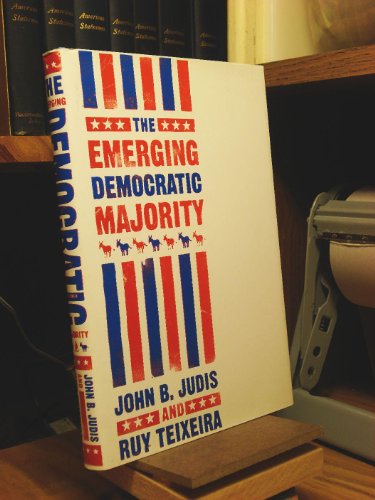
Forecasts a progressive era which is indicated by a rise of a diverse post-industrial society and offers opinions on such topics as health care and the environment.
"synopsis" may belong to another edition of this title.
About the Author
John B. Judis is a senior editor of The New Republic and author of William F Buckley, Jr. and The Paradox of American Democracy: Elites, Special Interests, and the Betrayal of Public Trust.
Reviews
In 1969 a prescient Kevin Phillips published The Emerging Republican Majority, predicting the rise of the conservative Republican movement. Now Judis, a senior editor at the New Republic, and Teixeira, a fellow at the Century Foundation and author of The Disappearing American Voter, argue that, if current demographic and political trends continue, a new realignment of political power is inevitable, this time sweeping Democrats to power. In support of their thesis they argue that the electorate is becoming increasingly diverse, with growing Asian, Hispanic and African-American populations-all groups that tend to vote Democratic. On the other hand, the number of white Americans, the voting population most likely to favor Republicans, remains static. Further, according to the authors, America's transition from an industrial to a postindustrial economy is also producing voters who trend strongly Democratic. Judis and Teixeira coin the word "ideopolis" for the geographic areas where the postindustrial economy thrives. They also argue that other changes, specifically the growing educated professional class and the continuing "gender gap," will benefit Democrats, whose political ideology is more consonant with the needs and beliefs of women and professionals. Judis and Teixeira predict that all these elements will converge by 2008, at the latest, when a new Democratic majority will emerge. Wisely, they warn that their predictions are just that, and that events might overtake the trends. But their warning will bring little comfort to Republicans, who will find their well-supported thesis disturbing.
Copyright 2002 Reed Business Information, Inc.
Kevin Phillip's The Emerging Republican Majority predicted the conservative revolution ushered in during the Reagan 1980s. Judis (William F. Buckley, Jr. and the Paradox of American Democracy) and Teixeira (America's Forgotten Majority: Why the White Working Class Still Matters) present an insightful and plausible case for a resurgent Democratic majority, which he believes will ascend by the end of the decade. The majority will be centrist, rather than leftist, and will be bolstered by African Americans, Hispanic and Asian minorities, women, professional employees, and the white working and middle classes that formerly made up the "Reagan Democrats." This majority's geographic base will be the "ideopolises" large metropolitan areas linked by technology cities and suburbs. The authors conclude that despite the events of September 11, 2001, assumed to have enhanced President Bush's popularity, a Democratic majority is soon to emerge when a presidential candidate synthesizes the aforementioned groups, who share similar Democratic economic and social interests. A thoughtful and well-argued book; recommended for all public libraries. Karl Helicher, Upper Merion Twp. Lib., King of Prussia, PA
Copyright 2002 Cahners Business Information, Inc.
Its title echoing a 1969 book well known to political junkies, Kevin Phillips' The Emerging Republican Majority, this heart-warmer for Democrats is grounded in the hoary theory collegians encounter in their first (and perhaps last) political science class: realignment theory. Following a refresher on how one party has historically achieved ascendancy over another, the authors pitch into their thesis that, notwithstanding Democratic disappointments in the 1994 and 2000 elections, which they chalk up to political misjudgment by Clinton and political windmill tilting by Nader, success beckons the Democratic Party. The authors focus on the concept of the "ideopolis," their term for regions where professionals congregate, such as North Carolina's Research Triangle. This group, they believe, citing copious polling data, is alienated from market forces and organizations that don't value its expertise (e.g., doctors versus HMOs) and is primed to join the traditional Democratic coalition of labor, liberals, and minorities. A confidently advanced argument for those active in and analytical about politics. Gilbert Taylor
Copyright © American Library Association. All rights reserved
"About this title" may belong to another edition of this title.
Search results for The Emerging Democratic Majority

Stock Image
The Emerging Democratic Majority
Seller: World of Books (was SecondSale), Montgomery, IL, U.S.A.
Seller rating 5 out of 5 stars

Condition: Fair. Seller Inventory # 00102397173
Stock Image
The Emerging Democratic Majority
Seller: World of Books (was SecondSale), Montgomery, IL, U.S.A.
Seller rating 5 out of 5 stars
Condition: Good. Seller Inventory # 00101875991
Seller Image
The Emerging Democratic Majority
Seller: Greenworld Books, Arlington, TX, U.S.A.
Seller rating 5 out of 5 stars
Condition: good. Fast Free Shipping â" Good condition. It may show normal signs of use, such as light writing, highlighting, or library markings, but all pages are intact and the book is fully readable. A solid, complete copy that's ready to enjoy. Seller Inventory # GWV.0743226917.G
Stock Image
The Emerging Democratic Majority (Lisa Drew Books)
Seller: Orion Tech, Kingwood, TX, U.S.A.
Seller rating 5 out of 5 stars
hardcover. Condition: Fair. Seller Inventory # 0743226917-4-30826832
Stock Image
The Emerging Democratic Majority (Lisa Drew Books)
Published by
Scribner (edition First Edition), 2002
ISBN 10: 0743226917
ISBN 13: 9780743226912
Used
Hardcover
First Edition
Seller: BooksRun, Philadelphia, PA, U.S.A.
Seller rating 5 out of 5 stars
Hardcover. Condition: Very Good. First Edition. With dust jacket. It's a well-cared-for item that has seen limited use. The item may show minor signs of wear. All the text is legible, with all pages included. It may have slight markings and/or highlighting. Seller Inventory # 0743226917-8-1-29
Stock Image
The Emerging Democratic Majority (Lisa Drew Books)
Seller: Once Upon A Time Books, Siloam Springs, AR, U.S.A.
Seller rating 4 out of 5 stars

Hardcover. Condition: Acceptable. This is a used book. It may contain highlighting/underlining and/or the book may show heavier signs of wear . It may also be ex-library or without dustjacket. This is a used book. It may contain highlighting/underlining and/or the book may show heavier signs of wear . It may also be ex-library or without dustjacket. Seller Inventory # mon0001356436
Stock Image
The Emerging Democratic Majority
Seller: Better World Books, Mishawaka, IN, U.S.A.
Seller rating 5 out of 5 stars
Condition: Very Good. 1 Edition. Pages intact with possible writing/highlighting. Binding strong with minor wear. Dust jackets/supplements may not be included. Stock photo provided. Product includes identifying sticker. Better World Books: Buy Books. Do Good. Seller Inventory # 9897773-6
Stock Image
The Emerging Democratic Majority
Seller: Better World Books: West, Reno, NV, U.S.A.
Seller rating 5 out of 5 stars
Condition: Very Good. 1 Edition. Pages intact with possible writing/highlighting. Binding strong with minor wear. Dust jackets/supplements may not be included. Stock photo provided. Product includes identifying sticker. Better World Books: Buy Books. Do Good. Seller Inventory # 9897773-6
Stock Image
The Emerging Democratic Majority
Seller: Better World Books, Mishawaka, IN, U.S.A.
Seller rating 5 out of 5 stars
Condition: Good. 1 Edition. Former library copy. Pages intact with minimal writing/highlighting. The binding may be loose and creased. Dust jackets/supplements are not included. Includes library markings. Stock photo provided. Product includes identifying sticker. Better World Books: Buy Books. Do Good. Seller Inventory # 807370-20
Stock Image
The Emerging Democratic Majority (Lisa Drew Books)
Seller: HPB-Ruby, Dallas, TX, U.S.A.
Seller rating 5 out of 5 stars
hardcover. Condition: Very Good. Connecting readers with great books since 1972! Used books may not include companion materials, and may have some shelf wear or limited writing. We ship orders daily and Customer Service is our top priority! Seller Inventory # S_463614866