
Items related to Chronicles, Vol. 1
Synopsis
WINNER OF THE NOBEL PRIZE IN LITERATURE
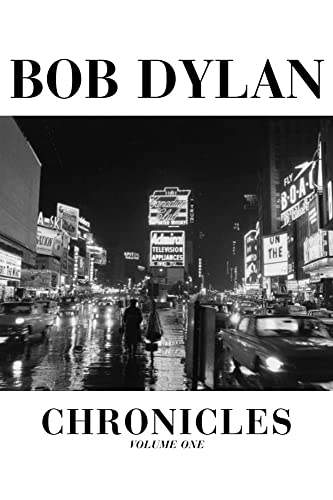
The celebrated first memoir from arguably the most influential singer-songwriter in the country, Bob Dylan.
“I’d come from a long ways off and had started a long ways down. But now destiny was about to manifest itself. I felt like it was looking right at me and nobody else.”
So writes Bob Dylan in Chronicles: Volume One, his remarkable book exploring critical junctures in his life and career. Through Dylan’s eyes and open mind, we see Greenwich Village, circa 1961, when he first arrives in Manhattan. Dylan’s New York is a magical city of possibilities—smoky, nightlong parties; literary awakenings; transient loves and unbreakable friendships. Elegiac observations are punctuated by jabs of memories, penetrating and tough. With the book’s side trips to New Orleans, Woodstock, Minnesota, and points west, Chronicles: Volume One is an intimate and intensely personal recollection of extraordinary times.
By turns revealing, poetical, passionate, and witty, Chronicles: Volume One is a mesmerizing window on Bob Dylan’s thoughts and influences. Dylan’s voice is distinctively American: generous of spirit, engaged, fanciful, and rhythmic. Utilizing his unparalleled gifts of storytelling and the exquisite expressiveness that are the hallmarks of his music, Bob Dylan turns Chronicles: Volume One into a poignant reflection on life, and the people and places that helped shape the man and the art.
"synopsis" may belong to another edition of this title.
About the Author
Bob Dylan has released thirty-nine studio albums, which collectively have sold over 125 million copies around the world. He won the 2016 Nobel Prize in Literature and has been awarded the French Legion of Honor, a Pulitzer Prize Special Citation, and the Presidential Medal of Freedom, the country’s highest civilian honor. His memoir, Chronicles: Volume One, spent a year on the New York Times bestseller list.
Reviews
Dylan, true to mercurial form, manages to be obscure and forthright in the long-anticipated first volume of his autobiography. For all his frankness, which catches many reviewers by surprise, he omits as much as he reveals. Less a straight biography than a series of well-written and compassionate vignettes, Dylan describes hundreds of past acquaintances in stunning detail, but then excludes or downplays what many consider to be key points of his biography. This sense of frustrated expectations colors what are otherwise glowing reviews; it is as if the critics are waiting to see what the proposed Volumes Two and Three hold before they give Dylan their final nod of approval.
Copyright © 2004 Phillips & Nelson Media, Inc.
Like his subject, the author is an English statesman—he has been a Member of Parliament and served as a Labour Cabinet minister—and this ample, absorbing life reflects an intimacy with the folkways of British politics that few biographies of Churchill can match. Jenkins shows us, at every point of Churchill's career, how he was viewed by colleagues, rivals, voters, and readers, and examines the issues that stirred or divided public feeling. When Churchill entered Parliament, in 1900, at the age of twenty-five, he was already famous as a soldier and war correspondent. He was brilliant and brash, and he compensated for his pushiness with superb oratory and very hard work. When he changed parties (Conservative to Liberal in 1904; Liberal to Conservative in 1924), he was welcomed by colleagues he had earlier opposed. Jenkins, who has written a biography of Gladstone, is fascinated by the ways in which politicians achieve power, use it, and lose it; his book serves as a road map to the changes in British government during the first half of the twentieth century. Although he treats his subject's blunders, such as the campaign against Indian self-government, without sympathy, he still concludes that Churchill was England's greatest Prime Minister.
Copyright © 2005 The New Yorker
Starred Review. After a career of principled coyness, Dylan takes pains to outline the growth of his artistic conscience in this superb memoir. Writing in a language of cosmic hokum and street-smart phrasing, he lingers not on moments of success and celebrity, but on the crises of his intellectual development. He reconstructs, for example, an early moment in New York when he realized "that I would have to start believing in possibilities that I wouldn’t have allowed before, that I had been closing my creativity down to a very narrow, controllable scale...that things had become too familiar and I might have to disorient myself." And he recounts how, in that search for larger reach, he actually went to the public library’s microfilm archives to learn the rhetoric of Civil War newspapers. Skipping the years of his greatest records, or perhaps saving those years for the second volume of his chronicle, Dylan recalls the times when he was sick of his public persona and made more lackluster albums like "Self-Portrait" and "New Morning." He then skips again to his comeback work with producer Daniel Lanois in the late 1980s. Dylan emphasizes that he was "indifferent to wealth and love," and readers looking for private revelations will be disappointed. But others will prize the display of musical integrity and seriousness that is evident in his minutia-filled accounts of his influences in folk and blues. Ultimately, this book will stand as a record of a young man’s self-education, as contagious in its frank excitement as the letters of John Keats and as sincere in its ramble as Jack Kerouac’s On the Road, to which Dylan frequently refers. A person of Dylan’s stature could have gotten away with far less; that he has been so thoughtful in the creation of this book is a measure of his talents, and a gift to his fans.
Copyright © Reed Business Information, a division of Reed Elsevier Inc. All rights reserved.
Acolytes and scholars have long argued over the meaning of Dylan's often cryptic songs. Now they have a new source of unparalleled authority to guide their interpretations in the first installment of his long-awaited memoirs, which jumps around chronologically, much as Dylan has veered stylistically over the years. It lurches from youth in Minnesota to arrival in New York City in 1961 to creative slump a decade later to the stirrings of creative revival in the 1980s. Most evocative is Dylan's depiction of early '60s Greenwich Village, which paints the burgeoning folk scene so vividly that it seems to have happened last week. Among the surprising revelations is Dylan's confession that his mundane output in the early '70s was the result of withdrawal into domestic life and a conscious attempt to reject the pressure he had felt as the "voice of a generation." Another surprise is that the book is so straightforward. As opposed to his obtusely surreal novel Tarantula (1971) and his famously evasive interviews, Dylan here is honest, bordering on confessional--that is, if he is to be taken at face value, always a risky proposition with this elusive artist. Dylan envisions this as the first of three volumes of memoirs, so fans shouldn't be upset that he ignores his most significant work but let the omission whet appetites for the sequels.
Gordon Flagg
Copyright © American Library Association. All rights reserved
There's no word yet on how far this first volume goes, but we'll bet that Dylan doesn't leave any answers blowin' in the wind. Look for the complete Lyrics (ISBN 0-7432-2627-8. $45), pubbing simultaneously.
Copyright 2002 Reed Business Information, Inc.
"About this title" may belong to another edition of this title.
Search results for Chronicles, Vol. 1

Stock Image
Dylan Chronicles: null
Seller: World of Books (was SecondSale), Montgomery, IL, U.S.A.
Seller rating 5 out of 5 stars

Hardback. Condition: Fair. Building on the success of Bob Dylan in His Own Words, an autobiographical portrait of the acclaimed musical performer recounts personal and professional experiences and features black-and-white photography. 250,000 first printing. Seller Inventory # 00095017738
Stock Image
Dylan Chronicles: null
Seller: World of Books (was SecondSale), Montgomery, IL, U.S.A.
Seller rating 5 out of 5 stars
Hardback. Condition: Good. Building on the success of Bob Dylan in His Own Words, an autobiographical portrait of the acclaimed musical performer recounts personal and professional experiences and features black-and-white photography. 250,000 first printing. Seller Inventory # 00098740620
Seller Image
Chronicles, Vol. 1
Seller: Zoom Books Company, Lynden, WA, U.S.A.
Seller rating 5 out of 5 stars
Condition: very_good. Book is in very good condition and may include minimal underlining highlighting. The book can also include "From the library of" labels. May not contain miscellaneous items toys, dvds, etc. . We offer 100% money back guarantee and 24 7 customer service. Seller Inventory # ZBV.0743228154.VG
Seller Image
Chronicles, Vol. 1
Seller: Aspen Book Co., Denver, CO, U.S.A.
Seller rating 5 out of 5 stars
Condition: very_good. Excellent condition with just a hint of character. Minor signs of love, but the pages are still clean and ready for adventure. Seller Inventory # PKV.0743228154.VG
Seller Image
Chronicles, Vol. 1
Seller: Aspen Book Co., Denver, CO, U.S.A.
Seller rating 5 out of 5 stars
Condition: good. A well-loved companion. Corners and cover might show a little wear, and you could find some notes or highlights. The dust jacket might be MIA, it might have been a library book and extras aren't guaranteedâ"but the story's all there! Seller Inventory # PKV.0743228154.G
Seller Image
Chronicles, Vol. 1
Seller: ZBK Books, Carlstadt, NJ, U.S.A.
Seller rating 5 out of 5 stars
Condition: good. Fast & Free Shipping â" Good condition. It may show normal signs of use, such as light writing, highlighting, or library markings, but all pages are intact and the book is fully readable. A solid, complete copy that's ready to enjoy. Seller Inventory # ZWV.0743228154.G
Stock Image
Chronicles, Vol. 1
Seller: Book Gurus, Tallahassee, FL, U.S.A.
Seller rating 5 out of 5 stars
hardcover. Condition: Very Good. Seller Inventory # 01KX3T0XXKZED52
Stock Image
Chronicles, Vol. 1
Published by
Simon & Schuster (edition First Edition), 2004
ISBN 10: 0743228154
ISBN 13: 9780743228152
Used
Hardcover
First Edition
Seller: BooksRun, Philadelphia, PA, U.S.A.
Seller rating 5 out of 5 stars
Hardcover. Condition: Very Good. First Edition. With dust jacket. It's a well-cared-for item that has seen limited use. The item may show minor signs of wear. All the text is legible, with all pages included. It may have slight markings and/or highlighting. Seller Inventory # 0743228154-11-1-29
Stock Image
Chronicles, Vol. 1
Seller: HPB-Diamond, Dallas, TX, U.S.A.
Seller rating 5 out of 5 stars
Hardcover. Condition: Very Good. Connecting readers with great books since 1972! Used books may not include companion materials, and may have some shelf wear or limited writing. We ship orders daily and Customer Service is our top priority! Seller Inventory # S_486021792
Stock Image
Dylan Chronicles: null
Seller: World of Books Inc, Montgomery, IL, U.S.A.
Seller rating 4 out of 5 stars

Hardback. Condition: Good. Building on the success of Bob Dylan in His Own Words, an autobiographical portrait of the acclaimed musical performer recounts personal and professional experiences and features black-and-white photography. 250,000 first printing. Seller Inventory # CIN0743228154G