
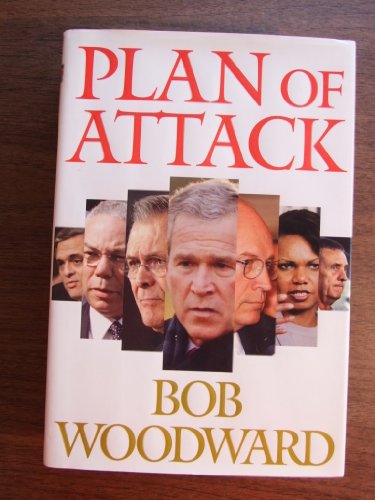
Synopsis
Details the sixteen months of planning and decision making between President Bush, his war council, and key foreign leaders leading up to the 2003 war in Iraq and the toppling of Saddam Hussein's regime. 750,000 first printing. First serial, The Washington Post.
"synopsis" may belong to another edition of this title.
About the Author
Bob Woodward is Assistant Managing Editor at THE WASHINGTON POST. His Pulitzer Prize-winning Watergate reporting is said to have set the standard for modern investigative reporting. Over the last 22 years he has authored or co-authored nine #1 internationally bestselling books.
Reviews
The United States may be a vast and democratic republic, but at the heart of our government is a small coterie of officials, friends and relatives around the president. It is our version of a royal court, and the politics of the court -- as opposed to the politics of the country -- would be instantly recognizable to the denizens of Versailles in the time of Louis XIV.
Nobody understands this aspect of American public life like The Washington Post's Bob Woodward -- the fly on the wall of White Houses going back to the Nixon years. Like the Duc de Saint-Simon, chronicler of life at Versailles and author of the eye-opening Mémoires, Woodward is a masterful recorder of the fascinating doings of our republican court.
In Plan of Attack, the court is divided. Prince Cheney and the Duc de Rumsfeld are the chieftains of the war party; Grand Marshal Powell takes every opportunity to warn the king that it is easier to start a war than to build a stable peace. "It is the Pottery Barn rule," warns the Marshal. (In Washington as in Versailles, epigrams count.) "You break it [Iraq], you own it." (Pottery Barn, as it turns out, has no such rule and took vigorous exception to this characterization.)
The politics of courts are always mysterious, but it appears that Condoleezza Rice -- whose access to the president is matched only by her apparent reticence around Woodward -- used the concept of "coercive diplomacy" to bridge the gap between the two factions: The United States would attempt to remove Saddam Hussein by diplomatic means; our diplomacy would include the threat of force -- and if diplomacy failed, force would be used.
Powell went to work on the diplomatic track; Rumsfeld developed the plans for war and for the postwar period when the Pottery Barn rule would apply. The president, determined from the beginning to implement the Clinton-era goal of regime change in Iraq, made the decision to go to war in the first week of January 2003, after the diplomatic track through the Security Council appeared to have finally failed.
Had the postwar reconstruction of Iraq proved to be anything like the "cakewalk" that the overthrow of Saddam turned out to be, Plan of Attack would read like a hymn of praise to the decisive leadership of George W. Bush.
As it is, the reader is left with questions that Plan of Attack does not address. Why did so many Middle East hands -- including the Saudi ambassador Prince Bandar, one of the great courtiers of our time -- think that Saddam's overthrow was so important? What was the connection in the president's mind -- alluded to but never closely examined here -- between the overthrow of Saddam Hussein and the renewal of the Middle East peace process? What was the hierarchy of American interests there? How did the region -- and American interests -- change after Sept. 11? What in the judgment of the administration's key players was the state of the Middle East? What is President Bush's strategic plan in the war on terror? What does Rumsfeld think the plan should be? What about Rice? Powell? Cheney? The answers to questions like these are necessary to understand why the various members of the administration thought and acted as they did -- but Plan of Attack does not show any sign of Woodward having discussed any such questions with his sources.
Woodward casts interesting light on what in hindsight has clearly emerged as the greatest political blunder of the administration's war strategy so far -- pinning so much of the public case for war on what increasingly seem to be vastly overblown estimates of Iraq's Weapons of Mass Destruction programs (WMD) under Saddam. Here the inquest exculpates the president and the White House war hawks from cooking the evidence; it is CIA director George Tenet who overwhelms Bush's questions about WMD by calling the case for WMD "a slam dunk." It is not quite clear whether WMD became the central pillar of the public case for war because the administration thought that this threat was the most politically persuasive or because this threat was, in fact, the driving force in the administration's own thinking.
Plan of Attack is less successful when it comes to the second great blunder of the war: the failure of the occupation. Woodward gives us the barest outline. Rumsfeld wanted responsibility for the occupation placed in the Department of Defense. Powell concurred; historically, military occupations have been run by the military. But clearly the plans for occupation were far more slipshod than the military plans for the conquest. To some degree that was inevitable; occupation is a far more complex process than conquest, and planners face many more unknowns.
Plan of Attack vividly demonstrates that Rumsfeld is an inspired leader when it comes to military planning. He was ruthless at dissecting military proposals for the war, asking questions that pointed up shaky assumptions and logical fallacies, and demanding over and over again that military planners go back to the drawing board and produce something better.
What happened to this Rumsfeldian ruthlessness when it came to the preparation for the political and security challenges of an Iraqi occupation? Were the assumptions behind the planning -- for example, confidence in the political abilities of Ahmed Chalabi, the controversial head of the Iraqi National Congress -- subjected to the scalding skepticism heaped on the military's pet war-fighting assumptions? Were assumptions about Iraq's purported eagerness for democracy critically examined? Were multiple scenarios rigorously and cold-bloodedly analyzed, and alternatives fully thought through?
Again, Woodward doesn't ask. Historians will want to know a great deal more about how this process worked. Voters will also be curious.
Had Woodward cast a wider net, he would have had a richer book and one with a longer shelf life. Still, one is grateful. Bob Woodward is the most accomplished political reporter of his generation, and Plan of Attack gives us the best glimpse of life in our republican court that we are likely to have until the principals retire to their private estates and avenge themselves on their rivals by writing memoirs.
Reviewed by Walter Russell Mead
Copyright 2004, The Washington Post Co. All Rights Reserved.
Based on exhaustive research and remarkable access to the White House, including two sessions with President Bush and more than 75 interviews with administration officials, veteran Washington Post assistant managing editor Woodward delivers an engrossing blow-by-blow of the run-up to war in Iraq. In November 2001, just months after September 11, Woodward reports, Bush pulled aside defense secretary Donald Rumsfeld and asked him to secretly begin updating war plans for Iraq. Sixteen months later, in March 2003, after an intense war-planning effort, a tense political fight at home and a carefully crafted "if-you-don’t-we-will" diplomatic strategy with the U.N., the American invasion began. Woodward has penned a forceful, often disturbing narrative that captures the deep personality and policy clashes within the Bush administration. Bush, along with Dick Cheney, Condoleezza Rice, Karl Rove and Paul Wolfowitz, are portrayed as believing in a sweeping mission to export democracy and to have America be viewed as strong and willing to walk the walk. They are counterbalanced by Colin Powell, who emerges here as a reluctant warrior, a pragmatic voice—eventually muted—cautioning the president against a rush to war. The most stunning aspect of the story, however, is the glaring intelligence failure of George Tenet’s CIA, from bad WMD information to what Woodward reports as the outright manipulation of questionable intelligence to make the case for war. With this book, Woodward, the author of an astonishing nine number-one bestsellers, has delivered his most important and impressive work in years. Ultimately, this first-class work of contemporary history will be remembered for shedding needed light on the Iraq War, whatever its final outcome.
Copyright © Reed Business Information, a division of Reed Elsevier Inc. All rights reserved.
"About this title" may belong to another edition of this title.
Other Popular Editions of the Same Title

Search results for Plan of Attack

Stock Image
Plan of Attack
Seller: World of Books (was SecondSale), Montgomery, IL, U.S.A.
Seller rating 5 out of 5 stars

Condition: Good. Item in good condition. Textbooks may not include supplemental items i.e. CDs, access codes etc. Seller Inventory # 00045425527
Stock Image
Plan of Attack
Seller: World of Books (was SecondSale), Montgomery, IL, U.S.A.
Seller rating 5 out of 5 stars
Condition: Acceptable. Item in good condition. Textbooks may not include supplemental items i.e. CDs, access codes etc. Seller Inventory # 00044729332
Stock Image
Plan of Attack
Seller: Gulf Coast Books, Cypress, TX, U.S.A.
Seller rating 5 out of 5 stars
Hardcover. Condition: Good. Seller Inventory # 074325547X-3-21841385
Stock Image
Plan of Attack
Seller: Orion Tech, Kingwood, TX, U.S.A.
Seller rating 5 out of 5 stars
Hardcover. Condition: Fair. Seller Inventory # 074325547X-4-22932601
Stock Image
Plan of Attack
Seller: Orion Tech, Kingwood, TX, U.S.A.
Seller rating 5 out of 5 stars
Hardcover. Condition: Good. Seller Inventory # 074325547X-3-23376016
Stock Image
Plan of Attack
Seller: Your Online Bookstore, Houston, TX, U.S.A.
Seller rating 5 out of 5 stars
hardcover. Condition: Good. Signed by Author. Seller Inventory # 074325547X-7-33669394
Seller Image
Plan of Attack
Seller: Zoom Books East, Glendale Heights, IL, U.S.A.
Seller rating 5 out of 5 stars
Condition: very_good. Book is in very good condition and may include minimal underlining highlighting. The book can also include "From the library of" labels. May not contain miscellaneous items toys, dvds, etc. . We offer 100% money back guarantee and 24 7 customer service. Seller Inventory # ZEV.074325547X.VG
Seller Image
Plan of Attack
Seller: Reliant Bookstore, El Dorado, KS, U.S.A.
Seller rating 5 out of 5 stars
Condition: acceptable. Readable copy. Pages may have considerable notes highlighting. May have varying covers. Fast Shipping - Mailed in plastic mailer! Seller Inventory # 56JR8Z001U7O_ns
Stock Image
Plan of Attack
Seller: More Than Words, Waltham, MA, U.S.A.
Seller rating 5 out of 5 stars
Condition: Good. A sound copy with only light wear. Overall a solid copy at a great price! Seller Inventory # BOS-L-01i-01474
Stock Image
Plan of Attack
Seller: More Than Words, Waltham, MA, U.S.A.
Seller rating 5 out of 5 stars
Condition: Very Good. A bright, square, and overall a nice copy. Seller Inventory # BOS-B-02c-02162