
Items related to About Grace: A Novel
Synopsis
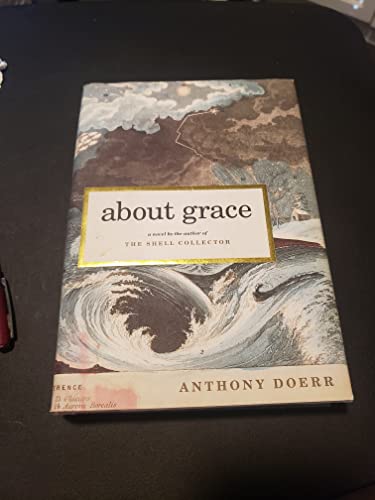
Possessing an unsettling ability to predict random future events, Anchorage resident David Winkler foresees his infant daughter's drowning death and travels thousands of miles to Ohio and the Caribbean to prevent the tragedy, learning about human frailty and the importance of everyday miracles along the way. By the author of The Shell Collector. A first novel. 75,000 first printing.
"synopsis" may belong to another edition of this title.
About the Author
Anthony Doerr is the author of a collection of short stories, The Shell Collector, the novel About Grace, and a memoir titled Four Seasons in Rome. His books have been a New York Times Notable Book, an American Library Association Book of the Year, a "Book of the Year" in the Washington Post, and he has won the Barnes & Noble Discover Prize, the Rome Prize, the Hodder Fellowship from Princeton, and shared the New York Public Library’s Young Lions Fiction Award. His book reviews have appeared in the New York Times and Der Spiegel, and he writes the “On Science” column for the Boston Globe. Doerr is the Writer-in-Residence for the state of Idaho.
Reviews
David Winkler, the 59-year-old protagonist of Anthony Doerr's debut novel, About Grace, is a dreamer but not, alas, of the carefree, California kind. Instead Winkler is a modern-day Cassandra who dreams about future events -- some momentous, some trivial -- and when he tries to warn people, he meets, for the most part, with incredulity and skepticism. As a result of this questionable gift, he also shares characteristics with two other legendary figures: Like Oedipus, Winkler is cursed with a terrible prophecy about himself that he does his utmost to avoid, and, like Odysseus, he must go on a long journey and endure many hardships before he can return home. In the hands of a lesser writer, these mythic premises might prove disastrous, but in those of the wonderfully talented Doerr, the result is a beautiful and expansive novel.
About Grace opens with an account of Winkler catching a plane from the Caribbean to Cleveland. Soon after takeoff he falls asleep in his window seat only to be awakened by the woman next to him. " 'You were dreaming,' she said. 'Your legs were shaking.' . . . He sat awhile and studied the clouds. Finally, with a resigned voice, he said, 'The compartment above you isn't latched properly. In the turbulence it'll open and the bag inside will fall out.' " Of course the woman doesn't believe him, and of course her souvenir martini glasses end up breaking in the aisle. The first half of the book goes on to detail why Winkler fled to the Caribbean in the first place and why, after more than two decades, he feels able to return to America.
Like several of the characters in Doerr's first book, the highly acclaimed collection of stories The Shell Collector, Winkler is a scientist of sorts, an aspiring hydrologist who, fortunately for someone born in Alaska, particularly loves snow. Initially he shares this passion with his empathetic mother, one of the few people to understand about his dreams. Her death when he's a teenager leaves him bereft and solitary. He grows up, goes to college and graduate school, writes a dissertation that nobody reads and gets a job with the weather service. Then one March day when he's 32, Winkler walks over to the local market to buy a sandwich and sees a woman in a tan polyester suit standing at the magazine rack, "tiny particles of dust drifting in the air between her ankles." Suddenly he knows what will happen next; he has dreamed this encounter a few nights before. The woman will drop a magazine, and he will pick it up and give it back. But when he holds out her copy of Good Housekeeping, the woman closes her eyes for a moment "as if waiting out a spell of vertigo," forgets her shopping and hurries away.
Winkler pays for her groceries and eventually tracks down the woman, Sandy, at the bank where she works as a teller; her husband of almost 15 years is the branch manager. Winkler, as he himself is fully aware, is not a prepossessing figure -- he lives above a garage, has few friends, and his only distinctive feature is glasses with "thick, Coke-bottle lenses." But after a certain amount of initial resistance, Sandy agrees to go to the movies with him.
Doerr's writing about their affair is particularly fine. He manages to convey simultaneously Sandy's ordinariness and Winkler's devotion. "He could study the colors and creases in her palm for fifteen minutes, imagining he could see the blood travelling through her capillaries." When she becomes pregnant, the two elope to Cleveland where Winkler has found a job as a meteorologist. They set up house together and seem set to live happily ever after. But soon after the birth of their daughter, Grace, Winkler begins to dream, obsessively, that he will be responsible for her dying in a flood. He starts sleepwalking, and Sandy, although she knows nothing of the dream, becomes afraid he will harm Grace. When the rains start, Winkler panics and flees to the Caribbean.
There, penniless, starving, deeply unhappy, he finds himself dependent on the kindness of strangers and, perhaps rather surprisingly, they appear. A family of fellow refugees -- Soma and Felix have fled from Chile -- takes him in and helps him to find a job, first building and then maintaining an inn. He remains for 25 years -- shades of Circe's island -- until he dreams of a second death by drowning, that of Soma and Felix's beloved daughter, Naaliyah. Partly under Winkler's influence, Naaliyah has grown up to be an ardent naturalist who spends many hours alone in a small boat, collecting specimens. With prodigious effort, he manages to change the outcome of the dream and in so doing not only saves Naaliyah's life but begins to realize, as his mother once suggested, that his dreams may not be inevitable. He applies for a passport and buys a ticket to Cleveland, determined to search for Sandy and Grace.
A quest novel is, by its nature, about delayed gratification; still, even by Odyssean standards, Winkler can be an exasperating hero. He never goes directly from A to B but instead drives a decrepit car thousands of miles around America visiting various Grace Winklers. He is at times almost willfully odd and inept. But as I turned the pages of About Grace, I realized how fully I had come to believe in him, how much I wanted him to reconnect with Sandy and Grace; I felt myself, like Winkler in his dreams, in the presence of an experience. As I neared the end, I read more and more slowly, increasingly reluctant to leave him and his intricately imagined world behind. Happily, now that the last page has been turned, I find I haven't: Winkler, with all his virtues and foibles, has taken up residence in my brain.
Reviewed by Margot Livesey
Copyright 2004, The Washington Post Co. All Rights Reserved.
In his award-winning short story collection The Shell Collector (2002), Doerr drew a vast, gorgeous portrait of the natural world’s effects on the human condition. Here, he pays the same painstaking attention to detail, from descriptions of snowflakes to "tiny particles of dust drifting in the air between her ankles." Yet, the intricate, nature-driven plots that captivated readers in The Shell Collector fall short here. Critics agree that Doerr sacrifices a plausible storyline, which takes place over two decades, for setting. The characters seem authentic, but Winkler’s lack of self-forgiveness and ill-conceived search for Grace frustrated most critics. Yet, if About Grace seems short on plot, it’s worth reading for its lyrical descriptions of nature.
Copyright © 2004 Phillips & Nelson Media, Inc.
The majesty of nature, the meaning of courage, the redemptive power of love and the pathos of isolation—all are gracefully explored in Doerr's story of the price paid for a gift. So why does so little seem to happen in this beautiful, ponderous and sometimes monotonous first novel by the author of the exquisite collection The Shell Collector? David Winkler has seen glimpses of the future ever since he was a boy. As a 32-year-old hydrologist in Anchorage, Alaska, he dreams of his future wife; soon they meet, fall in love and run away to Ohio, where she gives birth to their daughter, Grace. But when he dreams that he fails to save Grace from a flood, Winkler abandons wife and child, hoping to flee the future. He becomes a hermetic handyman on a Caribbean island near St. Vincent, befriended by a local family. The years pass until, emboldened by his surrogate family's grown daughter, a gifted marine biologist, Winkler realizes that he must embark on a journey to discover if Grace is alive. This is a lyrical tale tuned a bit too fine: Doerr's dreamy prose accords more attention to nature than character, so that Winkler, transfixed by the wonders of water and snowflakes but singularly unreflective about his actual life, is a frustratingly opaque protagonist. There are gorgeous moments here, but a stifling lack of story.
Copyright © Reed Business Information, a division of Reed Elsevier Inc. All rights reserved.
As a boy in Anchorage, David Winkler began having strange dreams--which come true. Sometimes the dreams represent more mundane elements of life, such as luggage falling during an airplane flight; sometimes they signify momentous encounters, such as meeting the woman he would eventually marry. Winkler also dreamed things he did not want to come true--such as a man in a brown suit being killed by a bus. He dreamed that his newly born daughter would drown in a flood, and when the flooding began, Winkler fled, traveling thousands of miles, leaving his family and his comfortable life, hoping to stop his daughter's inevitable death. Twenty-five years later, he returns to Alaska to search for her and experiences an awakening of his own. As Winkler struggles to understand his dreams, he grows more and more alone, miserable, and hopeless. Winkler devastates his own life to a save another's--but in the process, he discovers that there is a saving grace in doing just that. Michael Spinella
Copyright © American Library Association. All rights reserved
"About this title" may belong to another edition of this title.
Search results for About Grace: A Novel

Stock Image
About Grace
Seller: World of Books (was SecondSale), Montgomery, IL, U.S.A.
Seller rating 5 out of 5 stars

Condition: Good. Item in good condition. Textbooks may not include supplemental items i.e. CDs, access codes etc. Seller Inventory # 00108352312
Stock Image
About Grace
Seller: World of Books (was SecondSale), Montgomery, IL, U.S.A.
Seller rating 5 out of 5 stars
Condition: Very Good. Item in very good condition! Textbooks may not include supplemental items i.e. CDs, access codes etc. Seller Inventory # 00110323757
Stock Image
About Grace: A Novel
Seller: Evergreen Goodwill, Seattle, WA, U.S.A.
Seller rating 5 out of 5 stars
hardcover. Condition: Good. Seller Inventory # mon0000435129
Stock Image
About Grace: A Novel
Seller: ThriftBooks-Phoenix, Phoenix, AZ, U.S.A.
Seller rating 5 out of 5 stars
Hardcover. Condition: Good. No Jacket. Missing dust jacket; Pages can have notes/highlighting. Spine may show signs of wear. ~ ThriftBooks: Read More, Spend Less. Seller Inventory # G0743261828I3N01
Stock Image
About Grace: A Novel
Seller: ThriftBooks-Atlanta, AUSTELL, GA, U.S.A.
Seller rating 5 out of 5 stars
Hardcover. Condition: Fair. No Jacket. Former library book; Readable copy. Pages may have considerable notes/highlighting. ~ ThriftBooks: Read More, Spend Less. Seller Inventory # G0743261828I5N10
Stock Image
About Grace: A Novel
Seller: ThriftBooks-Dallas, Dallas, TX, U.S.A.
Seller rating 5 out of 5 stars
Hardcover. Condition: Fair. No Jacket. Former library book; Readable copy. Pages may have considerable notes/highlighting. ~ ThriftBooks: Read More, Spend Less. Seller Inventory # G0743261828I5N10
Stock Image
About Grace: A Novel
Seller: ThriftBooks-Dallas, Dallas, TX, U.S.A.
Seller rating 5 out of 5 stars
Hardcover. Condition: Good. No Jacket. Missing dust jacket; Pages can have notes/highlighting. Spine may show signs of wear. ~ ThriftBooks: Read More, Spend Less. Seller Inventory # G0743261828I3N01
Stock Image
About Grace: A Novel
Seller: Wonder Book, Frederick, MD, U.S.A.
Seller rating 5 out of 5 stars
Condition: Good. Good condition. Good dust jacket. A copy that has been read but remains intact. May contain markings such as bookplates, stamps, limited notes and highlighting, or a few light stains. Seller Inventory # Y12K-00033
Seller Image
About Grace: A Novel
Seller: Austin Goodwill 1101, Austin, TX, U.S.A.
Seller rating 5 out of 5 stars
Condition: good. Book shows general signs of use and handling. May have light wear on the cover or edges and minimal writing or highlighting. Binding remains tight, and pages are clean and readable. Seller Inventory # CTXV.0743261828.G
Stock Image
About Grace: A Novel
Seller: St Vincent de Paul of Lane County, Eugene, OR, U.S.A.
Seller rating 5 out of 5 stars
Condition: Acceptable. DUST JACKET HAS SOME LIQUID STAINING. hardcover 100% of proceeds go to charity! Acceptable reading copy with obvious signs of use, wear, and/or cosmetic issues. Item is complete and remains readable despite notable condition issues. Seller Inventory # E-03-5107