
Items related to The Essence of Style: How the French Invented High...
The Essence of Style: How the French Invented High Fashion, Fine Food, Chic Cafes, Style, Sophistication, and Glamour - Hardcover
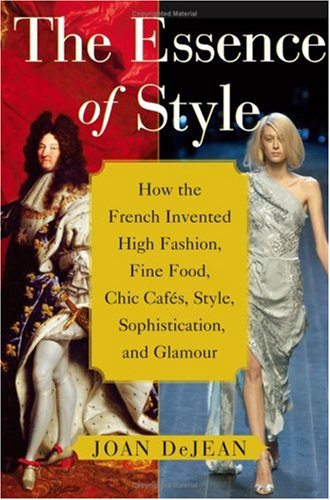
Synopsis
An exploration of how French culture during the reign of Louis XIV has had an enduring influence on modern traditions and style cites the French origins of such practices as haute cuisine, interior design, and the consumption of celebratory champagne. 40,000 first printing.
"synopsis" may belong to another edition of this title.
About the Author
Joan DeJean, author of seven previous books on French literature, history, and culture during the reign of Louis XIV, is Trustee Professor of French at the University of Pennsylvania, where she has taught for the past fifteen years. She has also held positions at both Princeton and Yale. Bicultural, she shuttles regularly between her homes in Philadelphia and Paris, with her finger on the pulse of both venues.
Reviews
Adult/High School–DeJean gives readers an entertaining and engrossing account of how and when France cornered the market on luxury. Beginning with a description of what life was like before Louis XIV ascended the throne in 1643, she then details the radical changes that occurred as he and his ministers redirected French manufactures toward the creation of new luxury items. Each of the various subjects she discusses has its own chapter that can stand alone; taken together they show how desire for style created new products and markets. Louis's sumptuous, constantly redesigned wardrobe was copied by his court. The interest in the elegant new styles led to the development of the fashion press. The magazines with their engravings (the original fashion plates) enthralled the common people, who wanted their own bit of glamour. The manufacture of luxury accessories allowed almost everyone to feel like a fashionista. Since women needed somewhere to show off their stylish clothes, the dark, smoky coffeehouses were replaced by elegant, glittering cafés with fine coffee and exquisite pastries. Teens who gather in modern cafés, flip through fashion magazines, and purchase designer bags will enjoy this book. They will also discover that Madison Avenue has nothing on 17th-century Paris.–Kathy Tewell, Fairfax County Public Library, VA
Copyright © Reed Business Information, a division of Reed Elsevier Inc. All rights reserved.
The Essence of Style is about what its author calls "the most crucial period ever in the history of elegance, élan, and luxury goods." If you are inclined to feel, as I am, that in history's great sweep this is at best a trivial if not outright silly little footnote, it is interesting all the same, and, despite Joan DeJean's occasional foray into flippancy, her book is interesting as well. Its central premise is stated at the outset:
"At that moment, Louis XIV, a handsome and charismatic young king with a great sense of style and an even greater sense of history, decided to make both himself and his country legendary. When his reign began, [France] in no way exercised dominion over the realm of fashion. By its end, his subjects had become accepted all over the Western world as the absolute arbiters in matters of style and taste, and his nation had found an economic mission: it ruled over the sectors of the luxury trade that have dominated that commerce ever since. . . ."
Like it or not -- and a great many Americans don't -- this is true. During Louis XIV's incredibly long reign -- he assumed the throne as a boy in 1643 and left it at his death in 1715, four days shy of his 77th birthday -- France, Paris specifically, was indeed transformed into "the world capital of style" and remains that to this day. It is true that the Sun King plundered the French treasury to fight an endless succession of wars (mentioned by DeJean only in passing), built a vast monument to himself at Versailles and adorned himself in raiment almost too grand and lavish to describe, but he also goaded and inspired his country's artists and artisans to make France synonymous with elegance, sophistication and panache.
From the late 17th century to the early 18th century, France metamorphosed from a place wracked by internal dissension and civil war into something approximating the unified nation of today, though plenty more dissension and civil strife lay ahead of it. In the arts and life's other finer pursuits, though, France made astonishing progress from which it would never retreat. In close cooperation with his prime minister, Jean-Baptiste Colbert, "the man who wrote the modern book on economic protectionism and trade wars," Louis XIV concentrated on making France economically self-sufficient. This policy had many manifestations, not the least of which was his campaign to stop importing luxury goods and start creating them at home, which was intended to reduce the drain on the treasury (giving him more money to fight all those wars) and, as it turned out, to make "haute cuisine and haute couture" the essential ingredients in "France's national image." Louis XIV succeeded on both counts, which has much to do with the high regard in which he was held by Voltaire and many other French intellectuals and the reputation he has enjoyed over the centuries as an enlightened if self-indulgent ruler.
The catalogue of accomplishments in haute cuisine and haute couture that DeJean has assembled is impressive indeed. At times, to be sure, you feel as if you are wading through a 17th-century equivalent of one of those glossy American magazines that bow in whatever direction wretched excess is to be found, but it is true that, as DeJean argues, the achievements in food and fashion that were made on behalf of Louis XIV and his court in time benefited the lesser orders as well. The folding umbrella, for example, invented by Jean Marius in the early 18th century with "a steel frame virtually indistinguishable from those found in modern folding umbrellas," was initially exceedingly expensive (even by mid-century it fetched "somewhere between $750 and $1,100"), but as production techniques improved it became available to just about everyone, making it possible for people to go their ways in damp weather without arriving at their destinations sopping wet.
The same goes for mirrors. Until Louis XIV goosed French artisans into action, the mirror market had been cornered by the glassblowers of Venice, whose products were very small, very irregular and very expensive, primarily because the glass was blown. Once the French figured how to make sheet glass, it became possible to manufacture large, even wall-size, mirrors, with their "capacity to brighten up a room, to multiply the glitz of glittering surfaces, and to make everything seem larger than life." Again, at first only the very wealthy could afford them, but soon enough the less affluent were able to use mirrors for all those purposes as well as to groom themselves, which for a 17th-century Frenchman or Frenchwoman occupied as much as three hours a day.
It is to fashion, though, that DeJean gives greatest emphasis. Even those of us who find the fashionistas tiresome and/or contemptible must acknowledge that she is right to do so, for the global influence of French haute couture cannot be overestimated. "In the late 1670s," DeJean writes, "a number of developments essential to the transformation of fashion into the fashion industry came together: an expanded clientele for high-fashion goods; increasingly sophisticated means of supplying the new demand; and for the first time ever, ways of disseminating news of trends in the making widely and quickly, thereby guaranteeing that the ranks of the fashion obsessed would continue to grow. And perhaps most important of all, it was then that fashionistas were introduced to what is still today the fundamental tool in the marketing of fashion: in the late 1670s, fashion seasons began."
DeJean, who obviously takes fashion very, very seriously (according to her publisher, "She divides her time between Philadelphia and Paris, where she lives in the most fashionable neighborhood of 17th-century Paris, the Marais"), no less obviously knows her subject. She is smart about how "imitation" -- finding for yourself "that adorable little number you saw on a lady strolling down the Champs-Elysées" -- ranks high among the "thrills" of fashion, about how women superseded men as the chief beneficiaries of and market for fashion, and how the market gradually evolved from catering to the aristocracy to serving a far wider public. Her discussion of the outer garment known as the mantua makes this last point:
" . . . the mantua was not close-fitting, so while it could be made to measure, this wasn't strictly necessary. It thus marked the first giant step toward prêt-à-porter. And since it was less expensive to produce, the mantua was the first high-fashion garment to which nonaristocratic women could aspire. They could never hope to own a mantua made from luxe fabric, but they could -- and did -- adopt the new style. The mantua meant that for the first time a woman's outfit did not function as an absolute class marker; from then on, it was far less easy to know at a glance who belonged where on the social spectrum."
As for haute cuisine, DeJean has less to say than one might expect. She dates "the process by which France became a culinary world apart" to the publication in 1651 of a cookbook by a professional chef, Francois Pierre, called Le Cuisinier français (The French Chef). Following this, "Paris became enshrined as gastronomy's international capital: the age of celebrity chefs, of the restaurant, and of must-have dishes had begun." Sweet dishes, previously part of every course, were moved to the end of the meal, and French cuisine as we now know it began to take shape. Like many other French eaters, Louis XIV benefited from these dramatic culinary developments (as his full-length portraits make unmistakably clear), but in this instance he seems to have been more the beneficiary than the initiator.
Precisely where all of this fits in the larger scheme of things is not entirely clear, apart from the obvious economic benefits to France, tourism among them. Certainly, though, The Essence of Style is a useful reminder that every once in a while the now-repudiated Great Man theory of history is absolutely correct: The Sun King was indeed a Great Man, and -- no matter how one feels about fashionistas and other frivolities -- the magnitude of his legacy cannot be denied.
Copyright 2005, The Washington Post Co. All Rights Reserved.
Not only do French women not get fat, they've led the world in style for the past 300 years. French historian DeJean's premise is simple yet wonderfully effective: largely because of one obsessive spendthrift, Louis XIV, France, in the late 17th century, became the arbiter of chic, a position from which it has never since faltered. Louis's outrageous vanity, sumptuous court and devotion to his own well-being led to growth in the manufacturing of fine clothing and shoes, and the invention of shops in which to buy them, and to celebrity cuisine, cafes and Champagne (a particularly amusing—and explosive—chapter). Louis was enthralled by glitter, which fostered a huge increase in the diamond trade; the theft of the Venetians' mirror-making secrets and subsequent rise of France as world leader in that field; and the first night streetlights (hence the "City of Lights"). Louis also abhorred mud (so streets were paved with cobblestones) and disliked getting wet (thus umbrellas were invented). This engaging history "lite"—to be published on Bastille Day—is a fun read despite its many Sex in the City references. Photos, illus. Agent, Alice Martell. (July 14)
Copyright © Reed Business Information, a division of Reed Elsevier Inc. All rights reserved.
The first hairdresser, the first celebrity chef, and the first bubbly. The list is almost endless. And according to DeJean, professor and French historian, the French supremacy in all things luxe started in the seventeenth century by command (mostly) of the Sun King, Louis XIV. By sleight of research, she fascinates, cajoles, and intrigues with little-known facts and figures, weaving stories inside and out each topic, from fashion, shoes, and coiffeurs to streetlights, cafes, and mirrors. Examples include the first truly French apparel design debuting in the 1670s in the shape of a simple kimono called a mantua, the king's shoe addiction fed by a craftsman named Lestage, and, a century later, Jean-Honore Fragonard's Swing capturing the nation's fascination with footwear. And, yes, the humble folding umbrella was birthed in 1709, a six-ouncer invented by Jean Marius--and today an ubiquitous accessory. An unusual and delightfully educational perspective on snob appeal. Barbara Jacobs
Copyright © American Library Association. All rights reserved
"About this title" may belong to another edition of this title.
Search results for The Essence of Style: How the French Invented High...

Stock Image
The Essence of Style: How the French Invented High Fashion, Fine Food, Chic Cafes, Style, Sophistication, and Glamour
Seller: World of Books (was SecondSale), Montgomery, IL, U.S.A.
Seller rating 5 out of 5 stars

Hardback. Condition: Good. What makes fashionistas willing to pay a small fortune for a particular designer accessory? Why does a special occasion only become really special when a champagne cork pops? Why are diamonds the status symbol gemstone, instantly signifying wealth, power, and even emotional commitment? Writing with great lan, one of the foremost authorities on seventeenth-century French culture provides the answer to these and other fascinating questions in her account of how, at one glittering moment in history, the French under Louis XIV set the standards of sophistication, style, and glamour that still rule our lives today. Joan DeJean takes us back to the birth of haute cuisine, the first appearance of celebrity hairdressers, chic caf s, nightlife, and fashion in elegant dress that extended well beyond the limited confines of court circles. And Paris was the magical center -- the destination of travelers all across Europe. Full of wit, dash, and verve, The Essence of Style will delight fans of history and everybody who wonders about the elusive definition of good taste. Seller Inventory # 00105024150
Stock Image
The Essence of Style: How the French Invented High Fashion, Fine Food, Chic Cafes, Style, Sophistication, and Glamour
Seller: World of Books (was SecondSale), Montgomery, IL, U.S.A.
Seller rating 5 out of 5 stars
Hardback. Condition: Fair. What makes fashionistas willing to pay a small fortune for a particular designer accessory? Why does a special occasion only become really special when a champagne cork pops? Why are diamonds the status symbol gemstone, instantly signifying wealth, power, and even emotional commitment? Writing with great lan, one of the foremost authorities on seventeenth-century French culture provides the answer to these and other fascinating questions in her account of how, at one glittering moment in history, the French under Louis XIV set the standards of sophistication, style, and glamour that still rule our lives today. Joan DeJean takes us back to the birth of haute cuisine, the first appearance of celebrity hairdressers, chic caf s, nightlife, and fashion in elegant dress that extended well beyond the limited confines of court circles. And Paris was the magical center -- the destination of travelers all across Europe. Full of wit, dash, and verve, The Essence of Style will delight fans of history and everybody who wonders about the elusive definition of good taste. Seller Inventory # CIN0743264134A
Seller Image
The Essence of Style: How the French Invented High Fashion, Fine Food, Chic Cafes, Style, Sophistication, and Glamour
Seller: Zoom Books East, Glendale Heights, IL, U.S.A.
Seller rating 5 out of 5 stars
Condition: good. Book is in good condition and may include underlining highlighting and minimal wear. The book can also include "From the library of" labels. May not contain miscellaneous items toys, dvds, etc. . We offer 100% money back guarantee and 24 7 customer service. Seller Inventory # ZEV.0743264134.G
Seller Image
The Essence of Style: How the French Invented High Fashion, Fine Food, Chic Cafes, Style, Sophistication, and Glamour
Seller: Greenworld Books, Arlington, TX, U.S.A.
Seller rating 5 out of 5 stars
Condition: very_good. Fast Free Shipping â" Very Good condition book with a firm cover and clean pages. Shows normal use and some light wear or limited notes markings. A solid, nice copy to enjoy. Seller Inventory # GWV.0743264134.VG
Stock Image
The Essence of Style: How the French Invented High Fashion, Fine Food, Chic Cafes, Style, Sophistication, and Glamour
Seller: World of Books Inc, Montgomery, IL, U.S.A.
Seller rating 4 out of 5 stars

Hardback. Condition: Good. What makes fashionistas willing to pay a small fortune for a particular designer accessory? Why does a special occasion only become really special when a champagne cork pops? Why are diamonds the status symbol gemstone, instantly signifying wealth, power, and even emotional commitment? Writing with great lan, one of the foremost authorities on seventeenth-century French culture provides the answer to these and other fascinating questions in her account of how, at one glittering moment in history, the French under Louis XIV set the standards of sophistication, style, and glamour that still rule our lives today. Joan DeJean takes us back to the birth of haute cuisine, the first appearance of celebrity hairdressers, chic caf s, nightlife, and fashion in elegant dress that extended well beyond the limited confines of court circles. And Paris was the magical center -- the destination of travelers all across Europe. Full of wit, dash, and verve, The Essence of Style will delight fans of history and everybody who wonders about the elusive definition of good taste. Seller Inventory # CIN0743264134G
Stock Image
The Essence of Style: How the French Invented High Fashion, Fine Food, Chic Cafes, Style, Sophistication, and Glamour
Seller: World of Books Inc, Montgomery, IL, U.S.A.
Seller rating 4 out of 5 stars
Hardback. Condition: Fair. What makes fashionistas willing to pay a small fortune for a particular designer accessory? Why does a special occasion only become really special when a champagne cork pops? Why are diamonds the status symbol gemstone, instantly signifying wealth, power, and even emotional commitment? Writing with great lan, one of the foremost authorities on seventeenth-century French culture provides the answer to these and other fascinating questions in her account of how, at one glittering moment in history, the French under Louis XIV set the standards of sophistication, style, and glamour that still rule our lives today. Joan DeJean takes us back to the birth of haute cuisine, the first appearance of celebrity hairdressers, chic caf s, nightlife, and fashion in elegant dress that extended well beyond the limited confines of court circles. And Paris was the magical center -- the destination of travelers all across Europe. Full of wit, dash, and verve, The Essence of Style will delight fans of history and everybody who wonders about the elusive definition of good taste. Seller Inventory # CIN0743264134A
Stock Image
The Essence of Style: How the French Invented High Fashion, Fine Food, Chic Cafes, Style, Sophistication, and Glamour
Seller: ThriftBooks-Atlanta, AUSTELL, GA, U.S.A.
Seller rating 5 out of 5 stars
Hardcover. Condition: Fair. No Jacket. Former library book; Readable copy. Pages may have considerable notes/highlighting. ~ ThriftBooks: Read More, Spend Less. Seller Inventory # G0743264134I5N10
Stock Image
The Essence of Style: How the French Invented High Fashion, Fine Food, Chic Cafes, Style, Sophistication, and Glamour
Seller: ThriftBooks-Atlanta, AUSTELL, GA, U.S.A.
Seller rating 5 out of 5 stars
Hardcover. Condition: Good. No Jacket. Missing dust jacket; Pages can have notes/highlighting. Spine may show signs of wear. ~ ThriftBooks: Read More, Spend Less. Seller Inventory # G0743264134I3N01
Stock Image
The Essence of Style: How the French Invented High Fashion, Fine Food, Chic Cafes, Style, Sophistication, and Glamour
Seller: ThriftBooks-Atlanta, AUSTELL, GA, U.S.A.
Seller rating 5 out of 5 stars
Hardcover. Condition: Good. No Jacket. Pages can have notes/highlighting. Spine may show signs of wear. ~ ThriftBooks: Read More, Spend Less. Seller Inventory # G0743264134I3N00
Stock Image
The Essence of Style: How the French Invented High Fashion, Fine Food, Chic Cafes, Style, Sophistication, and Glamour
Seller: ThriftBooks-Dallas, Dallas, TX, U.S.A.
Seller rating 5 out of 5 stars
Hardcover. Condition: Very Good. No Jacket. May have limited writing in cover pages. Pages are unmarked. ~ ThriftBooks: Read More, Spend Less. Seller Inventory # G0743264134I4N00