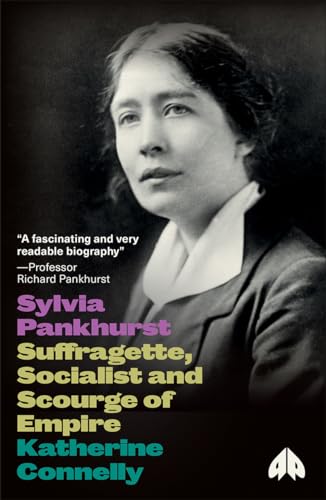
From militant suffragette at the beginning of the twentieth century to campaigner against colonialism in Africa after the Second World War, Sylvia Pankhurst dedicated her life to fighting oppression and injustice.
In this vivid biography Katherine Connelly examines Pankhurst’s role at the forefront of significant developments in the history of radical politics. She guides us through Pankhurst's construction of a suffragette militancy which put working-class women at the heart of the struggle, her championing of the Bolshevik Revolution and her clandestine attempts to sabotage the actions of the British state, as well as her early identification of the dangers of Fascism.
The book explores the dilemmas, debates and often painful personal consequences faced by Pankhurst which were played out in her art, writings and activism. It argues that far from being an advocate of disparate causes, Pankhurst’s campaigns were united by an essential continuity which hold vital lessons for achieving social change. This lively and accessible biography presents Pankhurst as a courageous and inspiring campaigner, of huge relevance to those engaged in social movements today.
"synopsis" may belong to another edition of this title.
Katherine Connelly is a leading member of Counterfire and a regular contributor to its online magazine. She has also contributed to International Socialism and Socialist Review, and is currently conducting doctoral research in History at Queen Mary, University of London.
Acknowledgements, vii,
Introduction, 1,
1 Portrait of the Artist as a Young Woman, 4,
2 Suffragettes, Socialism and Sacrifice, 17,
3 Working For Their Own Emancipation, 39,
4 Resisting the War, 67,
5 Sylvia's Communism, 87,
6 Anti-Fascism, Women and Democracy, 116,
7 Fighting Imperialism in War and Peace, 130,
Conclusion, 148,
Notes, 150,
Index, 166,
Portrait of the Artist as a Young Woman
THE PANKHURSTS
I was a child of the late nineteenth century, an inheritor of the struggle for political democracy, not fully accomplished then even for men, whilst women were still outside the political system, profiting by the gains of democracy only adventitiously. The Labour movement for the economic betterment of the masses was stirring towards its birth. The idea of internationalism, in the sense that the world is every man's country, to be valued and respected equally with his birthplace, was gaining ground.
These words, written by Sylvia Pankhurst in 1938, describe the struggles which informed her whole life: the struggles for democracy, women's rights, working-class emancipation, internationalism, and against imperialism.
She was born into a political family at a time of intense political turmoil. Her parents, Emmeline Goulden and Dr Richard Marsden Pankhurst, both came from big Liberal families in Manchester, the city of manufacture and commerce that epitomised nineteenth-century Liberalism. Emmeline Goulden was the eldest daughter of Robert Goulden, a partner in a cotton printing and bleaching firm and local Liberal councillor. Richard Pankhurst, the son of a Liberal Baptist Dissenter, worked as a barrister. In the late 1870s the Conservative government allied itself with the repressive Turkish Empire, almost dragging Britain into war with Russia, and fought unpopular and disastrous wars in Afghanistan and South Africa. Emmeline and Richard met in the ferment of the antiwar agitation championed by the Liberal Party, and married in 1879. They shared a passion for radical politics and challenging injustice; in their short courtship Richard wrote to Emmeline 'every struggling cause shall be ours'. Only 21 when she married, Emmeline had attended her first women's suffrage meeting at the age of 14. Richard, who was 20 years older, had been involved in politics for far longer. He declared himself a republican in the 1870s, campaigned for the abolition of the House of Lords, was a prominent supporter of women's suffrage and Home Rule for Ireland, and championed the Mechanics Institutes, which pioneered working-class higher education.
In 1880 their first child, Christabel Harriette, was born, and became, by all accounts, her mother's favourite child. On the 5th of May 1882 their second child Estelle Sylvia was born. The name Estelle, which had been chosen by her mother, was swiftly rejected by the independent-minded child who insisted on using her middle name which had been chosen by her father, something that perhaps strengthened the very close relationship she had with him. Three more children followed: Henry Francis Robert (Frank) was born in 1884, but died in 1888, Adela Constantia Mary was born in 1885, and Henry Francis (Harry) in 1889.
A year after Sylvia's birth, Richard Pankhurst declared his intention to run in a Manchester by-election, publicly backed by his father-in-law Robert Goulden whose home the Pankhursts had moved into. However, since the Liberal Party had come into office in 1880 all the idealism it expressed in opposition had melted away. Richard resigned from the local Liberal Association and ran as an independent candidate, openly criticising the Liberal government's repressive policies in India and Ireland. He was to pay a high price for his radical programme. Even though the only other candidate in the election was a Conservative, the Liberal Association called on its members not to vote for Richard Pankhurst and the Liberal press attacked him as a 'wild extremist'. Richard lost the election and his rebellious stance saw him subject to a professional boycott. His reaction to this would generate profound political and personal changes for the Pankhurst family.
ALL THAT IS SOLID MELTS INTO AIR: THE POLITICS OF THE 1880s
Immediately after the 1883 election Richard helped found a Radical Association to challenge the Liberals and took up the case of a fruit and vegetable salesman against the powerful Corporation of Manchester. This was all rather too much for the respectable businessman Robert Goulden to tolerate, especially as he found his own business was now being boycotted. After a series of bitter arguments the Pankhursts left the Goulden home and moved to London. Emmeline never spoke to her father again. It was instilled into Sylvia from an early age that principles came first no matter what the financial or personal cost.
The Pankhursts' political trajectory reflected the wider social and political developments of the 1880s. The antiwar movement of the late 1870s had radicalised many of its supporters who, like Richard Pankhurst, became disillusioned with the Liberal government and began to look for new ideas which resonated with their desire for radical social change. New radical and socialist organisations sprang up: the Democratic Federation, established in 1881, became the more socialist Social Democratic Federation in 1884, and in the same year the Fabian Society and the Socialist League were formed. In 1886 a demonstration protesting at the destitution faced by the unemployed turned violent and leading socialists were put on trial. A year later a demonstration in Trafalgar Square against repression in Ireland was met by mounted police who attacked the protestors on what became known as 'Bloody Sunday'. In response, campaigns for free speech were launched. In 1888 hundreds of matchwomen in East London went on strike, marched on Parliament, formed a union and won their dispute. Their action inspired other groups of workers, who were classed as 'unskilled' and left unorganised by the trade unions, to take militant strike action and form their own unions. A year after the matchwomen, the gas workers struck, swiftly followed by the Great Dock Strike which galvanised hundreds of thousands of workers into activity and a wave of strike action across the country. This was described as New Unionism and it was evident why: in 1889 union membership had stood at 860,000, by 1890 it stood at nearly 2 million. New Unionism marked a level of working-class militancy and self-organisation that had not been seen since the Chartist movement in the 1840s. In ten years the landscape of stale political certainties had been transformed into one characterised by strikes, protests and acute social tensions.
In 1885 Richard Pankhurst again stood unsuccessfully for Parliament, but this time as a Radical for the London constituency of Rotherhithe. In the mid 1880s Richard and Emmeline continued their political trajectory away from their Liberal Party backgrounds, joining the moderate socialist Fabian Society and participating in the free speech agitation. But like many of the moderate socialists they had only marginal contact with New Unionism – apart from mixing with some of the labour movement leaders and donating money to the matchwomen's strike fund, they kept their distance from the huge strike wave.
EMANCIPATION BEGINS AT HOME
Whereas many suffragette memoirs tell of childhood battles for the right, as daughters, to spend time reading, Sylvia Pankhurst recalled of her London childhood: 'we chose what books we pleased at the London Library, and any in the house; there were no barriers'. The enlightened Dr Pankhurst encouraged his daughters to read voraciously: 'For many years he brought a book home to us every night; history, travel, simple science, astronomy, botany, chemistry, engineering, fairy-tales, standard novels, reproductions of works of art, the best illustrations.' He read them the radical poetry of Shelley and Whitman, and Sylvia's writings about her early life are filled with the vivid impressions from her childhood reading. Imaginative and emotional, Sylvia was haunted by the depictions of poverty in Dickens's novels: 'they dealt me horrible dreams and sleepless nights; but they made real for me the cause of the People and the Poor. The miseries of Oliver Twist and the other exploited children bit deep into my little heart.'
Defying the social expectation that young middle-class women should concentrate on getting married and confining themselves to the home, Sylvia recalled that her father impressed upon his daughters the importance of working for a living: 'When we were still but toddlers he was for ever asking us: "What do you want to be when you grow up?" and urging: "Get something to earn your living by that you like and can do."'
Sylvia's vocation, from very early childhood, was art, and this was encouraged despite the precarity of an artistic profession. She was deeply influenced by the art produced by Walter Crane for the labour movement, such as his drawings celebrating May Day, and by William Morris's evocations of egalitarian societies – in particular she was struck by Morris's illustration accompanying the lines 'When Adam delved and Eve span, who was then the gentleman', in his A Dream of John Ball (1888). Her earliest ideas about art were thus inextricably linked with the struggle for a better world, and one of her earliest ambitions was to make that struggle itself beautiful, aesthetically uplifting and inspiring:
I would be a decorative painter; I would portray the world that is to be when poverty is no more. I would decorate halls where people would foregather in the movement to win the new world, and make banners for the meetings and processions. I had been with my parents to meetings of the social [sic] Democratic Federation in dingy rooms in back streets, and to drab and dreary demonstrations in Hyde Park; I wanted to make these beautiful.
The Pankhursts' unusual childhood was compounded by the fact that their mother refused to allow them to go to school while they lived in London, declaring that 'I want to develop their individuality above all things.' They were therefore erratically educated by a series of governesses and derived an extensive political awareness at the meetings their parents held, attended by figures from across the contemporary radical movements: 'The house was soon a centre for many gatherings, of Socialists, Fabians, Anarchists, Suffragists, Free Thinkers, Radicals and Humanitarians of all schools.'
'IMMEDIATE AND UNCONDITIONAL EMANCIPATION': THE LESSONS OF THE WOMEN'S FRANCHISE LEAGUE
In the late nineteenth century the argument over how radical the women's suffrage movement should be centred around the problem of 'coverture' – the status imposed on wives under English common law which denied them a legal existence independent of their husband. In the 1860s the parliamentary Bills for women's suffrage made no mention of coverture, and many of the campaigners for these Bills were working to dismantle coverture. Richard Pankhurst drafted the Married Women's Property Act, giving married women the right to their own property, which was passed into law in 1882, the year Sylvia was born. It seemed that by the time women's suffrage was granted coverture would be abolished and so all women, whether married or not, would win the vote. However, from 1874, after the Liberal Jacob Bright lost his seat and the women's suffrage movement their most radical supporter in Parliament, MPs began to introduce women's suffrage Bills which explicitly excluded married women, a development that was tolerated by the women's suffrage societies. But by 1889, when Liberal MP William Woodall introduced a Bill with the proviso 'that nothing in this Act contained shall enable women under coverture to be registered to vote at such elections', the social and political tempo outside Parliament had changed. A group of campaigners, mostly Radical Liberals, feminists who were openly critical of marriage, and some members of the new socialist organisations, organised to fight this discriminatory clause and in 1889 split from the other suffrage societies to form the Women's Franchise League (WFL).
The Pankhursts were leading members of the WFL which, from the start, made it clear that they rejected the idea that the fight for women's suffrage could be separated from the wider struggle for women's emancipation. The WFL inaugural meeting was addressed by William Lloyd Garrison whose father, of the same name, had been prominent in the American struggle to abolish slavery. Lloyd Garrison likened the suffrage movement to the anti-slavery movement. He asserted that the approach of the 'moderates' was worse than the 'openly frank and brutal' opposition of the slave-holders, for they 'were always trying to temper zeal, weaken testimony, decry strong language, and apologise for the wrong-doer'. Meanwhile, the Abolitionists' 'only response was "immediate and unconditional emancipation." They knew full well that the moral force of their uncompromising advocacy would mould legislation more powerfully than temporising and wire-pulling to accomplish partial Acts.'
Richard Pankhurst endorsed this message: 'We will not take a piece of justice if thereby we prejudice and injure all the rest.' In 1890 the WFL called an International Conference held at the Pankhursts' home in London which proclaimed the 'modern movement' to be one that 'seeks to place society in all its relations upon principles of equal justice, [and] has necessarily attacked the privileges and disabilities grounded on colour, race, religion, and class'.
The WFL lasted only into the early 1890s, disintegrating shortly after the Pankhursts moved back to Manchester, but it was the radical tradition of social struggle that it represented, its insistence on going on the offensive in campaigns and refusing to submit to divisions encouraged from above, that inspired the early militant suffragettes and Sylvia's lifelong vision of campaigning.
SYLVIA'S FIRST CAMPAIGNS
By the beginning of the 1890s New Unionism found itself faced with a huge bosses' offensive. The strike wave that had seen such significant victories was now experiencing devastating defeats; some employers imposed a lock-out on workers, starving them into submission. Some socialists began to argue that resorting to offensive strike action had been wrong all along, and that instead workers should focus their efforts on achieving reforms through Parliament. At the beginning of the 1890s thousands of workers striking against wage cuts in Bradford's Manningham Mills were starved back to work, and it was in Bradford, symbolically, that the Independent Labour Party (ILP) was founded in January 1893. The turn towards a political route was not seen as a way of strengthening a working-class movement which could challenge capitalism but was designed to substitute for such a movement, maintaining that an equal and just society could be created through parliamentary reforms alone. This was the view of socialism that Richard and Emmeline Pankhurst were comfortable with. Unlike revolutionary socialists such as Eleanor Marx, who was deeply involved in New Unionism, helping in the day-to-day running of the strikes and discussing political strategies, the Pankhursts were not in favour of spreading industrial action. Indeed at the 1898 ILP Conference Richard Pankhurst moved the resolution reading: 'That this conference of Socialists deplores the action of trades unionists in resorting to strikes to obtain industrial reform, and declares in favour of political action for labour reform.' He then went on to add that 'the serious questions which were usually involved in strikes should be left to the responsible settlement of Parliament'. The Pankhursts were more comfortable viewing workers as victims whom they could speak on behalf of. They were thus predisposed to the ILP, becoming early leading members of the organisation, and forming a close friendship with Keir Hardie, one of the ILP's founding members.
But Sylvia did not experience this change in orientation in the same way her parents did. As a young child in London she had been largely confined to the home, meeting only figureheads from the labour movement. As a teenager in Manchester she was able to go out campaigning alongside her parents in the new socialist campaigns. From Sylvia's perspective, the 1890s marked not a retreat from class struggle to more politically focused action, but a move towards the working class as she was now meeting working-class people in significant numbers for the first time. She helped her mother distribute food to the destitute unemployed in the winter of 1894–5, finding herself 'heartsick at the grim sight of those hungry thousands waiting in the bitter cold to receive that meagre aid'. She went with her father when he spoke to crowds in the working-class districts of Manchester, and when Richard stood as the ILP candidate for Gorton in 1895 (again he was unsuccessful) she went out canvassing for him and heard the terrible experiences of poor families. Above all, these experiences filled her with a profound anger against poverty:
I would ask myself whether it could be just that I should live in Victoria Park, and go well fed and warmly clad, whilst the children of these grey slums were lacking the very necessities of life. The misery of the poor, as I heard my father plead for it, and saw it revealed in the pinched faces of his audiences, awoke in me a maddening sense of impotence; and there were moments when I had the impulse to dash my head against the dreary walls of those squalid streets.
Excerpted from Sylvia Pankhurst by Katherine Connelly. Copyright © 2013 Katherine Connelly. Excerpted by permission of Pluto Press.
All rights reserved. No part of this excerpt may be reproduced or reprinted without permission in writing from the publisher.
Excerpts are provided by Dial-A-Book Inc. solely for the personal use of visitors to this web site.
"About this title" may belong to another edition of this title.
Seller: WeBuyBooks, Rossendale, LANCS, United Kingdom
Condition: Good. Most items will be dispatched the same or the next working day. A copy that has been read but remains in clean condition. All of the pages are intact and the cover is intact and the spine may show signs of wear. The book may have minor markings which are not specifically mentioned. Seller Inventory # wbs6152732863
Quantity: 1 available
Seller: Midtown Scholar Bookstore, Harrisburg, PA, U.S.A.
paperback. Condition: Very Good. Very Good - Crisp, clean, unread book with some shelfwear/edgewear, may have a remainder mark - NICE PAPERBACK Standard-sized. Seller Inventory # M0745333222Z2
Seller: WorldofBooks, Goring-By-Sea, WS, United Kingdom
Paperback. Condition: Very Good. The book has been read, but is in excellent condition. Pages are intact and not marred by notes or highlighting. The spine remains undamaged. Seller Inventory # GOR008494636
Quantity: 5 available
Seller: Books-R-Keen, DuBois, PA, U.S.A.
paperback. Condition: New. Seller Inventory # 7B-RL42542871
Seller: Greener Books, London, United Kingdom
Paperback. Condition: Used; Very Good. **SHIPPED FROM UK** We believe you will be completely satisfied with our quick and reliable service. All orders are dispatched as swiftly as possible! Buy with confidence! Greener Books. Seller Inventory # 4515610
Quantity: 1 available
Seller: Lucky's Textbooks, Dallas, TX, U.S.A.
Condition: New. Seller Inventory # ABLIING23Feb2416190147255
Seller: Rarewaves.com USA, London, LONDO, United Kingdom
Paperback. Condition: New. From militant suffragette at the beginning of the twentieth century to campaigner against colonialism in Africa after the Second World War, Sylvia Pankhurst dedicated her life to fighting oppression and injustice. In this vivid biography Katherine Connelly examines Pankhurst's role at the forefront of significant developments in the history of radical politics. She guides us through Pankhurst's construction of a suffragette militancy which put working-class women at the heart of the struggle, her championing of the Bolshevik Revolution and her clandestine attempts to sabotage the actions of the British state, as well as her early identification of the dangers of Fascism. The book explores the dilemmas, debates and often painful personal consequences faced by Pankhurst which were played out in her art, writings and activism. It argues that far from being an advocate of disparate causes, Pankhurst's campaigns were united by an essential continuity which hold vital lessons for achieving social change. This lively and accessible biography presents Pankhurst as a courageous and inspiring campaigner, of huge relevance to those engaged in social movements today. Seller Inventory # LU-9780745333229
Quantity: Over 20 available
Seller: Orbiting Books, Hereford, United Kingdom
Paperback. Condition: New. Next day dispatch from the UK (Mon-Fri). Please contact us with any queries. Seller Inventory # mon0000638538
Quantity: Over 20 available
Seller: Ria Christie Collections, Uxbridge, United Kingdom
Condition: New. In. Seller Inventory # ria9780745333229_new
Quantity: Over 20 available
Seller: Books Puddle, New York, NY, U.S.A.
Condition: New. pp. 176. Seller Inventory # 2651380216