In 2005, a group of photographers took a stand alongside the people of the small town of Bil’in, and documented their fight to stop the Israeli government building the infamous West Bank Barrier. Inspired by what they had seen in Bil’in, the group went on to form Activestills, a collective whose work has become vital in documenting the struggle against Israeli occupation and everyday life in extraordinary situations.
Activestills: Photography as Protest in Palestine/Israel examines the collective’s archive and activity from historical, theoretical, critical, and personal perspectives. It is the result of an in-depth dialogue among members of the collective and activists, journalists, intellectuals, and academics, and stands as the definitive study of the collective’s work.
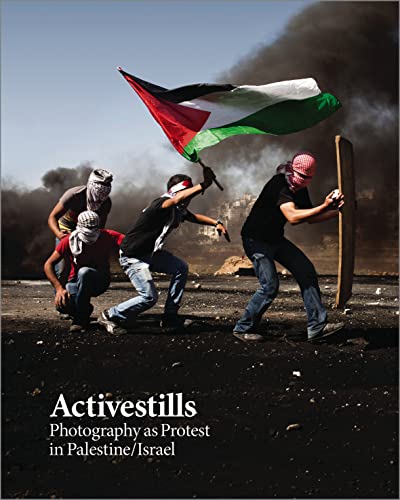
Combining striking full-colour photographs with essays and commentary, Activestills stands as both a major contribution to reportage on Israel/Palestine and a unique collection of visual art.
"synopsis" may belong to another edition of this title.
Vered Maimon is a senior lecturer in the Art History Department at Tel Aviv University. Shiraz Grinbaum is the Activestills Collective’s curator and photo editor.
Foreword Miki Kratzman, 024,
Introduction Vered Maimon and Shiraz Grinbaum, 028,
Part I Active,
Activestills' Photographic Archive: A Common Treasure Ariella Azoulay, 044,
Distributing Dissents: Activestills and Alternative Israeli Media Haggai Matar, 058,
The Middle East and New Media: The Challenge and the Opportunity Ramzy Baroud, 066,
Contentious Displays: Activestills' Street Exhibitions Simon Faulkner, 074,
Conversations,
Zehava Greenfeld, 090,
Nariman Tamimi, 096,
Hakmih Abu Mdigim and Salim Abu Mdigim, 104,
Issa Amaro, 110,
Activists' Texts,
Abdallah Abu Rahmah, 120,
Monim Mandela, 130,
Reuven Abergel, 136,
Carmen Elmakiyes, 142,
Chen Misgav, 146,
Lilach Ben David, 152,
Adi Winter, 160,
Santiago Gomez, 164,
Part II Stills,
Surviving Images and Images of Survival: On Activestills' Photographs of Protest Vered Maimon, 182,
Communities of Touch: Photography's Spaces of Appearance Meir Wigoder, 196,
Before the Law Sharon Sliwinski, 206,
Being There Ruthie Ginsburg, 214,
Photographers' Texts,
Ahmad Al-Bazz, 232,
Faiz Abu Rmeleh, 244,
Tess Scheflan, 258,
Anne Paq, 264,
Basel Alyazouri, 270,
Yotam Ronen, 278,
Ryan Rodrick Beiler, 282,
Keren Manor, 288,
Shachaf Polakow, 292,
Oren Ziv, 296,
Epilogue,
Sarit Michaeli, 306,
Contributors, 310,
Photographers, 312,
Acknowledgments, 315,
Index, 316,
Activestills' Photographic Archive: A Common Treasure
Ariella Azoulay
The cemented violence known as the Israeli separation wall is not the monster; it is merely its tail. However, it is quite big for a tail, big enough not to slip out of people's sight. And even though it stands still in broad daylight, many people pass by it without shouting "monster!" Monster is the word used to describe an unusual creature whose appearance, mode of being, and acting deviate from the accepted norms. Calling something a monster is sometimes a way to awaken it. The monster should be roused, not because it doesn't bite when it seems to be sleeping but because there are too many people who behave as if it does not bite and, with the many norms established by the Israeli regime of occupation from which it does not deviate, it is no wonder that people have become inured to it and can barely recognize its monstrosity. Awakening it is a way of forcing it to stop passing for something else and make it appear, not only in the eyes of the victims it explicitly targets who never, not even for a second, confused it with something else in all its monstrosity, as part of larger state apparatuses for which it functions merely as the tail. The monster, of which the wall is a part (whatever it is exactly and regardless of its size), continues to pass for many other things that are casually discussed and debated in common languages, in national and international forums, and by people in official positions of authority. We must say what it is, clearly and simply: the Israeli separation wall is part of a monster that not only deprives Palestinians of their right to move freely, to access their workplaces, lands, institutions, and facilities, but it is part of a larger apparatus that consolidates the continuous expulsion of Palestinians from their homeland and the differential inclusion of those of them who remained in Palestine or were added to the body politic of its governed as non-citizens in 1967, when more areas of what was Palestine were colonized. In this sense, qualifying the wall as a "separation" wall dismisses the very political principle on which the Israeli regime is built — Palestinians are included in the body politic of the governed, but they are governed differentially. The imaginary separation imposed and nurtured by the Israeli state propaganda apparatuses is so strong that Jewish citizens could refer to separation as a reality rather than as the devastating project that they are engaged in implementing against people with whom they are governed, i.e., Palestinians. The photographic archive produced by members of Activestills over one decade is an unprecedented opportunity to study the tensions between the reality in which people live, act, and interact with each other, and the devastating political project of separation whose implementation requires more and more violence.
A look inside a Palestinian home makes it less abstract [Fig. 1]. But, is this a home or a military post? The army needed an outpost, and this house was in just the right place to serve this "military" need. Its height and proximity to the wall turned it into a strategic point for snipers who could hit anyone in the crowd taking part in the weekly demonstration against the wall. The photograph was taken a few minutes after the soldiers had entered the house and a few minutes before they clashed with its residents and ransacked their living space. In the photo, one can see how Palestinians, together with international activists and Israelis (some of them members of Activestills), insist on not letting the soldiers' invasion of a private space be dominated by military logic, in other words, carried out behind closed doors without anyone else able to see. If this home is no longer a private space, at least they are there to make sure that this event will be made public. They refuse to be deprived further of their right and ability to accurately frame the act of this invasion for what it is: violence, with them as the target, not because of something they did, but, simply, because of who they are.
The wall does not separate two communities living on either side. Rather, it differentiates between them. Most, if not all, Palestinian declarations and actions are treated as suspect and as a kind of terror. This is not surprising since, by definition, any claim to abolish differential rule actually means the abolition of Jewish supremacy. The monstrosity of the wall is not only because of what it does to Palestinians, but also because of what it does to Jewish Israelis: it naturalizes their privilege and diminishes their encounters with those who are its direct victims, and thereby damages their ability to recognize their role as the perpetrators of its despicable effect. If people were struck by the monstrosity of the wall, less paperwork — and fewer photographs — would have been necessary in order to persuade different persons in the chain of command to either forbid its presence altogether, or at the very least, to change its location in order that it be able to impose only the tiniest bit of its tail.
In this photograph, the wall appears curled up in a sleeping position that makes it hard to imagine the bully it really is [Fig. 2]. Poised ceremoniously like a crown atop a head, it reveals little about the nature of its cruelty, or about how it functions, or what its mission or role is. This photograph is hard to comprehend at first since it does not convey an existing situation but rather, it presents a psychic image of some of the desires and expectations involved in the wall's construction and euphemistic name, "the separation fence." Palestinians are absent from the photo, assumed to be contained within its circular shape, kept obedient behind it, subservient to its authority. But as other photographs often reveal, instead of absent, the Palestinians are present, refusing to obey the set of commands the wall represents: "Do not approach," "Do not climb," "Do not pass through," "Do not infiltrate," "Do not damage," "Do not touch" [Fig. 3]. Moreover, since they recognize it for the monster that it is, they challenge it, and take joy in seeing how they can make it betray its role. Rather than a firm and solid wall that can stop them, they find ways to go through it, to transform it into a platform for the performance of their refusal to be confined by its violent presence, and disregard of its illegitimate authority. Regardless of whether photographers or spectators are present, or the time of the day, Palestinians act individually or in groups against its violence, making concrete gains such as farming their fields, or more abstract ones such as being with their peers and realizing together their ideas of freedom and sharing.
No matter how many times its violence is made visible, whether by infographics, photographs, or actions, an individual image can never provide the ultimate and decisive proof that this is indeed a monster, or even the tail of one. The Israeli separation wall does not consist solely of cement panels and blocks. It consists of piles and piles of archival documents written in the evil language of the law. The brutality of the wall engenders the imperial archive, its very essence, if it would not produce that excessive amount of paper to nurture it. This is what makes it an imperial monster. The species of imperial monster is known for never having to be pulled out of a drawer, not because it excels in hiding, but because it never existed in a drawer hidden from people's inspection. It has always lain out in the open, growing bigger and bigger with every new document that feeds it. Hence, it cannot suddenly appear and surprise people with its peculiar form. It is the people who will suddenly realize that they were the ones who had ignored the monster that was always out in the open, not because it was sometimes unveiled and other times cloaked, but because even though some recognized it, they did not. Using the term "monster" to speak about imperial creatures is an effort perhaps as futile as others that preceded it to convey in images or in words on paper, the abnormality of a monster that is not different from the conditions that created it, conditions that affect the capacity to recognize it since its contours are blurred. An imperial monster cannot be either visible or not visible; moreover, visibility cannot be assumed to be its quality. The use of the term "monster" is not intended metaphorically, but rather as a denotation: Here is an imperial creature, present, manifest, demonstrable, when called by its name. Under the imperial condition, monsters are far from extraordinary. Their existence should be noted and their forms drawn and redrawn until others can recognize not only the monsters themselves, but those who serve as their spokespersons and interlocutors.
This photo captures a face-to-face encounter between a soldier, one among many in the line, and a Palestinian [Fig. 4]. While a still photograph deprives us from hearing the actual words the two may have exchanged, we can assume that they did not see things eye to eye. We can even speculate that it was all about the monster: the soldier denying its essence and existence and the Palestinian denying it and the soldier's authority. The Palestinian refuses to be stopped by the monster's presence embodied in the soldier and moves closer. The Palestinian is unarmed; approaching the soldier can endanger his life. The soldier is armed and he also has the support of the other armed soldiers next to him. Once the Palestinian succeeds in standing close to the soldier, a certain balance of power is installed and their assigned roles are somewhat disturbed. Though they are so near to each other, there is an unbridgeable gap that separates them, but also compels them to keep their emotions in check as they stare each other down. And while such face-to-face confrontations do occur from time to time, they are never ordinary. The soldier refrains from physical violence; the Palestinian refrains from responding violently to the violence that is constantly being perpetrated against him even when a particular soldier refrains from adding more. Despite their physical proximity, the soldier does not seem to grasp what the Palestinian is trying to explain to him either through his words or by his presence. The Palestinian's clearly visible frustration stems not only from the fact that he and other Palestinians are being blocked from moving freely and that they are being deprived of their rights, but also from the fact that this basic fact is not clear to others. In another photo, a few dozen Palestinians are seen holding a bit of the fence in their hands and in their frustration and rage are moving it back and forth, as if, at some point, through their orchestrated movements, it will be uprooted [Fig. 5]. They are aware that dismantling part of the fence will be met with punishment, but their action is not a matter of reasonable weighing of pros and cons; it is a performance of freedom to publicly state that this is a monster and they are not afraid of it. And if what they are saying is not understood, they are not afraid of showing that it is a monster. Once they run through the breach in the fence, like birds freed from a cage, they expect others, though perhaps not the soldiers themselves, to see the soldiers as the keepers not of the law but of the prison from which they are fleeing. Dressed up as a bird, the child may be more confident as he provokes the soldier, asking him: "Don't you see what I see? Can't you feel what I feel?" [Fig. 6].
In the thousands of demonstrations against the Israeli separation wall, it is never just about the wall; it is also about the monstrosity it represents, and its imperial particularity for not being immediately discernible as such. Rather than asking what are the conditions necessary for the wall to be seen as an imperial monster — as if dealing with an imperial monster were some kind of abstract situation — we should ask, what are the imperial conditions that enable such monsters to lie in the sun, to flourish, expand, and remain acceptable, within the accepted norms? To answer this, however, would require one to dwell on the transformation of imperial norms into "accepted norms" and the role of liberal citizens in maintaining them.
Palestinians and those who join them in their struggle know that the monster's tail is just one element in the imperial apparatus of differentiation that is constantly pushing them to the other side of not just the physical wall, but the cognitive wall at which they are left practically alone in recognizing its monstrosity. When, from time to time, a window of opportunity opens, they appeal to international law, but they are not unaware of the role of international law in the imperial conditions that render such visible monsters invisible. Not only were Palestinians already betrayed by international law and the international community in 1949 when the Jewish state, believed to be peace-loving, was admitted as a member to the United Nations, after already expelling the majority of the Palestinians from their lands, but now they know that their absurd situation of being "stateless" while being governed by a state — Israel — is part of the logic of international law, and this logic is part of the imperial legacy against which they struggled previously during the British occupation. In this photo [Fig. 7], the activists' mouths are covered with black tape, signifying the value of their claims, which are dismissed as if never uttered; their eyes are covered by the flag of the Israeli nation-state, signifying the power of the Israeli state to provide the lens through which Palestinians would be perceived — always as a threat from the outside, even though it is the state that expels them and has positioned them there; on their bodies the symbol of the United Nations, whose resolutions, even when in their favor, work against them.
Imperial monsters are not distinct creatures but the embodiments of their condition of possibility. If and when they are discernible, it is often only briefly and partially; first, because they are often experienced as part of given conditions, and second, because those who recognize them and protest against their presence, are incriminated for committing "ideological crimes" and organizing and participating in "illegal demonstrations," and are dispersed, arrested, and exposed to violence. Even when these monsters first emerge, as in the form of the Israeli separation wall, they lack the traits of inconceivable creatures whose presence surprises and scares, since in so many ways they, or their body parts, have always been there, assimilated into accepted norms or tools. Not only was the State of Israel constituted through expulsion followed by a fencing project, but even prior to that, Palestine itself was a product of imperial partitions, delineated from other areas that were divided and shared among different imperial powers. The imperial principles upon which an international organization like the United Nations is constituted has prevented the acts and crimes of nation-states from being dealt with as they should — subject to disruption and sanctions by the international community — and instead, has enabled them to be recognized as legitimate actions and the policies conducted by a sovereign state as a mode of self-defense.
Excerpted from Activestills by Vered Maimon, Shiraz Grinbaum. Copyright © 2016 Vered Maimon and Shiraz Grinbaum. Excerpted by permission of Pluto Press.
All rights reserved. No part of this excerpt may be reproduced or reprinted without permission in writing from the publisher.
Excerpts are provided by Dial-A-Book Inc. solely for the personal use of visitors to this web site.
"About this title" may belong to another edition of this title.