
Items related to Bittersweet Brexit: The Future of Food, Farming, Land...
Synopsis
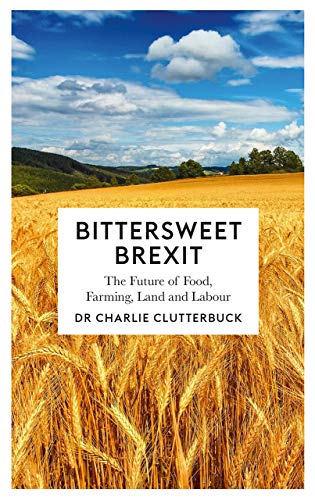
Although widely criticised and hugely wasteful, The Common Agricultural Policy did at least afford British farmers a degree of support. Post-Brexit, that support will vanish - to be replaced with a woefully misconceived agricultural export drive that cannot possibly deliver. Bittersweet Brexit suggests a solution: paying workers decent wages in the agricultural sector could radically transform the nature of farming in Britain. It would improve yields, increase sustainability and ensure greater self-sufficiency at a time when food security is becoming a vital issue. This scenario provides a progressive, forward-thinking and optimistic future for food and farming in Britain, which, unlike many other industries, is currently being ignored.
"synopsis" may belong to another edition of this title.
About the Author
Charlie Clutterbuck is an honorary research fellow at the Centre for Food Policy, City University, London. He has published extensively on food and farming.
Excerpt. © Reprinted by permission. All rights reserved.
Bittersweet Brexit
The Future of Food, Farming, Land and Labour
By Charlie ClutterbuckPluto Press
Copyright © 2017 Charlie Clutterbuck
All rights reserved.
ISBN: 978-0-7453-3770-8All rights reserved.
Contents
List of Photographs, Figures and Tables, ix,
Foreword, xi,
Acknowledgements, xiii,
Introduction, xiv,
PART I: THE STATE WE'RE IN,
1. All Change, 3,
2. Coming Out, 28,
3. Moving On, 47,
PART II: SOCIETY,
4. Trade, 63,
5. Labour, 83,
6. Land, 109,
PART III: FARM AND FOOD SCIENCE,
7. Sustainability, 139,
8. Obesity, 151,
9. Pesticides, 162,
10. Genetically Modified Organisms (GMOs), 176,
PART IV: THE FUTURE,
11. Favourite Foods, 191,
12. What We Can Do, 216,
Abbreviations, 235,
Notes, 238,
Index, 258,
CHAPTER 1
All Change
This chapter sets out where we are now, and the significance of food and farming, and how we may be undergoing some of the biggest changes in our food habits for many years. There is an opportunity to discuss what we want from our food system in ways we have not been able to do for decades. But in order to decide where we may be going, we have to look at where we have come from to learn some lessons.
In June 2016, a small majority of British people voted to leave the European Union. This is going to mean one of the biggest changes in our food and farming system in the last 200 years. The Tories repealed the Corn Laws in the 1840s and Labour introduced the Agricultural Act following the Second World War. Now Brexit takes us in another direction.
When we voted, there was virtually no discussion about how leaving the EU would change what and how we eat, or indeed much else. Yet, the changes will affect virtually every part of the food and farm chain. Our exit will change how much we pay for food, who works the soil, what we eat, how our land is used, and most importantly, where we get our food from. It won't just be a matter of losing the directives, changing the laws, deciding what we do about tariffs, but more a matter of who we want to be.
In the run-up to the Referendum, there were some rumblings about farm subsidies. Farmers were reassured that something similar to the EU subsidies would continue. But days after the result, government ministers were saying they couldn't promise anything. So alarmed were farmers that the Chancellor, Philip Hammond, guaranteed a month later that farm subsidies would remain till 2020. The Tory manifesto for the June 2017 election extended that to 2022. That is no time at all. When I lived on a Lancashire hill farm in the 1970s, we had to plan way beyond that timescale.
The food and farming sector voted in different ways. Fishing communities voted overwhelmingly for out – over 90 per cent. The National Farmers Union (NFU – the big farmowners' association), was divided, some being dependent on migrant workers, others on subsidies. The Fresh Produce Consortium adopted a policy of neutrality. 70 per cent of members of the Food and Drink Federation wanted to remain. The Country Landowners and Business Association (CLA) lobbied ministers to 'do the right thing', but didn't take a position. Farmers in Wales were convinced their subsidies would be safe, so voted to exit. I thought it was like turkeys voting for Christmas. Small farm tenants were clear they did not want to exit, as they believed the EU best served their interests. Tate & Lyle were avidly Brexit.
I spoke at a Food Ethics Council/Kindling Trust Conference in Manchester, one of the few food conferences addressing Brexit, in the run-up to the Referendum, where I made the case for remain. While I thought the EU's Common Agricultural Policy (CAP) was crap, I feared that our land and labour would be less protected outside of the EU. These two aspects are important to me as I believe that all our wealth is created from the soil and labour. Aspects of food production are of particular concern to me as I've represented farmworkers and I am a soil zoologist. I gained a doctorate in the early 1970s in soil ecology at Wye College, London University. I was on the National Sector Committee for Rural and Agricultural Workers of Unite, the union, having also represented them for many years on the Health and Safety Executive.
At that conference, I spelt out what drove Brexit in the first place. The main thrust to leave from the public came from the East of England, driven primarily by concerns over the number of migrant workers in the fields. I see these field operations as 'plantations' as they run monocultures with migrant workers on vast tracks of land – the definition of a plantation. While many of us think we are helping the country by buying vegetables wrapped in a Union Jack, we don't want to look too closely at how these crops are grown. Work conditions are so bad, most of us won't work there, and the soil conditions are also being badly degraded. We'll see more in the chapters on labour and land. People living in these growing areas feel that their own culture is being pushed aside, and their voice not heard.
During the talk, I put up a map of the predicted Brexit vote (see Figure 1), alongside another map showing the types of farming in Britain. The two maps were closely matched in terms of likely Brexit vote and areas of ploughed – arable – land in the East of England. In the Referendum, this Brexit vote was joined by high Brexit votes in Northern towns, where I have lived for 30 years. In these Eastern arable areas people voted 3–1 to Brexit, while the Northern mill towns voted around 2–1. Those in the cities, oblivious of the ways we produce our food, happy just to have cheap, convenient, fresh food, wanted to Remain.
That original thrust came because many people in the East of England didn't like the way we are producing our food. Good honest migrant workers doing jobs we won't do at all, in all weathers, were seen to be 'taking over our culture'. The blame was put on the migrant workers rather than the mode of agricultural production. The surrounding communities felt they had lost their own identity – just as many people in the Northern mill towns feel. We cannot duck this issue. It needs sorting, and is crucial to how we produce our food in the future.
While acknowledging that immigration was a major component of the Brexit vote, how different the outcome might have been if people had not also been under the cosh of austerity. Since the banking crash, the Coalition government of 2010–15 and the Tory government since have cut funding to schools, hospitals, bus routes, libraries and welfare benefits, mainly in areas outside the wealthier parts of London. The list goes on, with shortcuts in safety and health, frozen public-sector workers' wages, final salary pensions closed and wages in the private sector held back in an effort to plug the pension hole. We call this 'austerity', but it hardly begins to describe the pain.
Investment levels are at their lowest since the Second World War, and debt is higher than before the crash. During the June election of 2017, we kept hearing the Tories saying, as did the Prime Minister on 'Question Time',3 that 'there isn't a magic money tree we can shake.' Yet I know of an orchard full of magic money trees. It is a walled garden in the City of London, where only bankers are allowed. There they grew these magic money trees, producing nice juicy fruit – called bonds. Reaping this fruit harvest is called 'Quantitative Easing' (QE). This is where the government pays for these fruits to the tune of £375bn, yes billion, as explained by the Bank of England and an organisation called Positive Money. No harvest is too abundant here in the orchard of magic money trees. They know that if there is ever another 'banking crisis', the government will come and pick, pluck and pay for their juicy fruit, all over again. That must be where the phrase 'rich pickings' comes from.
In financial jargon, the Bank of England created new money (electronically or out of thin air) to buy back bonds from the commercial banking sector (ordinary banks to you and me) which was then free to use the proceeds as it wished. According to the Financial Times, in an article called 'There is a money tree – it's called QE', QE boosts assets like property and equities. So the already rich do well with their stocks, bonds and buildings, while the poorer and younger have to pay higher rents and don't get a final pension settlement anymore. It means there are hidden tax cuts for the rich but hidden tax rises for the poor. The FT went on to ask: 'QE may have contributed to the rise of populism. Could Brexit, Trump, and the dissatisfaction across western nations, be partly due to its effects?' So while we were bailing out the bankers, many were blaming the immigrants for their ills.
In this book I want to give you a flavour of a different world, where we could create a different food and farming system, which produces fruit for us all; lovely, lush, fresh, delicious and excitingly new foods to feed and nourish us all. It is quite feasible.
Up for Grabs
Perhaps Brexit will give us the chance to change. For a year after the Referendum, all we heard was 'Brexit means Brexit', whatever that means. We were told 'no deal is better than a bad deal', whatever that means. And that the government would get the best possible deal – whatever that means. It was as if everybody knew what they had voted for, and there was only one interpretation. There would be no discussion – the 'people had decided'. It took one individual, Gina Miller, to force the government even to allow debate in the mother of all parliaments. It all looked set. With a clear majority and a statutory period for the parliament, the 'will' of the people would prevail – whatever that meant. Yet, it seemed this invincible position was not enough – the Prime Minister, Theresa May – wanted a mandate for the negotiations, as a strong and stable leader. She called a snap general election.
She didn't get a mandate. She got the opposite. Overnight everything was up for grabs. The clear 'hard' Brexit we had been heading for, looked a lot less clear. All politicians were asked to clarify what they understood by Brexit, and where they stood. People started asking what is a 'hard' and a 'soft' Brexit? The negotiators in Europe said they didn't recognise either term. Some – like Michael Heseltine – raised the possibility that perhaps we could get what we want by staying in the EU. Others, like Ruth Davidson of the Scottish Conservatives, said they weren't bothered about coming out of the Single Market but did want to go off around the world doing deals. Labour fudged by keeping quiet on the matter, thereby attracting Remoaners in the South and Brexiteers in the North.
What is clear, amid all this confusion, is that we now have the opportunity to influence matters over the next few years in all sorts of ways. In this book, I will point out the options regarding food and farming. This requires explaining many of the issues involved with any form of Brexit, and I hope to cover most of those directly affecting food and farming.
Once outside the Single Market, we are out. Yet many believe that we can still have the same market access. It's called 'wanting our cake and eating it'. The response from Germany invoked another foodie phrase – that we cannot have an 'a la carte Europe'. The process of leaving the Single Market – divorcing from our other 27 partners – will be complex. Extricating ourselves from all sorts of laws and institutions will be hard enough, but there are many more problems ahead if we leave the Customs Union.
Customs is about taxes and food trade. Sorting out all the food taxes is a mammoth undertaking. Some 2,000 agricultural products attract taxes on trade (tariffs), each complicated with quotas. There are a further 15,000 processed foods (PAPs) attracting tariffs. Angela Merkel said that there will be no 'cherry picking'. The EU says we have to be divorced before we can talk about trade deals.
This book gets its name from the definition of bittersweet: (of food or drink) sweet with a bitter aftertaste, as in: 'she sipped the bittersweet drink'. Some say there is a land of milk and honey ahead – the sweet version. Others say that we are about to throw ourselves over the Tariff Cliff into the waves below. We know there will be bitter twists – barriers, blockages and borders. There will also be opportunities and challenges ahead. This book sets up debates about what is important in food and farming in terms of policy, politics and parliament in a way we've not been able to do in the last 50 years.
Many food businesses will be worried. The dependence on migrant workers from the EU is now clearly in jeopardy. Food producers have come to rely on easy access to the Single Market, moving food ingredients around freely. Lorries can come and go now, but in future there will be checks at the borders, whether for health or tax reasons. Yet we keep hearing people saying they want free access.
Add to this the hidden protection that has been afforded to food-producers and farmers. It has been a deliberate EU policy to protect food and farming. That used to be 'our' protection, now it is 'theirs'. Many food imports are subject to taxes – tariffs. Once outside the Single Market and Customs Union, many will urge that we should have access to cheaper food from abroad. For example, the Economist says, by protecting food producers, UK customers are being 'milked'. For producers there will be a double whammy as once we step outside the EU, we will be considered a 'third country'. Not only will the protections go, we will be subject to tariffs when we want to export our food into the EU – our biggest market.
Despite all the talk about 'the best possible deal for all', there is a major contradiction. Reducing tariffs on foodstuffs coming in to the UK would make food cheaper for consumers. But that puts the food and farm producers in the UK under increased pressure – when they have been protected up till now. Clearly there is conflict. Each foodstuff has different rules, tariffs and quotas, and there is no sign of how these will be sorted out. We will pick up on this in Chapter 2. First, let's take a closer look at where we are now.
WHERE WE ARE NOW
At present, we barely produce half of our own food (54 per cent to be precise). We import twice the value of food that we export. The Food Trade Deficit (FTD, as I'll call it, is $33bn). These values are expressed in dollars, as that is the main currency of international trade, and the import/export figures are recorded in dollars. It is useful, as import/ export figures in sterling are drastically different from a year or so ago, as the pound has devalued since the Brexit vote.
By spending the money spent on imports on our own foodstuffs, we could recycle money back into our economy. The amount we would spend on food would be the same. If we spent half of what we import on our own produce, our producers and the local economies would be a whole lot better off. Instead of going all over the place, often into speculators' pockets, we could spend it on ourselves. We could do a lot with that sort of money – over $30bn.
We spend less than 10 per cent of our earnings on food. The rich spend slightly less, and the poor a somewhat higher percentage of their earnings. This is the smallest proportion of any of the EU countries. More than any other country we have got used to 'cheap food', relying on foodstuffs coming from other countries. That cheap food costs the earth in terms of resources, water, energy, pollution, global warming and land used, all of which we will explore later. Over 70 per cent of our environmental food footprint occurs abroad – i.e. we do twice as much damage to the environment in other countries as we do in our own, because of the way we produce our food.
It is also clearly damaging our health. We are the fattest country in Europe. In percentage terms, the UK has the highest rate of women's obesity, while men manage third place, behind Malta and Slovenia. Obesity is a global epidemic. While I was working for the World Health Organisation (WHO) developing their education materials on food and nutrition plans and programmes, we asked participants, from across Africa and Asia, how their eating habits had changed in the last 25 years. They all said that they had moved away from sitting down to have a meal, to eating on the move. We found obesity and hunger alongside each other, even within families.
Obesity accounts for about four out of five cases of type 2 diabetes – the one you develop rather than are born with. It is caused when insulin, secreted whenever we eat sugars or refined carbohydrates, stops working properly. It is estimated that type 2 diabetes is now responsible for a tenth of all NHS costs. The total cost (direct care and indirect costs) associated with diabetes in the UK currently stands at £23.7bn and is predicted to rise to £39.8bn by 2035. (See Chapter 8.)
The proportion of what we produce ourselves to what we eat (self-sufficiency ratio) has been going down from a high of around three-quarters in the 1980s to just over half now. We can mark the decline from the moment that Mrs Thatcher opted to leave food policy to the supermarkets. Now could be the time to turn that round, and say we could easily produce more food for ourselves, and in the process build thriving new businesses.
Imports/Exports
We export about $33bn in foodstuffs, animals and vegetables. Around $8bn of those exports are whisky and gin. Included in overall food exports are $8bn of animal products, while fish in various forms account for a fifth. Vegetables bring in a further $3.3bn in exports, of which 15 per cent is wheat and grain – the same as tea and coffee. We manage to export $0.5bn of tea and coffee, despite growing neither.
(Continues...)
Excerpted from Bittersweet Brexit by Charlie Clutterbuck. Copyright © 2017 Charlie Clutterbuck. Excerpted by permission of Pluto Press.
All rights reserved. No part of this excerpt may be reproduced or reprinted without permission in writing from the publisher.
Excerpts are provided by Dial-A-Book Inc. solely for the personal use of visitors to this web site.
"About this title" may belong to another edition of this title.
Search results for Bittersweet Brexit: The Future of Food, Farming, Land...

Stock Image
Bittersweet Brexit: The Future of Food, Farming, Land and Labour
Seller: AwesomeBooks, Wallingford, United Kingdom
Seller rating 5 out of 5 stars

Paperback. Condition: Very Good. Bittersweet Brexit: The Future of Food, Farming, Land and Labour This book is in very good condition and will be shipped within 24 hours of ordering. The cover may have some limited signs of wear but the pages are clean, intact and the spine remains undamaged. This book has clearly been well maintained and looked after thus far. Money back guarantee if you are not satisfied. See all our books here, order more than 1 book and get discounted shipping. Seller Inventory # 7719-9780745337708
Buy Used
US$ 4.19
US$ 5.44 shipping
Ships from United Kingdom to U.S.A.
Ships from United Kingdom to U.S.A.
Quantity: 2 available
Stock Image
Bittersweet Brexit: The Future of Food, Farming, Land and Labour
Seller: Bahamut Media, Reading, United Kingdom
Seller rating 4 out of 5 stars

Paperback. Condition: Very Good. This book is in very good condition and will be shipped within 24 hours of ordering. The cover may have some limited signs of wear but the pages are clean, intact and the spine remains undamaged. This book has clearly been well maintained and looked after thus far. Money back guarantee if you are not satisfied. See all our books here, order more than 1 book and get discounted shipping. Seller Inventory # 6545-9780745337708
Buy Used
US$ 5.27
US$ 9.22 shipping
Ships from United Kingdom to U.S.A.
Ships from United Kingdom to U.S.A.
Quantity: 2 available
Seller Image
Bittersweet Brexit: The Future of Food, Farming, Land and Labour
Seller: MusicMagpie, Stockport, United Kingdom
Seller rating 5 out of 5 stars
Condition: Very Good. 1773912897. 3/19/2026 9:34:57 AM. Seller Inventory # U9780745337708
Buy Used
US$ 7.98
US$ 7.25 shipping
Ships from United Kingdom to U.S.A.
Ships from United Kingdom to U.S.A.
Quantity: 1 available
Stock Image
Bittersweet Brexit: The Future of Food, Farming, Land and Labour
Seller: Midtown Scholar Bookstore, Harrisburg, PA, U.S.A.
Seller rating 5 out of 5 stars
Paperback. Condition: Good. Good - Bumped and creased book with tears to the extremities, but not affecting the text block, may have remainder mark or previous owner's name - GOOD Standard-sized. Seller Inventory # M0745337708Z3
Stock Image
Bittersweet Brexit: The Future of Food, Farming, Land and Labour
Seller: WorldofBooks, Goring-By-Sea, WS, United Kingdom
Seller rating 5 out of 5 stars
Paperback. Condition: Very Good. The book has been read, but is in excellent condition. Pages are intact and not marred by notes or highlighting. The spine remains undamaged. Seller Inventory # GOR009090170
Buy Used
US$ 8.08
US$ 7.40 shipping
Ships from United Kingdom to U.S.A.
Ships from United Kingdom to U.S.A.
Quantity: 2 available
Stock Image
Bittersweet Brexit (Paperback)
Seller: Grand Eagle Retail, Bensenville, IL, U.S.A.
Seller rating 5 out of 5 stars
Paperback. Condition: new. Paperback. *Selected as one of openDemocracy's Best Political Books of 2017* Although widely criticised and hugely wasteful, The Common Agricultural Policy did at least afford British farmers a degree of support. Post-Brexit, that support will vanish - to be replaced with a woefully misconceived agricultural export drive that cannot possibly deliver. Bittersweet Brexit suggests a solution: paying workers decent wages in the agricultural sector could radically transform the nature of farming in Britain. It would improve yields, increase sustainability and ensure greater self-sufficiency at a time when food security is becoming a vital issue. This scenario provides a progressive, forward-thinking and optimistic future for food and farming in Britain, which, unlike many other industries, is currently being ignored." An optimistic solution to the post-Brexit crisis in Britain's agricultural sector Shipping may be from multiple locations in the US or from the UK, depending on stock availability. Seller Inventory # 9780745337708
Seller Image
Bittersweet Brexit : The Future of Food, Farming, Land and Labour
Seller: GreatBookPrices, Columbia, MD, U.S.A.
Seller rating 5 out of 5 stars
Condition: New. Seller Inventory # 29794336-n
Seller Image
Bittersweet Brexit
Seller: Rarewaves.com USA, London, LONDO, United Kingdom
Seller rating 5 out of 5 stars
Paperback. Condition: New. *Selected as one of openDemocracy's Best Political Books of 2017*Although widely criticised and hugely wasteful, The Common Agricultural Policy did at least afford British farmers a degree of support. Post-Brexit, that support will vanish - to be replaced with a woefully misconceived agricultural export drive that cannot possibly deliver. Bittersweet Brexit suggests a solution: paying workers decent wages in the agricultural sector could radically transform the nature of farming in Britain. It would improve yields, increase sustainability and ensure greater self-sufficiency at a time when food security is becoming a vital issue. This scenario provides a progressive, forward-thinking and optimistic future for food and farming in Britain, which, unlike many other industries, is currently being ignored. Seller Inventory # LU-9780745337708
Buy New
US$ 38.27
Free Shipping
Ships from United Kingdom to U.S.A.
Ships from United Kingdom to U.S.A.
Quantity: 3 available
Stock Image
Bittersweet Brexit - The Future of Food, Farming, Land and Labour (eng)
Seller: Brook Bookstore On Demand, Napoli, NA, Italy
Seller rating 5 out of 5 stars
Condition: new. Seller Inventory # d0cd17602116a671ac4a60b572d31a69
Stock Image
Bittersweet Brexit
Seller: PBShop.store UK, Fairford, GLOS, United Kingdom
Seller rating 5 out of 5 stars
PAP. Condition: New. New Book. Shipped from UK. Established seller since 2000. Seller Inventory # FW-9780745337708
Buy New
US$ 34.16
US$ 5.50 shipping
Ships from United Kingdom to U.S.A.
Ships from United Kingdom to U.S.A.
Quantity: 6 available