
Items related to How to Pass Technical Selection Tests
Synopsis
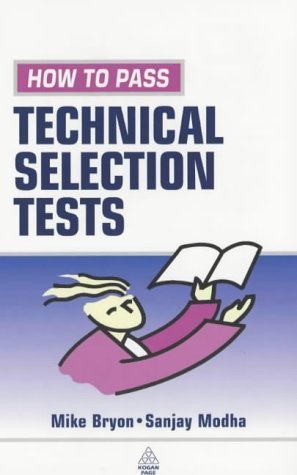
Complete with specimen extracts and practice material, this guide explains how technical selection tests work. It describes how these tests are based on technical vocabulary, the use of English, numerical computation, the ability to interpret drawings and technical know-how.
"synopsis" may belong to another edition of this title.
About the Author
Sanjay Modha BSc(Hons) Msc is a full time lecturer in a large Further Education College in London. He currently teaches Computing but has taught on a wide range of courses. He is also a qualified and registered user of Psychometric tests. Sanjay Modha has been involved in the setting up and running of recruitment and selection courses for large business organisations and government departments.
Excerpt. © Reprinted by permission. All rights reserved.
1 A brief guide to tests
What are selection tests?
Do tests discriminate?
Reliability and validity
Why do companies use tests?
Test administration
Test scores
2 How to prepare for tests
Practice makes perfect
How best to practise
Organise your study
Doing your best on the day
Test strategies
You have to try hard to do well in a test
What to do if you fail
3 Some of the most common types of technical tests
Categories of tests
Attainment tests
Aptitude tests
Work sample tests
Trainability tests
Technical tests of verbal reasoning
Technical tests of numerical reasoning
Tests of diagrammatic reasoning
Tests of mechanical reasoning
4 Other types of test that you may encounter
5 The technical selection tests essential dictionary
6 Technical numerical questions
Section one
Section two
Practice test
Area, volume and surface areas
Trainability and selection tests in construction
Electrical power
7 Technical verbal questions
Basic vocabulary of science and engineering
Basic principles of physics
8 Tests of diagrammatic reasoning
The format of the questions
9 Mechanical questions
Section one
Section two
10 Answers and explanations
"About this title" may belong to another edition of this title.
Search results for How to Pass Technical Selection Tests

Stock Image
Technical Selection Tests And How To Pass Them
Seller: AwesomeBooks, Wallingford, United Kingdom
Seller rating 5 out of 5 stars

Condition: Very Good. This book is in very good condition and will be shipped within 24 hours of ordering. The cover may have some limited signs of wear but the pages are clean, intact and the spine remains undamaged. This book has clearly been well maintained and looked after thus far. Money back guarantee if you are not satisfied. See all our books here, order more than 1 book and get discounted shipping. . Seller Inventory # 7719-9780749409838
Buy Used
US$ 3.46
US$ 5.44 shipping
Ships from United Kingdom to U.S.A.
Ships from United Kingdom to U.S.A.
Quantity: 2 available
Stock Image
Technical Selection Tests And How To Pass Them
Seller: Reuseabook, Gloucester, GLOS, United Kingdom
Seller rating 5 out of 5 stars
Paperback. Condition: Used; Very Good. Dispatched, from the UK, within 48 hours of ordering. Though second-hand, the book is still in very good shape. Minimal signs of usage may include very minor creasing on the cover or on the spine. Seller Inventory # CHL2442816
Buy Used
US$ 3.38
US$ 9.25 shipping
Ships from United Kingdom to U.S.A.
Ships from United Kingdom to U.S.A.
Quantity: 1 available
Stock Image
Technical Selection Tests and How to Pass Them
Seller: Better World Books Ltd, Dunfermline, United Kingdom
Seller rating 5 out of 5 stars
Condition: Good. Pages intact with minimal writing/highlighting. The binding may be loose and creased. Dust jackets/supplements are not included. Stock photo provided. Product includes identifying sticker. Better World Books: Buy Books. Do Good. Seller Inventory # 50147093-20
Buy Used
US$ 6.22
US$ 6.60 shipping
Ships from United Kingdom to U.S.A.
Ships from United Kingdom to U.S.A.
Quantity: 1 available
Stock Image
Technical Selection Tests And How To Pass Them
Seller: Bahamut Media, Reading, United Kingdom
Seller rating 4 out of 5 stars

Condition: Very Good. Shipped within 24 hours from our UK warehouse. Clean, undamaged book with no damage to pages and minimal wear to the cover. Spine still tight, in very good condition. Remember if you are not happy, you are covered by our 100% money back guarantee. Seller Inventory # 6545-9780749409838
Buy Used
US$ 4.11
US$ 9.22 shipping
Ships from United Kingdom to U.S.A.
Ships from United Kingdom to U.S.A.
Quantity: 2 available
Stock Image
Technical Selection Tests and How to Pass Them
Seller: Tall Stories BA, Stoneyford, Ireland
Seller rating 4 out of 5 stars
Paperback. Condition: Very Good. cover is grubby. Seller Inventory # 436
Buy Used
US$ 5.44
US$ 13.39 shipping
Ships from Ireland to U.S.A.
Ships from Ireland to U.S.A.
Quantity: 1 available
Stock Image
Technical Selection Tests And How To Pass Them
Seller: Brit Books, Milton Keynes, United Kingdom
Seller rating 4 out of 5 stars
Paperback. Condition: Used; Good. ***Simply Brit*** Welcome to our online used book store, where affordability meets great quality. Dive into a world of captivating reads without breaking the bank. We take pride in offering a wide selection of used books, from classics to hidden gems, ensuring there is something for every literary palate. All orders are shipped within 24 hours and our lightning fast-delivery within 48 hours coupled with our prompt customer service ensures a smooth journey from ordering to delivery. Discover the joy of reading with us, your trusted source for affordable books that do not compromise on quality. Seller Inventory # 1115934
Buy Used
US$ 4.99
US$ 21.12 shipping
Ships from United Kingdom to U.S.A.
Ships from United Kingdom to U.S.A.
Quantity: 1 available
Stock Image
Technical Selection Tests And How To Pass Them
Seller: Jenhams Books, Dundee, United Kingdom
Seller rating 5 out of 5 stars
Paperback. Condition: Very Good. Very Good unused condition. This book is in stock now, in our UK premises. Photos of our books are available on request (dustjacket and cover illustrations vary, and unless the image accompanying the listing is marked 'Bookseller Image', it is an Abebooks Stock Image, NOT our own). BUYERS OUTSIDE UK please also note the following: 1. shipping rates apply to packets of 750g and under, and should the packed weight of an item exceed this we reserve the right to ship via 'Economy', or request extra postage prior to fulfilling the order, or cancel 2. many countries apply import or other taxes - these are the buyers responsibility; we may ask for extra payment to cover any taxes which we have to pay 'up front' on the buyer's behalf. Seller Inventory # mon0000090134
Buy Used
US$ 5.77
US$ 35.67 shipping
Ships from United Kingdom to U.S.A.
Ships from United Kingdom to U.S.A.
Quantity: 1 available