
Items related to Introduction to Emergency Management
Synopsis
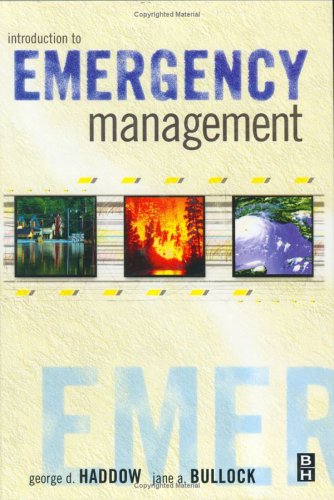
Introduction to Emergency Management is a practical reference for professionals and students who need to understand the process of disaster response planning and mitigation.
The book details the world's leading emergency management agency, the Federal Emergency Management Agency (FEMA), covering its history, organization, programs, and operations as well as the Federal Response Plan (FRP). The authors examine the roles, responsibilities, and interrelationship between FEMA, state and local emergency management systems and other critical partners. They also explain the government emergency resources available before, during, and after crises. Practical and easy-to-reference, the text includes a chapter on terrorism and the events of September 11, 2001, and reviews their impact on disaster management and emergency planning in the future.
This essential text includes the latest information on the Office of Homeland Security and several detailed appendices which include: a list of organizations involved in disaster management, a directory of disaster management and terrorism Web sites, a glossary of disaster management terms and acronyms, and a compendium of domestic and international disaster statistics.
* Includes numerous diagrams, illustrations, and statistics on disaster management history and concepts
* Provides case studies and examples of disasters from around the world to connect theory to real-world application
* Features a special chapter on September 11th, terrorism, and the new world order of disaster management
"synopsis" may belong to another edition of this title.
About the Author
George Haddow currently serves as an Adjunct Professor at the Institute for Crisis, Disaster and Risk Management at The George Washington University, Washington, DC. Prior to joining George Washington University, Mr. Haddow worked for eight years in the Office of the Director of the Federal Emergency Management Agency (FEMA) as the White House Liaison and the deputy Chief of Staff. In these positions, Mr. Haddow was involved in the day-to-day management of FEMA responsible for the Director's communications; policy formulation in the areas of disaster response, public/private partnerships, public information, environmental protection and disaster mitigation including the design and implementation of FEMA's national disaster mitigation initiative entitled Project Impact: Building Disaster Resistant Communities. As the Agency liaison with the White House for Presidential appointments to headquarters and FEMA regional positions, Mr. Haddow worked directly with the FEMA Director and the White House Office of Presidential Personnel in the recruitment and the hiring of all Presidential appointments at FEMA. He also managed FEMA's disaster management and mitigation projects in Argentina, Honduras, El Salvador, Nicaragua, Guatemala, Dominican Republic, Haiti, Ecuador and the Bahamas and coordinated FEMA activities with Korea and South Africa.
Jane A. Bullock has worked in emergency management for over 20 years most recently as the Chief of Staff to James Lee Witt the Director of the Federal Emergency Management Agency (FEMA). In this position Ms. Bullock served as principal advisor to the Director on all Agency programmatic and administrative activities, provided advice and recommendations to the Director on policies required to carry out the mission of the agency; managed the day-to-day operations of the Agency; directed, monitored, and evaluated Agency strategic and communication processes; and oversaw administration of the Agency's resources, including the disaster relief fund. Represented the Director and the Administration with Congress, State and municipal governments, foreign officials, constituent groups and the media. Served as a principal spokesperson for the Agency's programs both before, during and after disasters. Chief architect of FEMA's Project Impact: Building Disaster Resistant Communities, a nationwide effort by communities and businesses to implement prevention and risk reduction programs. Principal on a project to create National Disaster Response and Mitigation system for Argentina and in six Central American and Caribbean countries. Served as part of the Clinton Administration's communications team for the Y2K issue.
From the Back Cover
Introduction to Emergency Management provides a unique and practical insight into the current strategies of disaster response planning and disaster mitigation. Emergency Management, Industrial Health and Safety, and Security students and professionals will find this an essential resource that they will refer to again and again. The book outlines the worldÂ’s leading emergency management agency, the Federal Emergency Management Agency (FEMA), covering its history, organization, programs, and operations as well as the Federal Response Plan (FRP).
Highly practical and extremely easy to reference, this book provides the latest information of FEMA's emerging role within the Department of Homeland Security (DHS). The authors have also included a special and timely chapter on terrorism the recounts the events of September, 11, 2001, and what they mean to disaster management and emergency planning in the future.
The authors explain the roles, responsibilities, and interrelationship that exist among state and local emergency management systems, FEMA, and other critical partners. They also include federal emergency resources that are available to corporations and private organizations for dealing with all phases of a crisis - information critical for corporate executives, security managers, and business continuity experts.
Offering a current list of disaster management organizations' Web sites, a glossary of terms and acronyms, and a reference compendium of domestic and international disaster statistics, Introduction to Emergency Management is an invaluable resource.
Key Features:
* Includes numerous diagrams, illustrations, and statistics on disaster management history and concepts
* Provides case studies and examples of disasters from around the world to connect theory to real-world application
* Features a special chapter on September 11th, terrorism, and the new world order of disaster management
"About this title" may belong to another edition of this title.
Search results for Introduction to Emergency Management

Stock Image
Introduction to Emergency Management
Seller: World of Books (was SecondSale), Montgomery, IL, U.S.A.
Seller rating 5 out of 5 stars

Hardback. Condition: Good. Introduction to Emergency Management is a practical reference for students and professionals covering disaster response planning and mitigation. The book details the Federal Emergency Management Agency (FEMA), the Federal Response Plan (FRP), and the roles, responsibilities, and interrelationship between FEMA and state and local emergency management systems. It also covers the changes in emergency management since the events of September 11, 2001, the latest information on the Office of Homeland Security, and several detailed appendices. Seller Inventory # 00106336414
Stock Image
Introduction to Emergency Management
Seller: World of Books Inc, Montgomery, IL, U.S.A.
Seller rating 4 out of 5 stars

Hardback. Condition: Good. Introduction to Emergency Management is a practical reference for students and professionals covering disaster response planning and mitigation. The book details the Federal Emergency Management Agency (FEMA), the Federal Response Plan (FRP), and the roles, responsibilities, and interrelationship between FEMA and state and local emergency management systems. It also covers the changes in emergency management since the events of September 11, 2001, the latest information on the Office of Homeland Security, and several detailed appendices. Seller Inventory # CIN0750676892G
Stock Image
Introduction to Emergency Management
Seller: ThriftBooks-Atlanta, AUSTELL, GA, U.S.A.
Seller rating 5 out of 5 stars
Hardcover. Condition: Very Good. No Jacket. Missing dust jacket; May have limited writing in cover pages. Pages are unmarked. ~ ThriftBooks: Read More, Spend Less. Seller Inventory # G0750676892I4N01
Stock Image
Introduction to Emergency Management
Seller: HPB-Red, Dallas, TX, U.S.A.
Seller rating 5 out of 5 stars
hardcover. Condition: Good. Connecting readers with great books since 1972! Used textbooks may not include companion materials such as access codes, etc. May have some wear or writing/highlighting. We ship orders daily and Customer Service is our top priority! Seller Inventory # S_479068709
Stock Image
Introduction to Emergency Management
Seller: Better World Books: West, Reno, NV, U.S.A.
Seller rating 5 out of 5 stars
Condition: Fine. Used book that is in almost brand-new condition. May contain a remainder mark. Better World Books: Buy Books. Do Good. Seller Inventory # 56709882-75
Stock Image
Introduction to Emergency Management
Seller: Poverty Hill Books, Mt. Prospect, IL, U.S.A.
Seller rating 4 out of 5 stars
hardcover. Condition: New. HARDCOVER, BRAND NEW, Perfect Shape, No Remainder Mark,Fast Shipping With Online Tracking, International Orders shipped Global Priority Air Mail, All orders handled with care and shipped promptly in secure packaging, we ship Mon-Sat and send shipment confirmation emails. Our customer service is friendly, we answer emails fast, accept returns and work hard to deliver 100% Customer Satisfaction! Seller Inventory # 9080379