
Items related to Play for a Kingdom
Synopsis
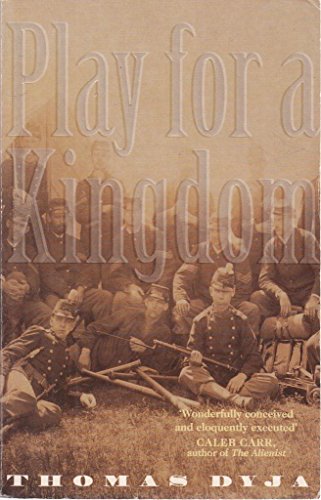
At first glance, the storyline of Thomas Dyja's Play for a Kingdom story sounds corny: a Union company from Brooklyn encounters an Alabama company while on picket duty after the Battle of the Wilderness (May, 1864) and proceeds to challenge them to a series of baseball games before all hell breaks loose in Spottsylvania. The first-time novelist, however, has surprises up his sleeve, and the vividly described sporting matches set up a series of betrayals and double crosses which test the camaraderie of the Union soldiers, calling their commitment to the war effort into question.
Dyja has a gifted understanding of the powerlessness one faces in combat. War in this novel is not tragic merely because it kills and maims good men; it is dispiriting because it robs them of their identities. He handles the multiple points of view of his Brooklyn protagonists superbly, differentiating them by class, social standing, and ethnicity, and aptly shows how the war frays their senses of themselves. Commanders become followers, Irish racists hide amongst black gravediggers, and staunch abolitionists measure their belief in liberty against their gut instincts concerning the corruptibility of human nature. If the sectional crisis of the first half of the 19th century was settled on the fields of battle, the class struggle of the second half was forged in the streets of Brooklyn--making Dyja's company all the more fascinating for the way they illustrate the transition. Although the novel's climax abandons historical materialism for genre convention, the tense mixture of espionage, betrayal, and vivid battle scenes in Play for a Kingdom should please discriminating fans of Civil War fiction. --John M. Anderson
"synopsis" may belong to another edition of this title.
Review
At first glance, the storyline of Thomas Dyja's Play for a Kingdom story sounds corny: a Union company from Brooklyn encounters an Alabama company while on picket duty after the Battle of the Wilderness (May, 1864) and proceeds to challenge them to a series of baseball games before all hell breaks loose in Spottsylvania. The first-time novelist, however, has surprises up his sleeve, and the vividly described sporting matches set up a series of betrayals and double crosses which test the camaraderie of the Union soldiers, calling their commitment to the war effort into question.
Dyja has a gifted understanding of the powerlessness one faces in combat. War in this novel is not tragic merely because it kills and maims good men; it is dispiriting because it robs them of their identities. He handles the multiple points of view of his Brooklyn protagonists superbly, differentiating them by class, social standing, and ethnicity, and aptly shows how the war frays their senses of themselves. Commanders become followers, Irish racists hide amongst black gravediggers, and staunch abolitionists measure their belief in liberty against their gut instincts concerning the corruptibility of human nature. If the sectional crisis of the first half of the 19th century was settled on the fields of battle, the class struggle of the second half was forged in the streets of Brooklyn--making Dyja's company all the more fascinating for the way they illustrate the transition. Although the novel's climax abandons historical materialism for genre convention, the tense mixture of espionage, betrayal, and vivid battle scenes in Play for a Kingdom should please discriminating fans of Civil War fiction. --John M. Anderson
About the Author
Thomas Dyja has worked as a book editor and literary agent. He is the author of the award-winning novel Play for a Kingdom, as well as Meet John Trow and The Moon in Our Hand. He lives in New York City.
"About this title" may belong to another edition of this title.
Search results for Play for a Kingdom

Stock Image
Play For A Kingdom
Seller: AwesomeBooks, Wallingford, United Kingdom
Seller rating 5 out of 5 stars

Paperback. Condition: Very Good. Play For A Kingdom This book is in very good condition and will be shipped within 24 hours of ordering. The cover may have some limited signs of wear but the pages are clean, intact and the spine remains undamaged. This book has clearly been well maintained and looked after thus far. Money back guarantee if you are not satisfied. See all our books here, order more than 1 book and get discounted shipping. Seller Inventory # 7719-9780751523607
Buy Used
US$ 5.43
US$ 5.46 shipping
Ships from United Kingdom to U.S.A.
Ships from United Kingdom to U.S.A.
Quantity: 2 available
Stock Image
Play for a Kingdom
Seller: WorldofBooks, Goring-By-Sea, WS, United Kingdom
Seller rating 5 out of 5 stars
Paperback. Condition: Very Good. The book has been read, but is in excellent condition. Pages are intact and not marred by notes or highlighting. The spine remains undamaged. Seller Inventory # GOR004292094
Buy Used
US$ 3.81
US$ 7.42 shipping
Ships from United Kingdom to U.S.A.
Ships from United Kingdom to U.S.A.
Quantity: 3 available
Stock Image
Play for a Kingdom
Published by
Little, Brown Book Group Limited, 1998
ISBN 10: 0751523607
ISBN 13: 9780751523607
Used
Softcover
Seller: Better World Books Ltd, Dunfermline, United Kingdom
Seller rating 5 out of 5 stars
Condition: Very Good. Pages intact with possible writing/highlighting. Binding strong with minor wear. Dust jackets/supplements may not be included. Stock photo provided. Product includes identifying sticker. Better World Books: Buy Books. Do Good. Seller Inventory # 54483643-20
Buy Used
US$ 6.26
US$ 6.62 shipping
Ships from United Kingdom to U.S.A.
Ships from United Kingdom to U.S.A.
Quantity: 1 available
Stock Image
Play For A Kingdom
Seller: Bahamut Media, Reading, United Kingdom
Seller rating 4 out of 5 stars

Paperback. Condition: Very Good. This book is in very good condition and will be shipped within 24 hours of ordering. The cover may have some limited signs of wear but the pages are clean, intact and the spine remains undamaged. This book has clearly been well maintained and looked after thus far. Money back guarantee if you are not satisfied. See all our books here, order more than 1 book and get discounted shipping. Seller Inventory # 6545-9780751523607
Buy Used
US$ 5.84
US$ 9.25 shipping
Ships from United Kingdom to U.S.A.
Ships from United Kingdom to U.S.A.
Quantity: 2 available
Seller Image
Play for a Kingdom
Seller: Book Express (NZ), Shannon, New Zealand
Seller rating 3 out of 5 stars

Paperback. Condition: Good. 426 pages. spine faded, writing on front cover and ffep ds corny: a Union company from Brooklyn encounters an Alabama company while on p icket duty after the Battle of the Wilderness (May, 1864) and proceeds to challe nge them to a series of baseball games before all hell breaks loose in Spottsylv ania. The first-time novelist, however, has surprises up his sleeve, and the viv idly described sporting matches set up a series of betrayals and double crosses which test the camaraderie of the Union soldiers, calling their commitment to th e war effort into question.Dyja has a gifted understanding of the powerle ssness one faces in combat. War in this novel is not tragic merely because it ki lls and maims good men; it is dispiriting because it robs them of their identiti es. He handles the multiple points of view of his Brooklyn protagonists superbly , differentiating them by class, social standing, and ethnicity, and aptly shows how the war frays their senses of themselves. Commanders become followers, Iris h racists hide amongst black gravediggers, and staunch abolitionists measure the ir belief in liberty against their gut instincts concerning the corruptibility o f human nature. If the sectional crisis of the first half of the 19th century wa s settled on the fields of battle, the class struggle of the second half was for ged in the streets of Brooklyn--making Dyja's company all the more fascinating f or the way they illustrate the transition. Although the novel's climax abandons historical materialism for genre convention, the tense mixture of espionage, bet rayal, and vivid battle scenes in Play for a Kingdom should please discriminatin g fans of Civil War fiction. --John M. Anderson. Seller Inventory # 5585b
Buy Used
US$ 5.25
US$ 45.00 shipping
Ships from New Zealand to U.S.A.
Ships from New Zealand to U.S.A.
Quantity: 1 available