
Items related to Popper (Great Philosophers)
Synopsis
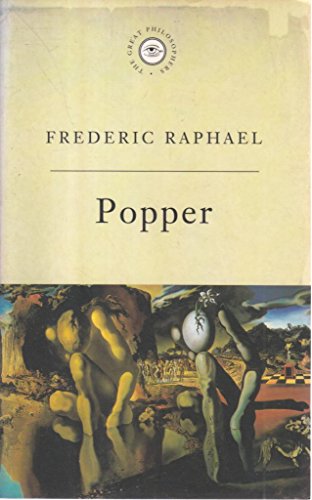
Karl Popper 1902-1994The political history of the twentieth century has been full of savage ‘certainties’. A similar idea of history warranted the callous savageries of both Marxism and Fascism. They shared a faith in what Karl Popper called ‘Historicism’: the belief that the future could be predicted and that man had to align himself with its bloody progress.Totalitarianism, Popper maintained, was based on ideas implicit in Western philosophy, from Plato to Hegel and Marx. It was his unique achievement to challenge the fundamental arguments in which Left and Right cloaked their authority.At a time when Communism and Fascism were devastatingly alluring to many intellectuals, Popper attacked their philosophical roots with passionate reasonableness and unflinching scepticism. As Frederic Raphael suggests in this elegant and intriguing introduction to his philosophy of science and history, Popper’s epic modesty may have made him the most radical thinker of our times.
"synopsis" may belong to another edition of this title.
From Library Journal
Once in a while, a publication comes along that on first sight seems oddly out of place but on second viewing is admirably suited to its purpose. This little series of biographical summaries of the thoughts of 24 Western philosophers from Democritus to Derrida is admirable not only for its reasonable price but even more for the intelligence and clarity of the writing. Each volume has been prepared by an expert in the subject, and the result is a series of well-drawn and exceptionally useful pocket-size (4.5 x 7 inches) sketches of major figures in the history of Western thought. The level is such that no special background in philosophy is required to understand the concepts discussed. Each volume also contains a short bibliography, some of which refer to electronic journals or web sites. Most of the individuals chosen for the series come as no surprise, e.g., Descartes, Hegel, Kant, Nietzsche, Locke, Hume, Plato, and Socrates. But there are a few unexpected choices, like Alan Turing and Karl PopperAalthough on further consideration, they make more sense. Turing's influence on mathematics and on the development of computers has long been recognized, but his 1936 paper "On Compatible Numbers," which appeared in the Proceedings of the London Mathematical Society in 1936-37, influenced studies in the philosophy of mind. Popper's development of the concept of "historicism" in such works as The Open Society and Its Enemies and The Poverty of Historicism significantly influenced 20th-century political thought. Ultimately, this set should be in every academic and public library as well as many school libraries.ATerry C. Skeats, Bishop's Univ. Lib., Lennoxville, Quebec
Copyright 1999 Reed Business Information, Inc.
"About this title" may belong to another edition of this title.
Search results for Popper (Great Philosophers)

Stock Image
The Great Philosophers: Popper
Seller: Greener Books, London, United Kingdom
Seller rating 4 out of 5 stars

Paperback. Condition: Used; Good. **SHIPPED FROM UK** We believe you will be completely satisfied with our quick and reliable service. All orders are dispatched as swiftly as possible! Buy with confidence! Greener Books. Seller Inventory # 2172400
Buy Used
US$ 5.06
US$ 26.79 shipping
Ships from United Kingdom to U.S.A.
Ships from United Kingdom to U.S.A.
Quantity: 1 available
Stock Image
Popper (Great Philosophers)
Seller: WorldofBooks, Goring-By-Sea, WS, United Kingdom
Seller rating 5 out of 5 stars

Paperback. Condition: Very Good. The book has been read, but is in excellent condition. Pages are intact and not marred by notes or highlighting. The spine remains undamaged. Seller Inventory # GOR003925389
Buy Used
US$ 35.07
US$ 7.50 shipping
Ships from United Kingdom to U.S.A.
Ships from United Kingdom to U.S.A.
Quantity: 2 available
Stock Image
Popper : historicism and its poverty.
Seller: Kloof Booksellers & Scientia Verlag, Amsterdam, Netherlands
Seller rating 4 out of 5 stars
Condition: very good. London : Phoenix , 1988. Paperback. 59 pp. (The great philosopers ; 16). Condition : very good copy. ISBN 9780753801895. Keywords : PHILOSOPHY, Popper, Karl R. (1902-1994). Seller Inventory # 175042
Buy Used
US$ 20.05
US$ 34.46 shipping
Ships from Netherlands to U.S.A.
Ships from Netherlands to U.S.A.
Quantity: 1 available
Stock Image
The Great Philosophers: Popper
Seller: Brit Books, Milton Keynes, United Kingdom
Seller rating 4 out of 5 stars
Paperback. Condition: Used; Good. ***Simply Brit*** Welcome to our online used book store, where affordability meets great quality. Dive into a world of captivating reads without breaking the bank. We take pride in offering a wide selection of used books, from classics to hidden gems, ensuring there is something for every literary palate. All orders are shipped within 24 hours and our lightning fast-delivery within 48 hours coupled with our prompt customer service ensures a smooth journey from ordering to delivery. Discover the joy of reading with us, your trusted source for affordable books that do not compromise on quality. Seller Inventory # 2535870
Buy Used
US$ 37.75
US$ 21.42 shipping
Ships from United Kingdom to U.S.A.
Ships from United Kingdom to U.S.A.
Quantity: 1 available