
Items related to How We Think (Barnes & Noble Library of Essential...
Synopsis
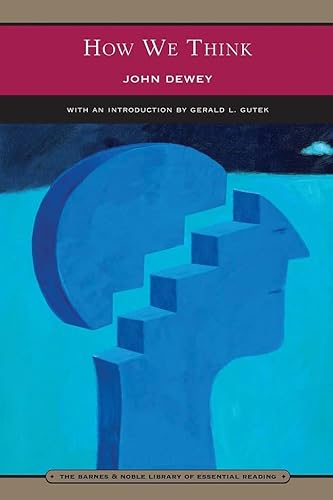
At a time when we are incessantly bombarded with factoids and informercials, John Deweys "How We Think" advises us to step back from the noisy clutter of the information age.
"synopsis" may belong to another edition of this title.
About the Author
John Dewey(1859 1952) was anAmerican philosopher, psychologistandeducational reformerwhose ideas have been influential in education and social reform. Dewey was an important early developer of the philosophy ofpragmatismand one of the founders offunctional psychology. He was a major representative ofprogressive educationandliberalism.In 1894 Dewey joined the newly foundedUniversity of Chicago(1894 1904) where he developed his belief in an empirically based theory of knowledge, becoming associated with the newly emerging Pragmatic philosophy. His time at the University of Chicago resulted in four essays collectively entitledThought and its Subject-Matter, which was published with collected works from his colleagues at Chicago under the collective titleStudies in Logical Theory(1903). During that time Dewey also initiated theUniversity of Chicago Laboratory Schools, where he was able to actualize the pedagogical beliefs that provided material for his first major work on education, The School and Social Progress(1899).In 1899, Dewey was elected president of theAmerican Psychological Association. From 1904 until his retirement in 1930 he was professor of philosophy at both Columbia Universityand Columbia University'sTeachers College.In 1905 he became president of theAmerican Philosophical Association. He was a longtime member of theAmerican Federation of Teachers.
"About this title" may belong to another edition of this title.
Search results for How We Think (Barnes & Noble Library of Essential...

Stock Image
How We Think
Seller: World of Books (was SecondSale), Montgomery, IL, U.S.A.
Seller rating 5 out of 5 stars

Paperback. Condition: Very Good. The thought process laid bare. One of America's greatest philosophers and educators examines the nature and process of human reasoning, intellect, and emotion. John Dewey took a common sense approach to the subject, using examples and explanations that resonate today. His pragmatism has influenced much modern philosophy and the social sciences-and in the effort he produced a timeless, captivating, and universally accessible study of the subject of human thought and logical decision-making. John Dewey (1859-1952) was a U.S. philosopher, education reformer, and psychologist, and an influential professor at the University of Michigan, University of Chicago, and Columbia University. His belief in an empirically based theory of knowledge informed much of his work on logic and philosophy, including HOW WE THINK. Dewey also explored political theory, psychology, and education in his many acclaimed books and academic articles. Part of the Classics of the Social Sciences Series from QUID PRO BOKS. Presented in a digitally remastered form, this new edition corrects the missing letters, underlines, and distracting stray marks typically found in such republications. It is ideal for general reading and classroom adoption. Note that this description may appear under other publishers' editions, but only the Quid Pro edition offers the features above.]. Seller Inventory # 00103246551
Stock Image
How We Think
Seller: World of Books (was SecondSale), Montgomery, IL, U.S.A.
Seller rating 5 out of 5 stars
Paperback. Condition: Good. The thought process laid bare. One of America's greatest philosophers and educators examines the nature and process of human reasoning, intellect, and emotion. John Dewey took a common sense approach to the subject, using examples and explanations that resonate today. His pragmatism has influenced much modern philosophy and the social sciences-and in the effort he produced a timeless, captivating, and universally accessible study of the subject of human thought and logical decision-making. John Dewey (1859-1952) was a U.S. philosopher, education reformer, and psychologist, and an influential professor at the University of Michigan, University of Chicago, and Columbia University. His belief in an empirically based theory of knowledge informed much of his work on logic and philosophy, including HOW WE THINK. Dewey also explored political theory, psychology, and education in his many acclaimed books and academic articles. Part of the Classics of the Social Sciences Series from QUID PRO BOKS. Presented in a digitally remastered form, this new edition corrects the missing letters, underlines, and distracting stray marks typically found in such republications. It is ideal for general reading and classroom adoption. Note that this description may appear under other publishers' editions, but only the Quid Pro edition offers the features above.]. Seller Inventory # 00104088488
Stock Image
How We Think (Barnes & Noble Library of Essential Reading)
Published by
Sterling Children's Books, 2005
ISBN 10: 0760770387
ISBN 13: 9780760770382
Used
paperback
Seller: Half Price Books Inc., Dallas, TX, U.S.A.
Seller rating 5 out of 5 stars
paperback. Condition: Very Good. Connecting readers with great books since 1972! Used books may not include companion materials, and may have some shelf wear or limited writing. We ship orders daily and Customer Service is our top priority! Seller Inventory # S_478166511
Stock Image
How We Think (Barnes & Noble Library of Essential Reading)
Published by
Sterling Children's Books, 2005
ISBN 10: 0760770387
ISBN 13: 9780760770382
Used
paperback
Seller: HPB Inc., Dallas, TX, U.S.A.
Seller rating 5 out of 5 stars
paperback. Condition: Very Good. Connecting readers with great books since 1972! Used books may not include companion materials, and may have some shelf wear or limited writing. We ship orders daily and Customer Service is our top priority! Seller Inventory # S_451008224
Stock Image
How We Think (Barnes & Noble Library of Essential Reading)
Published by
Sterling Children's Books, 2005
ISBN 10: 0760770387
ISBN 13: 9780760770382
Used
Softcover
Seller: Wonder Book, Frederick, MD, U.S.A.
Seller rating 5 out of 5 stars
Condition: Good. Good condition. A copy that has been read but remains intact. May contain markings such as bookplates, stamps, limited notes and highlighting, or a few light stains. Seller Inventory # E07I-01512
Stock Image
How We Think (Barnes & Noble Library of Essential Reading)
Published by
Sterling Children's Books, 2005
ISBN 10: 0760770387
ISBN 13: 9780760770382
Used
paperback
Seller: HPB-Diamond, Dallas, TX, U.S.A.
Seller rating 5 out of 5 stars
paperback. Condition: Very Good. Connecting readers with great books since 1972! Used books may not include companion materials, and may have some shelf wear or limited writing. We ship orders daily and Customer Service is our top priority! Seller Inventory # S_485880302
Stock Image
How We Think
Seller: ThriftBooks-Atlanta, AUSTELL, GA, U.S.A.
Seller rating 5 out of 5 stars
Paperback. Condition: Good. No Jacket. Pages can have notes/highlighting. Spine may show signs of wear. ~ ThriftBooks: Read More, Spend Less. Seller Inventory # G0760770387I3N00
Stock Image
How We Think
Seller: ThriftBooks-Atlanta, AUSTELL, GA, U.S.A.
Seller rating 5 out of 5 stars
Paperback. Condition: Very Good. No Jacket. Former library book; May have limited writing in cover pages. Pages are unmarked. ~ ThriftBooks: Read More, Spend Less. Seller Inventory # G0760770387I4N10
Stock Image
How We Think
Seller: ThriftBooks-Phoenix, Phoenix, AZ, U.S.A.
Seller rating 5 out of 5 stars
Paperback. Condition: Good. No Jacket. Pages can have notes/highlighting. Spine may show signs of wear. ~ ThriftBooks: Read More, Spend Less. Seller Inventory # G0760770387I3N00
Stock Image
How We Think
Seller: World of Books Inc, Montgomery, IL, U.S.A.
Seller rating 4 out of 5 stars

Paperback. Condition: Very Good. The thought process laid bare. One of America's greatest philosophers and educators examines the nature and process of human reasoning, intellect, and emotion. John Dewey took a common sense approach to the subject, using examples and explanations that resonate today. His pragmatism has influenced much modern philosophy and the social sciences-and in the effort he produced a timeless, captivating, and universally accessible study of the subject of human thought and logical decision-making. John Dewey (1859-1952) was a U.S. philosopher, education reformer, and psychologist, and an influential professor at the University of Michigan, University of Chicago, and Columbia University. His belief in an empirically based theory of knowledge informed much of his work on logic and philosophy, including HOW WE THINK. Dewey also explored political theory, psychology, and education in his many acclaimed books and academic articles. Part of the Classics of the Social Sciences Series from QUID PRO BOKS. Presented in a digitally remastered form, this new edition corrects the missing letters, underlines, and distracting stray marks typically found in such republications. It is ideal for general reading and classroom adoption. Note that this description may appear under other publishers' editions, but only the Quid Pro edition offers the features above.]. Seller Inventory # CIN0760770387VG