
Items related to The Npr Guide to Building a Classical Cd Collection
Synopsis
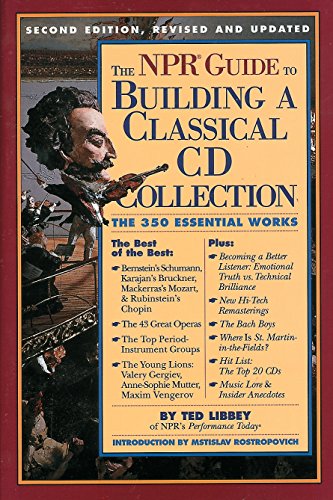
An update and revised guide by the host of National Public Radio's Performance Today recommends the best recordings of the three hundred most important classical works, and provides background information on each composer. Original.
"synopsis" may belong to another edition of this title.
About the Author
Ted Libbey is a commentator on NPR's "Performance Today", the features editor of The Schwann Opus, and a series producer for Time-Life Music, and was formerly music critic for The New York Times. He lives in Bethesda, Maryland.
From the Back Cover
Where Do You Go After Mozart's Jupiter? After Bach's Brandenburg Concertos? After Beethoven's Third?
In this informed and indispensable guide, now in a second edition featuring a hundred new recordings, National Public Radio's Ted Libbey takes you by the hand through the classical repertory and helps you build an essential CD collection. Not just another rating book, this is a foremost expert's thoughtful and entertaining appreciation--work by work, performer by performer, recording by recording--of the symphonies, concertos, chamber pieces, keyboard works, sacred works, and operas that belong in every music lover's library. It includes the core 20 works for starting out, recommendations especially suited for young listeners, and an appendix listing additional works, beyond those covered in the first edition, that the author feels most passionate about.
PRAISE FOR THE FIRST EDITION:
"I have been lost in this book for a week...Libbey('s) comparisons are wonders of lucidity, differentiation, and those 'open ears' Rostropovich spoke of." --Chicago Tribune
"An extensive guide and perfect companion to the basic classical repertory." --Digby Diehl, Playboy Magazine
Excerpt. © Reprinted by permission. All rights reserved.
Samuel Barber
Adagio for Strings
On the programs of American symphony orchestras, the American composer whose music is most frequently encountered is not Aaron Copland, Leonard Bernstein, or George Gershwin, but Samuel Barber (1910-1981). For many years, Barber's Adagio for Strings has been the most frequently performed concert work by an American composer. This intense, elegiac piece was originally the opening part of the second movement of Barber's String Quartet, Op. 11; the composer then scored it for string orchestra at the request of conductor Arturo Toscanini, who gave the first performance of the arrangement in 1938 with the NBC Symphony Orchestra. The music begins quietly with a feeling of subdued but deep sadness, builds to a searing climax of extreme poignancy, and subsides again into the stark, melancholy mood of its opening.
Though familiar from repeated playings (and from use in Oliver Stone's film Platoon), the Adagio for Strings remains one of the most moving and beautiful elegies ever conceived, an outstanding example of Barber's remarkable lyric gift.
Recommended Recordings
New York Philharmonic/Thomas Schippers.
Sony Classical "Masterworks Heritage" MHK 62837 [with other works by Barber, Menotti, Berg, and D'Indy]
Saint Louis Symphony Orchestra/Leonard Slatkin.
EMI CDC 49463 [with Overture to The School for Scandal, Essays Nos. 1-3 for Orchestra, and Medea's Meditation and Dance of Vengeance]
The most beautiful recording ever made of the Adagio for Strings is at last on CD, thoughtfully coupled with some of the other recordings the young Thomas Schippers made for Columbia Masterworks-of the music of Barber and others-between 1960 and 1965, at the start of his all-to-brief career. Although he was never on close personal terms with Barber, Schippers had the ability to put Barber's music across in just the right way, with the perfect blend of energy and lyricism, toughness and warmth, and, above all, with the feeling that its sentiment was real, but ineffably contained. The playing of the New York Philharmonic (in the Adagio, as well as in the Second Essay for orchestra, the Overture to The School for Scandal, Andromache's Farewell, and Medea's Dance of Vengeance) is aglow with inspiration, and the sound is exceptionally vivid, with a palpable sense of presence and space.
For the essential orchestral pieces of Barber, EMI's compilation with Slatkin and the Saint Louis Symphony is the best currently available. Slatkin's reading of the Adagio is beautifully built, exactly on the mark. The Essays-works of magnificent crafstmanship in which Barber unerringly balanced the sorrowful with the triumphant-are powerfully stated, and Medea's Meditation and Dance of Vengeance emerges as an orchestral tour de force. The recordings are full, spacious, superbly atmospheric.
"About this title" may belong to another edition of this title.
Search results for The Npr Guide to Building a Classical Cd Collection

Stock Image
Npr Guide - Bldg Classical CD Collection
Seller: World of Books (was SecondSale), Montgomery, IL, U.S.A.
Seller rating 5 out of 5 stars

Paperback. Condition: Good. National Public Radio's Ted Libbey takes readers by the hand and leads them through the classical canon, to provide direction on building a classical CD music library. Completely updated, the text sticks to the core 300 works while also featuring many new reviews and recommendations. Seller Inventory # 00087922052
Seller Image
The Npr Guide to Building a Classical Cd Collection
Seller: 3Brothers Bookstore, Egg harbor township, NJ, U.S.A.
Seller rating 5 out of 5 stars
Condition: very_good. Cover may have light wear, pages in very good condition and binding is sturdy; may have other light shelf wear or creases. May have notes or highlighting. Seller Inventory # EVV.0761104879.VG
Stock Image
The NPR Guide to Building a Classical CD Collection: Second Edition, Revised and Updated
Published by
Workman Publishing Company, 1999
ISBN 10: 0761104879
ISBN 13: 9780761104872
Used
Paperback
Seller: Orion Tech, Kingwood, TX, U.S.A.
Seller rating 5 out of 5 stars
Paperback. Condition: Good. Seller Inventory # 0761104879-3-20577225
Stock Image
The Npr Guide to Building a Classical Cd Collection
Seller: Gulf Coast Books, Cypress, TX, U.S.A.
Seller rating 5 out of 5 stars
paperback. Condition: Fair. Seller Inventory # 0761104879-4-37607700
Stock Image
The NPR Guide to Building a Classical CD Collection: Second Edition, Revised and Updated
Published by
Workman Publishing Company, 1999
ISBN 10: 0761104879
ISBN 13: 9780761104872
Used
Paperback
Seller: Gulf Coast Books, Cypress, TX, U.S.A.
Seller rating 5 out of 5 stars
Paperback. Condition: Very Good. Seller Inventory # 0761104879-2-20167202
Stock Image
The NPR Guide to Building a Classical CD Collection: Second Edition, Revised and Updated
Published by
Workman Publishing Company, 1999
ISBN 10: 0761104879
ISBN 13: 9780761104872
Used
Paperback
Seller: Your Online Bookstore, Houston, TX, U.S.A.
Seller rating 5 out of 5 stars
Paperback. Condition: Very Good. Seller Inventory # 0761104879-2-19003960
Seller Image
The NPR Guide to Building a Classical CD Collection: Second Edition, Revised and Updated
Seller: Used Book Company, Egg Harbor Township, NJ, U.S.A.
Seller rating 5 out of 5 stars
Condition: Very Good. Shows minimal signs of wear and previous use. Can include minimal notes/highlighting. A portion of your purchase benefits nonprofits! - Note: Edition & format may differ from what is shown in stock photo & item details. May not include supplementary material (toys, access code, dvds, etc). Seller Inventory # 584ZSU0000GF_ns
Seller Image
The Npr Guide to Building a Classical Cd Collection
Seller: Dream Books Co., Denver, CO, U.S.A.
Seller rating 5 out of 5 stars
Condition: good. Gently used with minimal wear on the corners and cover. A few pages may contain light highlighting or writing, but the text remains fully legible. Dust jacket may be missing, and supplemental materials like CDs or codes may not be included. May be ex-library with library markings. Ships promptly! Seller Inventory # DBV.0761104879.G
Seller Image
The Npr Guide to Building a Classical Cd Collection
Seller: Greenworld Books, Arlington, TX, U.S.A.
Seller rating 5 out of 5 stars
Condition: good. Fast Free Shipping â" Good condition. It may show normal signs of use, such as light writing, highlighting, or library markings, but all pages are intact and the book is fully readable. A solid, complete copy that's ready to enjoy. Seller Inventory # GWV.0761104879.G
Seller Image
The Npr Guide to Building a Classical Cd Collection
Seller: Greenworld Books, Arlington, TX, U.S.A.
Seller rating 5 out of 5 stars
Condition: very_good. Fast Free Shipping â" Very Good condition book with a firm cover and clean pages. Shows normal use and some light wear or limited notes markings. A solid, nice copy to enjoy. Seller Inventory # GWV.0761104879.VG