
Items related to The Complete Book of Breastfeeding
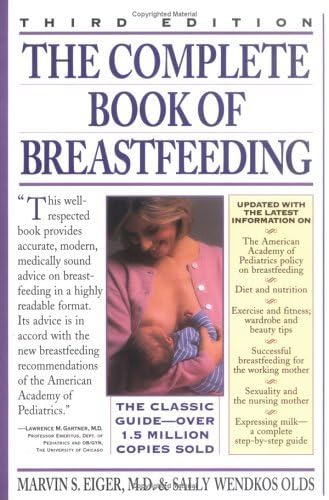
Synopsis
Provides information about nutrition and exercise, explains how lactation works, and offers advice to working mothers about breastfeeding
"synopsis" may belong to another edition of this title.
About the Author
Marvin S. Eiger, M.D. is a nationally known pediatrician who practiced in New York City for 30 years. Sally Wendkos Olds has written extensively about relationships, health, and personal growth, and has won national awards for both her book and magazine writing.
From the Back Cover
Make the Most of your Nursing Experience
Dr. Marvin Eiger, a nationally known pediatrician and breastfeeding authority, and Sally Wendkos Olds, an award-winning medical writer who nursed her own three childrem, provide you with all the new information you need to make nursing your baby a deeply rewarding part of your life.
Praise For The Third Edition:
"This edition is a wonderful blend of the art and science of breastfeeding. We all need it!...It is the only breastfeeding book that can be used by both health care personnel and the nursing mother and father. It is established as a classic in the medical field. The resource appendix and the emphasis on breastfeeding support systems are most welcome." - Cheston M. Berlin, Jr., M.D. University Professor of Pediatrics, The Pennsylvania State University College of Medicine
"This brilliant update of a classic book is an invaluable resource for contemporary nursing families. You'll find yourself picking it up daily for its practical advice, warmth, and comfort. It's like having a lactation expert in the house." - Barbara Seaman, Author and Co-founder, National Women's Health Network
"The Complete Book of Breastfeeding lives up to its title! It is a skillful blend of personal and professional information, reflecting the expertise of its outstanding authors and others in the field of lactation." - Betty L. Crase, IBCLC, Former Director of the Center for Breastfeeding Information, La Leche League International
Excerpt. © Reprinted by permission. All rights reserved.
Introduction
If you were living at some other time or in some other place, you might not need this book. You might even wonder about its purpose, since you would be getting much of the information of these pages from your mother, your aunts, your older sister, and your neighbors. They would share with you their breastfeeding experiences and those of their mothers before them. As you saw them suckling their infants, you would pick up the "tricks of the trade" without even realizing it. It would never occur to you that you would not nurse your baby, because every baby that you had ever seen would have been fed at his mother's breast - except in the extremely rare case when a mother was too ill to nurse.
The paragraph that you have just read appeared as the introduction to the original edition of this book, published in 1972. It is one of the very few paragraphs that were carried over to the second edition, published in 1987, and once again into this edition.
Much has changed in the twenty-six years since The Complete Book of Breastfeeding was first conceived. The year 1971 (when the first edition of this book was being researched and written) marked the lowest rate of breastfeeding in the history of this country: Only one in four women even bean to breastfeed their babies. By 1987, well over half of all American mothers were nursing their newborn infants, and among well-educated middle-class women, the incidence was even higher. There was a slight dip in the prevalence of breastfeeding in the early 1990s, but that reversal has been righted, and the rates of breastfeeding are climbing again.
Over these years we, the authors (a pediatrician who has cared for hundreds of breastfed babies and a medical writer who nursed her own three children), have been delighted to see an explosion of research into the properties of breast milk, the value of nursing for both mothers and babies, and the practices that enhance or hinder the course of breastfeeding.
We have applauded professional organizations like the American Academy of Pediatrics, which in its December 1997 policy statement on breastfeeding acknowledged its great importance and urged doctors to help mothers and babies follow practices to ensure healthy nursing experiences. The Canadian Pediatric Society and the World Health Organization have also issued strong statements urging mothers to nurse and urging medical professionals to help mothers breastfeed their babies.
We've been happy to note that today's physicians learn more about breastfeeding in medical school and are less likely to believe that formula is "just as good" as breast milk, and that more hospitals are instituting more policies that promote breastfeeding rather than interfere with it.
Today, then, if you have questions about breastfeeding, you're more likely to have sources to go to - the doctors, nurses, and midwives who help you in childbirth, the friends and neighbors who are nursing or have nursed their own children, and a wealth of published material. Still, depending on where you live and where you have your baby, the information to get may or may not be helpful.
In too many places you're still likely to hear outdated, incorrect advice. Some medical professionals have not kept up with new research findings about the nutritional and immunological advantages of human milk for infants. Some laypersons, especially those from a generation more familiar with bottle-fed babies, are still convinced of the myths and superstitions they heard in a less enlightened time.
Breastfeeding is easy; there is nothing complicated about it. And there is no single best way to do it. Still, it is a skill that you have to learn, and it is an activity whose success depends on the kind of information and support that you get. Nursing a baby may fulfill and instinctual drive, but both you and your baby need to learn the actual procedures for breastfeeding and need to be reassured while you're learning.
Some mothers intuitively know what to do, puzzled by no questions and troubled by no problems. Most new mothers, however, have questions about all aspects of infant care. Sometimes a lack of information about breastfeeding makes a woman hesitate to embark upon an adventure that seems strange and bewildering. Other times, women reluctantly switch to the bottle when, had their questions been answered and their problems solved, they would have much preferred to continue being part of a nursing couple.
To help you do what you want to do and to make the most of what may be among the most memorable and enjoyable experiences of your entire life, we have once again updated and revised this book. It is very exciting for us to realize that many of the women who are reading this edition of our book are the grown children of our first readers, now nursing their babies. It is always a thrill to have so many women - some of them grandmothers - come up to us at meeting and tell us, "Your book was my bible."
While we thought our book was quite complete when the first edition came out, it included much more in the second edition, and has even more in this third edition: the findings from the most up-to-date scientific research and the results of what so many nursing mothers have learned works well for them. It also addresses a number of lifestyle issues that are increasingly important to contemporary mothers.
Thus, you'll see more in this edition about diet and fitness, about breastfeeding for the working mother (including the best way to express or pump and store breast milk), about breastfeeding as a sexual passage in the life of the mother, about nursing in public and legal issues related to this and other aspects of breastfeeding, and about nursing in a variety of special situations.
Although there is, as we said, no one "best way" to breastfeed, there are certain practices that seem to make the course of nursing go more smoothly for most mothers and babies, and it's these practices that we describe and recommend in these pages. However, every baby is unique, every mother is unique, and every family situation is unique. You may find that you and your baby do better by changing some of our recommendations. If it works for you, do it - and more power to you!
We're really happy that you're beginning this journey, which may be among the most exhilarating of your life, and we hope that this book will help you navigate it smoothly.
The three essential tools for successful breastfeeding are (1) knowing what to do (2) feeling confident that you're doing the right thing for your baby and yourself, and (3) being determined to persist in the face of any minor setbacks that may come your way.
As authors who've learned much more about our subject since we wrote our first book - and then still more since the publication of its second edition - we hope that this newest edition will help you develop all three of these tools.
"About this title" may belong to another edition of this title.
Search results for The Complete Book of Breastfeeding

Stock Image
The Complete Book of Breastfeeding
Seller: World of Books (was SecondSale), Montgomery, IL, U.S.A.
Seller rating 5 out of 5 stars

Condition: Good. Item in good condition. Textbooks may not include supplemental items i.e. CDs, access codes etc. Seller Inventory # 00074147140
Seller Image
The Complete Book of Breastfeeding: Third Edition
Seller: Used Book Company, Egg Harbor Township, NJ, U.S.A.
Seller rating 5 out of 5 stars
Condition: Good. Shows minimal signs of wear and previous use. Can include minimal notes/highlighting. A portion of your purchase benefits nonprofits! - Note: Edition & format may differ from what is shown in stock photo & item details. May not include supplementary material (toys, access code, dvds, etc). Seller Inventory # 584XQ40008JQ_ns
Stock Image
The Complete Book of Breastfeeding
Seller: BookHolders, Towson, MD, U.S.A.
Seller rating 5 out of 5 stars
Condition: Fair. [ No Hassle 30 Day Returns ][ Ships Daily ] [ Underlining/Highlighting: NONE ] [ Writing: NONE ] [ Edition: third ] [ Water Damage: SLIGHT, doesn't affect use ] Publisher: Workman Publishing Company Pub Date: 1/2/1999 Binding: Paperback Pages: 432 third edition. Seller Inventory # 3114659
Stock Image
The Complete Book of Breastfeeding
Seller: World of Books Inc, Montgomery, IL, U.S.A.
Seller rating 4 out of 5 stars

Paperback. Condition: Good. This revised edition draws on research for information on how breastfeeding offers protection against various diseases, and the impact on a child's cognitive development. It also covers nutrition, social life and the role of the father. Seller Inventory # CIN0761109021G
Seller Image
The Complete Book of Breastfeeding
Seller: Austin Goodwill 1101, Austin, TX, U.S.A.
Seller rating 5 out of 5 stars
Condition: good. Book shows general signs of use and handling. May have light wear on the cover or edges and minimal writing or highlighting. Binding remains tight, and pages are clean and readable. Seller Inventory # CTXV.0761109021.G
Stock Image
Complete Book of Breastfeeding
Published by
Workman Publishing Company, Incorporated, 1999
ISBN 10: 0761109021
ISBN 13: 9780761109020
Used
Softcover
Seller: Better World Books, Mishawaka, IN, U.S.A.
Seller rating 5 out of 5 stars
Condition: Good. Former library copy. Pages intact with minimal writing/highlighting. The binding may be loose and creased. Dust jackets/supplements are not included. Includes library markings. Stock photo provided. Product includes identifying sticker. Better World Books: Buy Books. Do Good. Seller Inventory # 38580322-75
Stock Image
Complete Book of Breastfeeding
Published by
Workman Publishing Company, Incorporated, 1999
ISBN 10: 0761109021
ISBN 13: 9780761109020
Used
Softcover
Seller: Better World Books, Mishawaka, IN, U.S.A.
Seller rating 5 out of 5 stars
Condition: Good. Pages intact with minimal writing/highlighting. The binding may be loose and creased. Dust jackets/supplements are not included. Stock photo provided. Product includes identifying sticker. Better World Books: Buy Books. Do Good. Seller Inventory # 40551703-6
Stock Image
The Complete Book of Breastfeeding: Third Edition
Published by
Workman Publishing Company, 1999
ISBN 10: 0761109021
ISBN 13: 9780761109020
Used
Softcover
Seller: Wonder Book, Frederick, MD, U.S.A.
Seller rating 5 out of 5 stars
Condition: Very Good. Very Good condition. 3rd edition. A copy that may have a few cosmetic defects. May also contain light spine creasing or a few markings such as an owner's name, short gifter's inscription or light stamp. Seller Inventory # J10C-01591
Stock Image
The Complete Book of Breastfeeding: Third Edition
Published by
Workman Publishing Company, 1999
ISBN 10: 0761109021
ISBN 13: 9780761109020
Used
Paperback
Seller: Half Price Books Inc., Dallas, TX, U.S.A.
Seller rating 5 out of 5 stars
Paperback. Condition: Very Good. Connecting readers with great books since 1972! Used books may not include companion materials, and may have some shelf wear or limited writing. We ship orders daily and Customer Service is our top priority! Seller Inventory # S_452924823
Stock Image
The Complete Book of Breastfeeding: Third Edition
Published by
Workman Publishing Company, 1999
ISBN 10: 0761109021
ISBN 13: 9780761109020
Used
Paperback
Seller: HPB Inc., Dallas, TX, U.S.A.
Seller rating 5 out of 5 stars
Paperback. Condition: Very Good. Connecting readers with great books since 1972! Used books may not include companion materials, and may have some shelf wear or limited writing. We ship orders daily and Customer Service is our top priority! Seller Inventory # S_427211170