
Items related to The Book of Potentially Catastrophic Science: 50 Experiments...
The Book of Potentially Catastrophic Science: 50 Experiments for Daring Young Scientists (Irresponsible Science) - Hardcover
Book 3 of 7: Irresponsible Science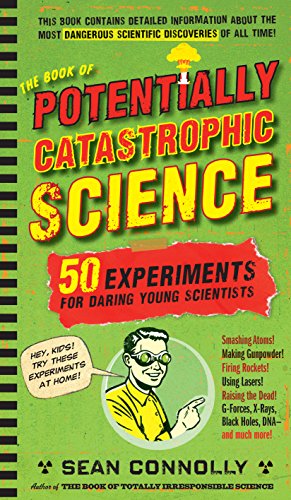
Synopsis
It’s never been more important to engage a child's scientific curiosity, and Sean Connolly knows just how to do it―with lively, hands-on, seemingly "dangerous" experiments that pop, ooze, crash, and teach! Now, the author of The Book of Totally Irresponsible Science, takes it one step further: He leads kids through the history of science, and then creates amazing yet simple experiments that demonstrate key scientific principles.
Tame fire just like a Neanderthal with the Fahrenheit 451 experiment. Round up all your friends and track the spread of "disease" using body glitter with an experiment inspired by Edward Jenner, the vaccination pioneer who's credited with saving more lives than any other person in history. Rediscover the wheel and axle with the ancient Sumerians, and perform an astounding experiment demonstrating the theory of angular momentum. Build a simple telescope―just like Galileo's―and find the four moons he discovered orbiting Jupiter (an act that helped land him in prison). Take a less potentially catastrophic approach to electricity than Ben Franklin did with the Lightning Mouth experiment. Re-create the Hadron Collider in a microwave with marshmallows, calculator, and a ruler―it won't jeopardize Earth with a simulated Big Bang, but will demonstrate the speed of light. And it's tasty!
By letting kids stand on the shoulders of Aristotle, Newton, Einstein, the Wright brothers, Marie Curie, Darwin, Watson and Crick, and more, The Book of Potentially Catastrophic Science is an uncommonly engaging guide to science, and the great stories of the men and women behind the science.
"synopsis" may belong to another edition of this title.
About the Author
Sean Connolly is the author of the Totally Irresponsible Science series and dozens of other books for both children and adults. A father of three, he is in an ideal position to explain the nuts and bolts of these experiments. He lives in England.
From the Back Cover
Here are 50 awesome experiments that demonstrate the principles behind the 34 greatest scientific breakthroughs in human history. The wheel―astound friends with an experiment that seems to defy the laws of gravity. The rocket―launch a soda bottle into the air. The microscope―peer through a lens made out of water. Atomic theory―prove it with food coloring. The Large Hadron Collider―re-create it with marshmallows. (Tasty!) Using stuff from around the house, the curious can now boldly go where the bravest scientists in history have gone before.
Reviews
Gr 5-10–Perhaps picking up on a trend started by Conn and Hal Iggulden's The Dangerous Book for Boys (Collins, 2007), this volume features a sensational title and lurid, retro cover art that might suggest a shallow and gimmicky package, once cracked. It's not. Instead, the content is solid and compelling. The premise is that all of humankind's greatest milestones in science and engineering have entailed risks and courage on the part of the innovators. Starting with Stone Age tools and ending with a Hadron Collider, each chapter details a historic leap forward in scientific understanding and explains what the potential downsides of those discoveries were. Potential catastrophic consequences include persecution for heresy, the very real risks of self-injury or death in the process of discovery, and the reality that almost every beneficial scientific discovery can also be tapped to create efficient means for humans to kill one another. As such, it's an illuminating survey. Unfortunately, kids who see the cover urging them to "try these experiments at home" and listing them as "smashing atoms, making gunpowder, firing rockets, and raising the dead," might be a little disappointed when the actual "experiments" turn out to be tamer–and sometimes lamer–analogous demonstrations of the concepts put forth in each chapter.Jeffrey Hastings, Highlander Way Middle School, Howell, MI
© Copyright 2010. Library Journals LLC, a wholly owned subsidiary of Media Source, Inc. No redistribution permitted.
From the author of The Book of Totally Irresponsible Science (2008), this volume approaches science historically, spotlighting certain periods, processes, individuals, discoveries, and inventions. Each of the 34 chapters includes a discussion and one or two related activities, such as making a Stone Age tool, creating an earthquake in Jell-O, building a parachute for an egg drop, and extracting a banana's DNA. Safety concerns are addressed for each project, and adult help will be necessary to complete some of the experiments successfully. Though the photos and cartoon-style drawings work well, several elements of the book's design are off-putting: the use of pistachio-green and purplish-gray background colors on the pages, the occasional graph-paper-like squares underlying the text, and the small black squares running up the pages' outer margins. While there is no back matter, not even an index, Connolly's writing is engaging, and the historical approach works well, offering kids a quick introduction to science history and the opportunity to explore certain ideas along the way. Grades 5-8. --Carolyn Phelan
"About this title" may belong to another edition of this title.
Search results for The Book of Potentially Catastrophic Science: 50 Experiments...

Stock Image
The Book of Potentially Catastrophic Science: 50 Experiments for Daring Young Scientists (Irresponsible Science)
Seller: Gulf Coast Books, Cypress, TX, U.S.A.
Seller rating 5 out of 5 stars

hardcover. Condition: Fair. Seller Inventory # 0761156879-4-36267867
Stock Image
The Book of Potentially Catastrophic Science: 50 Experiments for Daring Young Scientists (Irresponsible Science)
Published by
Workman Publishing Company, 2010
ISBN 10: 0761156879
ISBN 13: 9780761156871
Used
Hardcover
Seller: Orion Tech, Kingwood, TX, U.S.A.
Seller rating 5 out of 5 stars
Hardcover. Condition: Very Good. Seller Inventory # 0761156879-2-20226365
Stock Image
The Book of Potentially Catastrophic Science: 50 Experiments for Daring Young Scientists (Irresponsible Science)
Published by
Workman Publishing Company, 2010
ISBN 10: 0761156879
ISBN 13: 9780761156871
Used
Hardcover
Seller: Your Online Bookstore, Houston, TX, U.S.A.
Seller rating 5 out of 5 stars
Hardcover. Condition: Very Good. Seller Inventory # 0761156879-2-17711022
Stock Image
The Book of Potentially Catastrophic Science: 50 Experiments for Daring Young Scientists
Seller: World of Books (was SecondSale), Montgomery, IL, U.S.A.
Seller rating 5 out of 5 stars
Hardback. Condition: Good. It's never been more important to engage a child's scientific curiosity, and Sean Connolly knows just how to do it--with lively, hands-on, seemingly "dangerous" experiments that pop, ooze, crash, and teach! Now, the author of The Book of Totally Irresponsible Science, takes it one step further: He leads kids through the history of science, and then creates amazing yet simple experiments that demonstrate key scientific principles. Tame fire just like a Neanderthal with the Fahrenheit 451 experiment. Round up all your friends and track the spread of "disease" using body glitter with an experiment inspired by Edward Jenner, the vaccination pioneer who's credited with saving more lives than any other person in history. Rediscover the wheel and axle with the ancient Sumerians, and perform an astounding experiment demonstrating the theory of angular momentum. Build a simple telescope--just like Galileo's--and find the four moons he discovered orbiting Jupiter (an act that helped land him in prison). Take a less potentially catastrophic approach to electricity than Ben Franklin did with the Lightning Mouth experiment. Re-create the Hadron Collider in a microwave with marshmallows, calculator, and a ruler--it won't jeopardize Earth with a simulated Big Bang, but will demonstrate the speed of light. And it's tasty! By letting kids stand on the shoulders of Aristotle, Newton, Einstein, the Wright brothers, Marie Curie, Darwin, Watson and Crick, and more, The Book of Potentially Catastrophic Science is an uncommonly engaging guide to science, and the great stories of the men and women behind the science. Seller Inventory # 00092583996
Seller Image
The Book of Potentially Catastrophic Science: 50 Experiments for Daring Young Scientists (Irresponsible Science)
Seller: Reliant Bookstore, El Dorado, KS, U.S.A.
Seller rating 5 out of 5 stars
Condition: good. This book is in good condition with very minimal damage. Pages may have minimal notes or highlighting. Cover image on the book may vary from photo. Ships out quickly in a secure plastic mailer. Seller Inventory # RDV.0761156879.G
Seller Image
The Book of Potentially Catastrophic Science: 50 Experiments for Daring Young Scientists (Irresponsible Science)
Seller: Greenworld Books, Arlington, TX, U.S.A.
Seller rating 5 out of 5 stars
Condition: good. Fast Free Shipping â" Good condition. It may show normal signs of use, such as light writing, highlighting, or library markings, but all pages are intact and the book is fully readable. A solid, complete copy that's ready to enjoy. Seller Inventory # GWV.0761156879.G
Stock Image
The Book of Potentially Catastrophic Science: 50 Experiments for Daring Young Scientists (Irresponsible Science)
Published by
Workman Kids (edition Illustrated), 2010
ISBN 10: 0761156879
ISBN 13: 9780761156871
Used
Hardcover
Seller: BooksRun, Philadelphia, PA, U.S.A.
Seller rating 5 out of 5 stars
Hardcover. Condition: Very Good. Illustrated. It's a well-cared-for item that has seen limited use. The item may show minor signs of wear. All the text is legible, with all pages included. It may have slight markings and/or highlighting. Seller Inventory # 0761156879-11-1
Stock Image
The Book of Potentially Catastrophic Science: 50 Experiments for Daring Young Scientists (Irresponsible Science)
Published by
Workman Kids (edition Illustrated), 2010
ISBN 10: 0761156879
ISBN 13: 9780761156871
Used
Hardcover
Seller: BooksRun, Philadelphia, PA, U.S.A.
Seller rating 5 out of 5 stars
Hardcover. Condition: Very Good. Illustrated. It's a well-cared-for item that has seen limited use. The item may show minor signs of wear. All the text is legible, with all pages included. It may have slight markings and/or highlighting. Seller Inventory # 0761156879-8-6
Stock Image
The Book of Potentially Catastrophic Science: 50 Experiments for Daring Young Scientists
Seller: ThriftBooks-Phoenix, Phoenix, AZ, U.S.A.
Seller rating 5 out of 5 stars
Hardcover. Condition: Very Good. No Jacket. May have limited writing in cover pages. Pages are unmarked. ~ ThriftBooks: Read More, Spend Less. Seller Inventory # G0761156879I4N00
Stock Image
The Book of Potentially Catastrophic Science: 50 Experiments for Daring Young Scientists
Seller: ThriftBooks-Reno, Reno, NV, U.S.A.
Seller rating 5 out of 5 stars
Hardcover. Condition: Very Good. No Jacket. Former library book; May have limited writing in cover pages. Pages are unmarked. ~ ThriftBooks: Read More, Spend Less. Seller Inventory # G0761156879I4N10