
Items related to Encyclopedia of Disability, 5 volume set
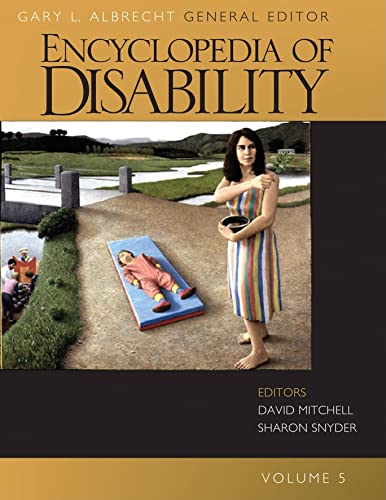
Synopsis
To read some sample entries, or to view the Readers Guide click on "Additional Materials" in the left column under "About This Book". The wide range of coverage distinguishes this particular set, which was designed "to bring current knowledge and experience with disability across a wide variety of places, conditions, and cultures to both the general reader and the specialist." Editor Albrecht (University of Illinois at Chicago) and over 500 authors from around the world contributed the more than 800 entries. . . drawing in readers from a wide range of studies and interests and helping them to see disability in an entirely new way. Highly recommended for academic and large public libraries." -- BOOKLIST (star review)
Obesity. Heart disease. Vision problems. Asthma. AIDS. Depression. Those maimed by land mines, machetes, bullets, bombs and beatings. These are just a few examples of how disability is becoming an increasingly common experience in our daily lives. Regardless of who we are or where we live, disability is with us.
SAGE Reference is proud to announce the five-volume Encyclopedia of Disability. This Encyclopedia represents the first attempt to bring an authoritative reference resource to the many faces of disability. It provides a fascinating entry into the world of disability where minds are expanded, prejudices shattered, and spirits raised. The Encyclopedia answers the question: What is disability and why is it important in my life? An international editorial board of seventy-four editors from the Americas, Europe, Australia, India, Japan, and China, all experts in their own sub-fields of disability, developed these volumes. The result is a multidisciplinary, cross-cultural, and historically grounded resource tool that guides the reader across fields, theories, debates, and practices.
Key Features
- Embraces five volumes that improve the reader′s understanding and appreciation of the world of disability: Volumes 1 - 4 cover disability A, including a Reader′s Guide, comprehensive bibliography, and index, and Volume 5 contains a wealth of primary source documents in the field of disability
- Includes contributions from more than 500 world-renowned scholars who have written over 1,000 entries―in a clear, accessible style―with the desire to bring all students, researchers, and interested readers closer to the daily experience of disability
- Provides print and Web site references to government documents and data that are rich resources to investigate how disability is measured and treated on an international level
- Includes a chronology to place the concept of disability in a historical context
The Encyclopedia of Disability is a must-have reference for all academic libraries, large public libraries, and any social science, medical, legal, or governmental reference collections. Non-governmental organizations, charitable foundations, and law firms will also want to add this set to their collection.
Senior Editors
Jerome Bickenbach, Queen′s University
Scott Brown
Dudley Childress, Northwestern University Medical School
Joseph Flaherty, Univeristy of Illinois at Chicago
Allen Heinemann, Northwestern University
Tamar Heller, Univeristy of Illinois at Chicago
Christopher Keys, Univeristy of Illinois at Chicago
David Mitchell, Univeristy of Illinois at Chicago
Trevor Parmenter, University of Sydney, Australia
Mairian Scott-Hill, Marsh Hills Cottage
Tom Shakespeare, University of Newcastle
Sharon Snyder, Univeristy of Illinois at Chicago
"synopsis" may belong to another edition of this title.
About the Author
Gary L. Albrecht is a Fellow of the Royal Belgian Academy of Arts and Sciences, Extraordinary Guest Professor of Social Sciences, University of Leuven, Belgium and Professor Emeritus of Public Health and of Disability and Human Development at the University of Illinois at Chicago. After receiving his Ph.D. from Emory University, he has served on the faculties of Emory University in Sociology and Psychiatry, Northwestern University in Sociology, Rehabilitation Medicine and the Kellogg School of Management and the University of Illinois at Chicago (UIC) in the School of Public Health and in the Department of Disability and Human Development. Since retiring from the UIC in 2005, he divides his time between Europe and the United States. He works in Boulder, Colorado and Brussels, Belgium. He was recently a Scholar in Residence at the Maison des Sciences de l’Homme (MSH) in Paris, a visiting Fellow at Nuffield College, the University of Oxford and a Fellow in Residence at the Royal Flemish Academy of Science and Arts, Brussels
Reviews
*Starred Review* One would expect to find discussion of such topics as accessibility, assistive technology, and mainstreaming in a reference source called Encyclopedia of Disability --but readers might be surprised to find Archaeology; Dickens, Charles; Norse sagas; and Postcolonialism in the list of entries. The wide range of coverage distinguishes this particular set, which was designed "to bring current knowledge and experience with disability across a wide variety of places, conditions, and cultures to both the general reader and the specialist."
Editor Albrecht (University of Illinois at Chicago) and over 500 authors from around the world contributed the more than 800 entries. Almost 200 of the entries are biographical, treating individuals from Homer and Socrates to Helen Keller and Franklin Roosevelt. Others treat history (Deaf, history of the; Freak show; History of disability: Medical care in Renaissance Europe); types of disability (Down syndrome, Multiple sclerosis,Obesity); medical and health concerns (Physical therapy, Genetic counseling, Managed care); legal and social matters (Americans with Disabilities Act of 1990, Deinstitutionalization, Public transportation); attitudes and conditions affecting daily life (Confinement, Deformity,Stigma); and more. A series of entries under the heading Experience of Disability discusses conditions in 13 countries, including Brazil, Ireland, and Japan. Entry length generally ranges from around 200 words to 10 pages. Most entries conclude with citations for further readings, and many also offer lists of Web sites.
The text is supported by a number of black-and-white illustrations, many of which show depictions of disability in works of art and film. All of the illustrations are contained in volume 5, which is also home to documents representing the "first effort at compiling primary source materials on disability." The documents are organized by historical period and arranged chronologically, from ancient Sumerian proverbs to Andrea Dworkin's 2005 essay "Through the Pain Barrier." Each document has a brief introduction that supplies context. Following the documents are a chronology and a section on finding and evaluating Web sites. To aid the reader, each volume includes an alphabetical list of entries and a "Reader's Guide," which groups entries under broad subject categories. Documents are also listed under pertinent categories here, providing useful links between documents and related text. Volume 4 contains a 120-page bibliography and the set index. A small inconvenience is that the index, though detailed, does not reference volume numbers, except in the case of the documents found in volume 5.
The encyclopedia's very inclusiveness inevitably gives rise to questions about what has been left out. Why is there an entry for the experience of disability in Costa Rica but not Nicaragua? Why is there an entry for Vincent Van Gogh but not Henri Toulouse-Lautrec? These questions are minor, however, compared to the achievement of drawing in readers from a wide range of studies and interests and helping them to see disability in an entirely new way. Highly recommended for academic and large public libraries. Mary Ellen Quinn
Copyright © American Library Association. All rights reserved
"About this title" may belong to another edition of this title.
Search results for Encyclopedia of Disability, 5 volume set

Seller Image
Encyclopedia of Disability, 5 volume set
Seller: ZBK Books, Carlstadt, NJ, U.S.A.
Seller rating 5 out of 5 stars

Condition: good. Fast & Free Shipping â" Good condition. It may show normal signs of use, such as light writing, highlighting, or library markings, but all pages are intact and the book is fully readable. A solid, complete copy that's ready to enjoy. Seller Inventory # ZWV.0761925651.G
Seller Image
Encyclopedia of Disability, 5 volume set
Seller: Greenworld Books, Arlington, TX, U.S.A.
Seller rating 5 out of 5 stars
Condition: very_good. Fast Free Shipping â" Very Good condition book with a firm cover and clean pages. Shows normal use and some light wear or limited notes markings. A solid, nice copy to enjoy. Seller Inventory # GWV.0761925651.VG
Seller Image
Encyclopedia of Disability, 5 volume set
Seller: Your Book Basket, Mechanicsburg, PA, U.S.A.
Seller rating 5 out of 5 stars
Paperback. Condition: Good. Good - . In good condition. All 5 volumes included. FEATURES. Seller Inventory # 35584
Seller Image
Encyclopedia of Disability, 5 volume set
Seller: Solr Books, Lincolnwood, IL, U.S.A.
Seller rating 5 out of 5 stars
Condition: very_good. This book is in Very good condition. There may be a few flaws like shelf wear and some light wear. Seller Inventory # BCV.0761925651.VG
Stock Image
Encyclopedia of Disability, 5 volume set
Published by
SAGE Publications, Inc, 2005
ISBN 10: 0761925651
ISBN 13: 9780761925651
Used
Hardcover
First Edition
Seller: Classic Books Of Virginia, Virginia Beach, VA, U.S.A.
Seller rating 5 out of 5 stars
Hardcover. Condition: Very Good. 1st Edition. EXLIBRARY with usual marks, appears uncirculated, this is a set of five (5) books, WILL require additional overseas or priority shipping. Seller Inventory # vb6075abe
Seller Image
Encyclopedia of Disability [Five Volumes]
Published by
SAGE Publications, Inc, 2005
ISBN 10: 0761925651
ISBN 13: 9780761925651
Used
Hardcover
First Edition
Seller: Book House in Dinkytown, IOBA, Minneapolis, MN, U.S.A.
Seller rating 5 out of 5 stars
hardcover. Condition: Very Good. First Edition. Complete in five volumes. SAGE, 2006; First Printing with full number line. Bindings are tight, sturdy, and square; light surface scratches on Vol. 4 front board, else pictorial boards in VG+ condition, corners sharp; text very good throughout. No dust jackets, as issued. Due to the size/weight of this set extra charges will apply for international and/or expedited shipping. Ships same or next business day from Dinkytown in Minneapolis, Minnesota. Seller Inventory # 332646
Stock Image
Encyclopedia of Disability, 5 volume set
Seller: Revaluation Books, Exeter, United Kingdom
Seller rating 5 out of 5 stars
Hardcover. Condition: Brand New. 1st edition. 2500 pages. 11.50x9.25x9.00 inches. In Stock. Seller Inventory # 0761925651
Buy New
US$ 1,482.97
US$ 46.30 shipping
Ships from United Kingdom to U.S.A.
Ships from United Kingdom to U.S.A.
Quantity: 1 available