
Items related to Crab Moon
Synopsis
Introduce young naturalists to the mysterious high tide of the horseshoe crabs.
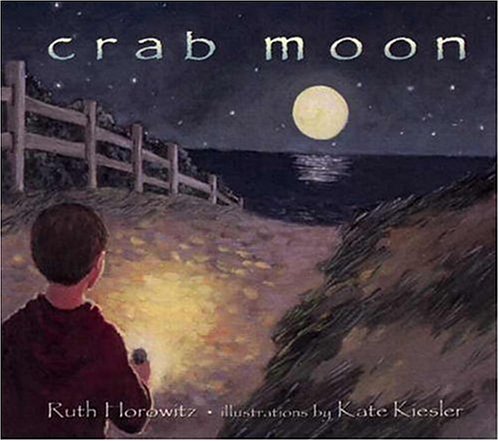
One June night, under the full moon, Daniel's mother wakes him up to see the extraordinary sight of horseshoe crabs spawning on the beach-just as they have every spring for 350 million years. In the morning, Daniel returns to find one lone crab, marooned upside down in the sand. Is it dead? Can he save it? Like a perfect weekend at the beach, CRAB MOON leaves an indelible memory of a special adventure between a parent and a child. And with luminous paintings by Kate Kiesler, it relays a powerful message that each of us must do our part to preserve even earth's oldest creatures.
"synopsis" may belong to another edition of this title.
About the Author
Ruth Horowitz is "drawn to species that get overlooked because they're not big-eyed or cuddly or cute. I hope this book will show readers the rewards of reaching out to a being that may seem utterly alien at first glance."
Kate Kiesler makes her home in the mountains but enjoyed painting the seashore. "On a snowy day I could walk into my studio and be at the beach. Sometimes I could almost smell the salty air."
Reviews
Kindergarten-Grade 3-On a summer weekend, Daniel, seven, and his family arrive at a seaside cottage. His mother remembers the seasonal spawning of horseshoe crabs on this selfsame shore when she was a child, and, at Daniel's urging, wakes him in the middle of the night to witness the phenomenon under the full moon. Hand in hand, they go to the moonlit beach and find the horseshoe crabs surging to the sand in clambering multitudes, caught in a springtide rhythm almost as old as time. The next morning, viewing the scene, Daniel finds "-one last, lonely crab marooned upside down," rights her, and follows her slow progress to the sea. Horowitz's quiet text reflects the moonlit awe of this ageless pattern, and Kiesler's luminous oils capture freeze-frame moments in perfect step (including the sandy borders and backgrounds). A page of Limulus facts is appended, which describes the stresses these ancient animals are encountering. Pair this with Mark Shasha's The Night of the Moonjellies (S & S, 1992; o.p.) for a quiet look at two unheralded, somewhat unlovely, but important marine creatures.
Patricia Manning, formerly at Eastchester Public Library, NY
Copyright 2000 Reed Business Information, Inc.
Despite its linguistic charms, Horowitz's (Bat Time) quiet text reads more like a science lesson than a full-fledged story. The plot is minimal: under the full moon, seven-year-old Daniel and his mother watch as streams of horseshoe crabs lay their eggs on the beach and, the next morning, Daniel helps an overturned crab return to the sea. Chock-full of information, the dialogue is unfortunately stilted. "The full moon in June brings the high tide of the horseshoe crabs," says Daniel's mother. "That's a female. The smaller crab on her back is a male." The plot's two-page conflict at the end of the book, about Daniel deciding to flip over a crab even though he's nervous about touching it, does not contain much in the way of suspense. On the other hand, Horowitz's poetic descriptions are buried throughout the text as smooth as sea glass. The reader sees how "the fat, round face of the full moon wavered on the surface of the water" and "curly black seaweed was strewn on the sand, like streamers left over from a party." Kiesler's seascapes are skillfully rendered but static, trading the ethereal qualities of her Fishing for a Dream for realism. Glowing yet somber, they do little to engage readers' emotions in Daniel's mild adventure. Ages 6-9. (May)
Copyright 2000 Reed Business Information, Inc.
June's full moon casts an atmospheric glow over Kiesler's (Old Elm Speaks, 1998) soft-focus shore scenes in this brief consciousness raiser. Seven-year-old David follows his mother down to the beach near their summer rental one night and watches, enchanted, as horseshoe crabs emerge to lay their eggs. The next morning, he finds an upended straggler, gingerly rights her, and watches her make her way, “quiet as a queen,” back to the sea. Along with books such as Saviour Pirotta's Turtle Bay (1997), this conveys a respectful attitude toward sea- and shore-dwelling wildlife in an unpreachy way. Young children whose interest is piqued by David's brief encounter with such ancient, alien-looking creatures will welcome the concluding page of general horseshoe crab facts. (Picture book. 6-8) -- Copyright © 2000 Kirkus Associates, LP. All rights reserved.
Horowitz tells an ancient sea story with gentle echoes of ecology, environmentalism, and respect for all creatures, accompanied by illustrations in oils with the dark luminescence of the seashore on a summer night. Seven-year-old Daniel's family rents a cottage at the beach for the first full moon in June, and his mother tells him that the horseshoe crabs will lay their eggs that night. Daniel is eager to see them, especially when his mother says that the crabs have been doing this for millions of years. That night, he and his mother go down to the shore and see the crabs moving and clacking, the females digging holes in the sand for their eggs and then pulling the males across to fertilize them. The next day, the crabs are gone, but Daniel finds one turned upside down and immobile. He rights her, and watches her scuttle back to the sea. Precise, lyrical language tells the story: the crabs sounding like "restless cobblestones"; black seaweed on the sand looking like "streamers left over from a party." Notes at the back give children more facts about horseshoe crabs. GraceAnne A. DeCandido
Copyright © American Library Association. All rights reserved
"About this title" may belong to another edition of this title.
Search results for Crab Moon

Stock Image
Crab Moon
Seller: World of Books (was SecondSale), Montgomery, IL, U.S.A.
Seller rating 5 out of 5 stars

Hardback. Condition: Good. Kiesler, Kate (illustrator). One June night, Daniel sees the beach covered with hundreds of horseshoe crabs spawning, as they have for 350 million years. In the morning he finds a lone marooned crab - can he save it? This text encourages the reader to preserve even the oldest species. Seller Inventory # CIN0763607096G
Stock Image
Crab Moon
Seller: Better World Books, Mishawaka, IN, U.S.A.
Seller rating 5 out of 5 stars
Condition: Good. Kiesler, Kate (illustrator). Library Binding. Former library copy. Pages intact with minimal writing/highlighting. The binding may be loose and creased. Dust jackets/supplements are not included. Includes library markings. Stock photo provided. Product includes identifying sticker. Better World Books: Buy Books. Do Good. Seller Inventory # GRP65388143
Stock Image
Crab Moon
Seller: HPB-Diamond, Dallas, TX, U.S.A.
Seller rating 5 out of 5 stars
hardcover. Condition: Very Good. Kiesler, Kate (illustrator). Connecting readers with great books since 1972! Used books may not include companion materials, and may have some shelf wear or limited writing. We ship orders daily and Customer Service is our top priority! Seller Inventory # S_478638473
Stock Image
Crab Moon
Seller: Hawking Books, Edgewood, TX, U.S.A.
Seller rating 4 out of 5 stars

Condition: Good. Kiesler, Kate (illustrator). Meets the good condition guidelines. Tear on cover. Has wear. Five star seller - Buy with confidence! Seller Inventory # X0763607096X3
Stock Image
Crab Moon
Seller: ThriftBooks-Atlanta, AUSTELL, GA, U.S.A.
Seller rating 5 out of 5 stars
Hardcover. Condition: Very Good. No Jacket. Kiesler, Kate (illustrator). May have limited writing in cover pages. Pages are unmarked. ~ ThriftBooks: Read More, Spend Less. Seller Inventory # G0763607096I4N00
Stock Image
Crab Moon
Seller: ThriftBooks-Atlanta, AUSTELL, GA, U.S.A.
Seller rating 5 out of 5 stars
Hardcover. Condition: Very Good. No Jacket. Kiesler, Kate (illustrator). Former library book; May have limited writing in cover pages. Pages are unmarked. ~ ThriftBooks: Read More, Spend Less. Seller Inventory # G0763607096I4N10
Stock Image
Crab Moon
Seller: ThriftBooks-Atlanta, AUSTELL, GA, U.S.A.
Seller rating 5 out of 5 stars
Hardcover. Condition: Good. No Jacket. Kiesler, Kate (illustrator). Pages can have notes/highlighting. Spine may show signs of wear. ~ ThriftBooks: Read More, Spend Less. Seller Inventory # G0763607096I3N00
Stock Image
Crab Moon
Seller: ThriftBooks-Dallas, Dallas, TX, U.S.A.
Seller rating 5 out of 5 stars
Hardcover. Condition: Good. No Jacket. Kiesler, Kate (illustrator). Former library book; Pages can have notes/highlighting. Spine may show signs of wear. ~ ThriftBooks: Read More, Spend Less. Seller Inventory # G0763607096I3N10
Stock Image
Crab Moon
Seller: World of Books Inc, Montgomery, IL, U.S.A.
Seller rating 4 out of 5 stars
Hardback. Condition: Good. Kiesler, Kate (illustrator). One June night, Daniel sees the beach covered with hundreds of horseshoe crabs spawning, as they have for 350 million years. In the morning he finds a lone marooned crab - can he save it? This text encourages the reader to preserve even the oldest species. Seller Inventory # CIN0763607096G
Stock Image
Crab Moon
Seller: Better World Books Ltd, Dunfermline, United Kingdom
Seller rating 5 out of 5 stars
Condition: Good. Kiesler, Kate (illustrator). Library Binding. Former library copy. Pages intact with minimal writing/highlighting. The binding may be loose and creased. Dust jackets/supplements are not included. Includes library markings. Stock photo provided. Product includes identifying sticker. Better World Books: Buy Books. Do Good. Seller Inventory # GRP65388143
Buy Used
US$ 6.35
US$ 6.69 shipping
Ships from United Kingdom to U.S.A.
Ships from United Kingdom to U.S.A.
Quantity: 1 available