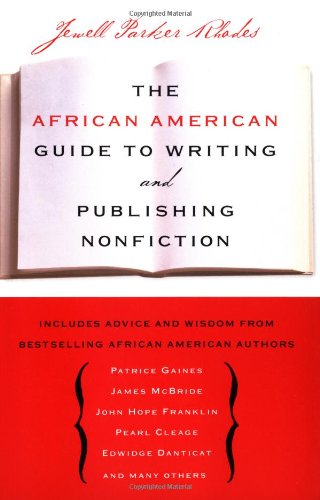
In college and graduate school, Jewell Parker Rhodes never encountered a single reading assignment or exercise that featured a person of color. Now she has made it her mission to rectify the situation, gathering advice and inspiring tips tailored for African Americans seeking to express their life experiences. Comprehensive and totally energizing, the African American Guide to Writing and Publishing Nonfiction bursts with supportive topics such as:
·Finding your voice
·Getting to know your literary ancestors
·Overcoming a bruised ego and finding the determination to pursue your dreams
·Gathering material and conducting research
·Tapping sweet, bittersweet, and joyful memories
·Knowing when to keep revising, and when to let go
The guide also features unforgettable excerpts from luminaries such as Maya Angelou, Brent Staples, Houston Baker, and pointers from bestselling African American authors Patrice Gaines, E. Lynn Harris, James McBride, John Hope Franklin, Pearl Cleage, Edwidge Danticat, and many others. It is a uniquely nurturing and informative touchstone for affirming, bearing witness, leaving a legacy, and celebrating the remarkable journey of the self.
"synopsis" may belong to another edition of this title.
Dr. Jewell Parker Rhodes is the former director of the graduate-level creative writing program at Arizona State University. She is the author of Free Within Ourselves: Fiction Lessons for Black Authors and the works Magic City, Voodoo Dreams, and the forthcoming Frederick Douglass’ Women. A recipient of fellowships from Yaddo and the National Endowment for the Arts, she lives in Phoenix, Arizona.
nd graduate school, Jewell Parker Rhodes never encountered a single reading assignment or exercise that featured a person of color. Now she has made it her mission to rectify the situation, gathering advice and inspiring tips tailored for African Americans seeking to express their life experiences. Comprehensive and totally energizing, the African American Guide to Writing and Publishing Nonfiction bursts with supportive topics such as:
·Finding your voice
·Getting to know your literary ancestors
·Overcoming a bruised ego and finding the determination to pursue your dreams
·Gathering material and conducting research
·Tapping sweet, bittersweet, and joyful memories
·Knowing when to keep revising, and when to let go
The guide also features unforgettable excerpts from luminaries such as Maya Angelou, Brent Staples, Houston Baker, and pointers from bestselling African American authors Patrice Gaines, E. Lyn
Rhodes, former director of a university writing program, begins by conveying the necessity of writers, particularly African American writers, to find their voice and write about their experiences. She notes that since slave narratives, African Americans have recognized the need to merge African oral traditions and Western written traditions. Rhodes catalogs black literary ancestors and provides solid advice on gathering ideas from life's joys and disappointments and using source materials from interviews with relatives to libraries and Web sites. After each chapter, Rhodes offers exercises that include reading a variety of nonfiction. She asks the reader to take careful note of how writers execute tone, texture, and rhythm and convey information. She provides helpful advice on writing autobiography and includes samples from such famous authors as Maya Angelou, Lorene Cary, and Nathan McCall. Finally, Rhodes provides information on getting published. She includes wisdom and advice from other black writers, a recommended reading list, and enthusiastic encouragement. Although the information is culturally specific to African Americans, any reader interested in writing will enjoy this book. Vanessa Bush
Copyright © American Library Association. All rights reserved
ONE
FINDING YOUR VOICE
Whether it's the first time, the hundredth or the thousandth time, give yourself permission to speak, to write your heart and soul down on paper.
Always believe--there is no better voice than your own unique voice. No better story than the one you need to write.
Select a journal--a three-ring binder, a legal pad, a leather-bound blank book, whatever's most comfortable for you. This journal is your life line to writing more effectively and productively. Select a special pen--a felt tip, roller ball, fountain pen, or a profusion of rainbow gels. Journal writing should be a tactile experience, alive with the joy of your hand moving across the page, of leaving colored markings that speak about your self and the world at large.
On page one, write:
I Am (your name)
I Believe in Myself
I Have Something to Say
When you feel doubtful about your voice, reread the first page of your journal. Remind yourself that this journal is your song, your celebration of how you observe and experience the world. It is your private practice field. You'll collect ideas and feelings, but you'll explore how best to express them--how best to sing your song, speak your mind, and say what needs to be said!
A journal is for shouts and whispers, cries and laughter. It is never a place for silence. With each sentence you write in your journal, you affirm and improve your voice, the power of your words.
Just as musicians play scales to strengthen their rhythm and tone, to limber their fingers, hands, and mouths, so, too, a writer must practice the basics of writing prose. Observation, clarity, description, voice, sentence structure, and rhythm are all essential skills that require continual practice.
Don't try to do the following exercises all at once. Take time between exercises to experience, observe, reflect, and revise. If you're struggling with an exercise, repeat it. Move on when you feel your writing is improving. By doing the exercises in this book, you'll be allowed to make mistakes and to explore thoughts and feelings. After practicing these exercises, when you do sit down to write an essay or book, you'll be much better prepared to succeed.
MY BEST ADVICE
Treasure your journal. A journal begins the process of crafting ideas into art.
For those of you who are new to writing, this chapter will help limber your skills of observing, listening, recording, and assembling portraits of your world. For those of you who have been writing for a while, these opening exercises will give you the opportunity to sharpen your skills and reflect again how heritage can influence and deepen your writing.
In either case, don't hurry your growth. Writing is a process. Nothing is discrete; everything is interconnected. Who you are, what subjects you select, what skills you learn, and what nonfiction you choose to write are integrated, much like single grains of sand shaping a shoreline.
REMEMBER: There are many trails to follow as a writer, but the main toll road is the same--a willingness to explore who you are and a belief that your voice matters.
When you're anxious or filled with self-doubt, remember: the collective spirit of our people is with you. Your journey to discover the power of voice, your words are an affirmation of all of us. Your journal is your life line, life support, and key to finding your voice!
Open your journal. Take a deep breath. The adventure begins.
EXERCISE 1
EXPERIENCING A COMMUNITY EVENT
Like a cub reporter, go out and observe an event worth celebrating. It can be a political rally, church service, a family reunion, or lunchtime at your community park. Write quickly for twenty minutes; don't edit.
When you've finished, reread your description and ask yourself: Is it specific? Are there sounds in your description? Are there colors, textures, smells, tastes? What did you fail to observe? What did you leave out? What did you write just right?
For twenty minutes, rewrite the description, adding more details.
Compare the two versions and decide which one you like best, which conveys the more complete picture.
EXERCISE 2
EXPERIENCING THE FOLK
Look for a person to describe, someone worth focusing on and writing about. It can be someone you know, a trusted teacher, a performance poet, or young girl playing defense in a pick-up game of basketball. Write quickly for twenty minutes; don't edit.
When you've finished, reread your description. How well did you describe the person? Would I recognize them if I saw them on the street, saw them in action? How does your person dress, talk, move? What do they feel--joy, anger, exhilaration? How can you tell? What outward signs, what actions best express personality? How do they react to others? How do they react to touch, sight, taste, and sound?
What makes this person special to you? What about them are you highlighting?
Revise your description for twenty minutes, adding new details.
Compare the two versions and decide which one you like best. Which version is more accurate? The most vibrant and "lifelike?"
EXERCISE 3
TALKING THAT TALK: COMMUNITY STORYTELLERS
Storytelling is a fundamental human activity--some stories are short (leaving you breathless for more), some are long and twisting, some teach, some give praise, some slander, some help you imagine a time and place where you've never lived. In Africa, the griot was honored as master storyteller, responsible for maintaining the stories and legends of the tribe. The griot tradition did not die with the advent of American slavery. Indeed, cultural storytelling kept the past alive and sustained a newly born people. Slaves were not "blank slates" but a community who mirrored, shaped, celebrated, informed, and inspired themselves through stories.
Many of us when we hear or see the word "story" immediately think fiction, think only of stories as untrue, created out of the imagination. Not necessarily so. Stories can be true, drawn from concrete reality. But even while you may be recording a "true story," you'll want to write it as interesting as fiction--you'll want to capture sensory details, characterization, and the voice of the storyteller!
Go out and find a storyteller--a former diva who used to sing for Motown, a young adult remembering the glamor of prom night, a grandmother on the front porch spinning stories about her childhood and her family's migration north. Go to the local barbershop or beauty salon and talk to the elders or the most colorful person in the room.
Listen to the voice of this storyteller, the rhythms in his or her speech. Is the talk slow and meandering or fast and focused? Is the voice loud or soft, rough or smooth? Is the voice conversational or formal? Write a page in the "voice" of the storyteller you've studied. Try to recapture their story--feel free to elaborate, to improve upon your memory. The important thing is to keep writing the "voice" of the storyteller you've heard. To keep imitating the rhythm, sounds, and speech.
Reread your writing. Can you hear the storyteller's voice? Rewrite any sentences that don't sound like your storyteller.
Repeat this exercise with two other people. If you first wrote a young man's tale of valor, try capturing the scratchy cadences of a deejay or the ebullient voice of a teenager. Stretch yourself--look for a variety of voices to challenge you. If you haven't heard enough good storytellers, don't underestimate the power of simply asking: "Please, tell me a story. Tell me about something that happened to you." You'll be surprised by the "truths" you may hear.
Once you've captured three storytellers, list the differences among the three "voices." Which "voice" did you capture best? Who told the best story? Why was it the best? How did the voice make the story more interesting?
Over time you'll train yourself to hear nuances of speech, differences of grammar, word choice, rhythm, and sound.
For now, listen up! As a writer, you need daily practice in listening to people talk--becoming more in tune with the full range of human sounds.
For one week, listen more and talk less. Record your experiences in your journal.
EXERCISE 4
TALKING THAT TALK: FAMILY TALES
Our ancestors shape our family's stories. Talk to an aunt, a grandparent, a second cousin, about your family's heritage. Ask to see pictures, mementos, genealogy charts, family Bibles. What stories are attached to these objects? What do these stories reveal about the African American spirit in your family? What makes them dramatic and intriguing?
Certain stories are easily passed down through the generations within families. Other stories are told in whispers, with long silences between incidents. Listen for the "gaps" in one of your family's stories. Listen for the silences, for what might be left unsaid, the secrets, then--explore, investigate.
For an hour, write the family tale you found; write the story just as your family member told it.
Next, put a star by all the points in the story where you don't know what happened. These starred points represent opportunities for research.
For example, in my family, my mother often told how her grandmother was a slave owned by a Georgia planter with the surname Wright:
"When Master decided to sell Grandmother, she begged to be sold with her husband and infant. Master agreed; and years later, when the family was emancipated, they kept the Wright name."
Mother's tale has been passed down for three generations; nonetheless, I wasn't sure the tale was entirely true. Having a slave family sold intact was highly unusual. And while many slaves kept their masters' names, why did my ancestors keep the Wright name? Was it an expression of appreciation? Had they refused to adopt the name of their last owner? Why didn't they just...
"About this title" may belong to another edition of this title.
Seller: ThriftBooks-Atlanta, AUSTELL, GA, U.S.A.
Paperback. Condition: Very Good. No Jacket. May have limited writing in cover pages. Pages are unmarked. ~ ThriftBooks: Read More, Spend Less. Seller Inventory # G0767905784I4N00
Seller: ThriftBooks-Dallas, Dallas, TX, U.S.A.
Paperback. Condition: Very Good. No Jacket. May have limited writing in cover pages. Pages are unmarked. ~ ThriftBooks: Read More, Spend Less. Seller Inventory # G0767905784I4N00
Seller: ThriftBooks-Dallas, Dallas, TX, U.S.A.
Paperback. Condition: Good. No Jacket. Former library book; Pages can have notes/highlighting. Spine may show signs of wear. ~ ThriftBooks: Read More, Spend Less. Seller Inventory # G0767905784I3N10
Seller: ThriftBooks-Atlanta, AUSTELL, GA, U.S.A.
Paperback. Condition: Good. No Jacket. Pages can have notes/highlighting. Spine may show signs of wear. ~ ThriftBooks: Read More, Spend Less. Seller Inventory # G0767905784I3N00
Seller: Better World Books: West, Reno, NV, U.S.A.
Condition: Good. Former library book; may include library markings. Used book that is in clean, average condition without any missing pages. Seller Inventory # 6054144-6
Seller: Better World Books, Mishawaka, IN, U.S.A.
Condition: Good. Used book that is in clean, average condition without any missing pages. Seller Inventory # 10200719-75
Seller: Better World Books, Mishawaka, IN, U.S.A.
Condition: Good. Former library book; may include library markings. Used book that is in clean, average condition without any missing pages. Seller Inventory # 6054144-6
Seller: HPB-Ruby, Dallas, TX, U.S.A.
paperback. Condition: Very Good. Connecting readers with great books since 1972! Used books may not include companion materials, and may have some shelf wear or limited writing. We ship orders daily and Customer Service is our top priority! Seller Inventory # S_438447924
Seller: Anybook.com, Lincoln, United Kingdom
Condition: Fair. This is an ex-library book and may have the usual library/used-book markings inside.This book has soft covers. In fair condition, suitable as a study copy. Please note the Image in this listing is a stock photo and may not match the covers of the actual item,400grams, ISBN:9780767905787. Seller Inventory # 8845073
Quantity: 1 available
Seller: The Book Spot, Sioux Falls, MN, U.S.A.
Paperback. Condition: New. Seller Inventory # Abebooks108785