
Items related to Image-Guided and Adaptive Radiation Therapy
Synopsis
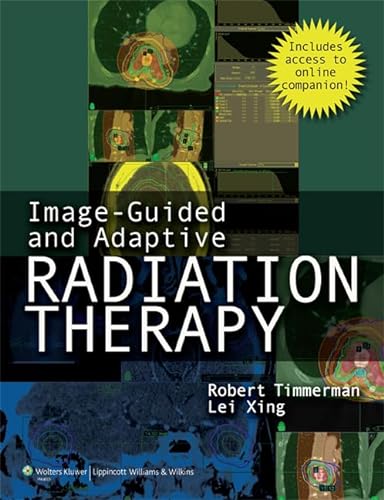
This book provides detailed, state-of-the-art information and guidelines on the latest developments, innovations, and clinical procedures in image-guided and adaptive radiation therapy. The first section discusses key methodological and technological issues in image-guided and adaptive radiation therapy, including use of implanted fiducial markers, management of respiratory motion, image-guided stereotactic radiosurgery and stereotactic body radiation therapy, three-dimensional conformal brachytherapy, target definition and localization, and PET/CT and biologically conformal radiation therapy. The second section provides practical clinical information on image-guided adaptive radiation therapy for cancers at all common anatomic sites and for pediatric cancers. The third section offers practical guidelines for establishing an effective image-guided adaptive radiation therapy program.
"synopsis" may belong to another edition of this title.
Review
"The capacity to use image data during the delivery of radiation therapy represents a major development in radiation oncology, and along with adaptive radiotherapy, it is the topic of this review on Image Guided Adaptive Radiation Therapy (IGART). The book is edited by Robert Timmerman and Lei Xing, with 22 chapters by 71 authors grouped into three parts. Part I is an overview of image-guided adaptive radiotherapy (IGART), with two informative introductory chapters summarizing its rationale, methods, current status, and future expectations. It explains current image-guided radiotherapy (IGRT) and IGART methods, with the assistance of a table that allows comparisons among different methods. Next are several chapters, each explaining a major topic in IGART, such as errors and margins, management of respiratory motion, IGART in brachytherapy, stereotactic radiosurgery, and stereotactic body RT, and implanted fiducial markers. The justification for IGART is to ‘‘reduce the uncertainty and treatment margins,’’ by addressing three issues—tumor delineation, interfractional, and intrafractional uncertainties, and the chapter on errors and margins is particularly well-written, identifying the gain that is achieved and potentially achievable by addressing each of these three issues.
The second part of the book is organized by anatomic site, with chapters focusing on IGART for head-and-neck, lung, breast, liver, gastrointestinal, genitourinary, gynecologic, central nervous system, and pediatric cancers. The type and amount of uncertainties, treatment margins, possible IGART applications, and potential clinical gain from IGART are explored for each treatment site...overall, they convey a thorough description of the role of IGART in each of these anatomic sites.
Part III discusses the technical and practical challenges encountered when introducing IGART to the clinic. IGART applications, especially the frequent plan adaptations, require effective solutions to manage challenges such as increased workload, reimbursement for the additional work, increased complexity of operation and equipment, an increased possibility of error, and more difficult data management and access. A long chapter outlines seven commercially available IGART platforms, each in a separate subsection written by the developers of these technologies...learning the systems’ existing capabilities, as well as the vendors’ works in progress, is informative."
"The book provides high-quality information and perspective, with coverage both wide and deep on topics of interest. Both the novice and experienced users of IGART can learn from this book, and the book should be a source of ideas for investigators."
Ergun Ahunbay, Ph.D.
Department of Radiation Oncology
Medical College of Wisconsin
Milwaukee, WI
The capacity to use image data during the delivery of radiation therapy represents a major development in radiation oncology, and along with adaptive radiotherapy, it is the topic of this review on Image Guided Adaptive Radiation Therapy (IGART). The book is edited by Robert Timmerman and Lei Xing, with 22 chapters by 71 authors grouped into three parts. Part I is an overview of image-guided adaptive radiotherapy (IGART), with two informative introductory chapters summarizing its rationale, methods, current status, and future expectations. It explains current image-guided radiotherapy (IGRT) and IGART methods, with the assistance of a table that allows comparisons among different methods. Next are several chapters, each explaining a major topic in IGART, such as errors and margins, management of respiratory motion, IGART in brachytherapy, stereotactic radiosurgery, and stereotactic body RT, and implanted fiducial markers. The justification for IGART is to ‘‘reduce the uncertainty and treatment margins,’’ by addressing three issues—tumor delineation, interfractional, and intrafractional uncertainties, and the chapter on errors and margins is particularly well-written, identifying the gain that is achieved and potentially achievable by addressing each of these three issues.
The second part of the book is organized by anatomic site, with chapters focusing on IGART for head-and-neck, lung, breast, liver, gastrointestinal, genitourinary, gynecologic, central nervous system, and pediatric cancers. The type and amount of uncertainties, treatment margins, possible IGART applications, and potential clinical gain from IGART are explored for each treatment site...overall, they convey a thorough description of the role of IGART in each of these anatomic sites.
Part III discusses the technical and practical challenges encountered when introducing IGART to the clinic. IGART applications, especially the frequent plan adaptations, require effective solutions to manage challenges such as increased workload, reimbursement for the additional work, increased complexity of operation and equipment, an increased possibility of error, and more difficult data management and access. A long chapter outlines seven commercially available IGART platforms, each in a separate subsection written by the developers of these technologies...learning the systems’ existing capabilities, as well as the vendors’ works in progress, is informative.
...The book provides high-quality information and perspective, with coverage both wide and deep on topics of interest. Both the novice and experienced users of IGART can learn from this book, and the book should be a source of ideas for investigators.
Ergun Ahunbay, Ph.D.
Department of Radiation Oncology
Medical College of Wisconsin
Milwaukee, WI -- Ergun Ahunbay, Ph.D., Int. J. Radiation Oncology Biol. Phys., Vol. 80, No. 4, p. 1278 Published On: 2011-04-21
"About this title" may belong to another edition of this title.
Search results for Image-Guided and Adaptive Radiation Therapy

Seller Image
Image-Guided and Adaptive Radiation Therapy
Seller: Greenworld Books, Arlington, TX, U.S.A.
Seller rating 5 out of 5 stars

Condition: very_good. Fast Free Shipping â" Very Good condition book with a firm cover and clean pages. Shows normal use and some light wear or limited notes markings. A solid, nice copy to enjoy. Seller Inventory # GWV.0781782821.VG
Stock Image
Image-Guided and Adaptive Radiation Therapy
Seller: ThriftBooks-Atlanta, AUSTELL, GA, U.S.A.
Seller rating 5 out of 5 stars
Hardcover. Condition: As New. No Jacket. Pages are clean and are not marred by notes or folds of any kind. ~ ThriftBooks: Read More, Spend Less. Seller Inventory # G0781782821I2N00
Stock Image
Image-Guided and Adaptive Radiation Therapy
Published by
Lippincott Williams And Wilkins, 2010
ISBN 10: 0781782821
ISBN 13: 9780781782821
Used
Hardcover
Seller: Anybook.com, Lincoln, United Kingdom
Seller rating 5 out of 5 stars
Condition: Good. This is an ex-library book and may have the usual library/used-book markings inside.This book has hardback covers. In good all round condition. No dust jacket. Please note the Image in this listing is a stock photo and may not match the covers of the actual item,1350grams, ISBN:9780781782821. Seller Inventory # 8542873
Buy Used
US$ 33.64
US$ 17.42 shipping
Ships from United Kingdom to U.S.A.
Ships from United Kingdom to U.S.A.
Quantity: 1 available
Seller Image
Image-Guided and Adaptive Radiation Therapy
Seller: Cycle Books LA, South el monte, CA, U.S.A.
Seller rating 5 out of 5 stars
Condition: new. Seller Inventory # AMTV.0781782821.N
Stock Image
Image-Guided & Adaptive Radiation Therapy (Hb)
Seller: Romtrade Corp., STERLING HEIGHTS, MI, U.S.A.
Seller rating 5 out of 5 stars
Condition: New. This is a Brand-new US Edition. This Item may be shipped from US or any other country as we have multiple locations worldwide. Seller Inventory # ABBB-51609
Stock Image
Image-Guided & Adaptive Radiation Therapy (Hb)
Seller: Basi6 International, Irving, TX, U.S.A.
Seller rating 5 out of 5 stars
Condition: Brand New. New. US edition. Expediting shipping for all USA and Europe orders excluding PO Box. Excellent Customer Service. Seller Inventory # ABEOCT25-117161
Stock Image
Image-Guided and Adaptive Radiation Therapy
Published by
Lippincott Williams & Wilkins, 2009
ISBN 10: 0781782821
ISBN 13: 9780781782821
New
Hardcover
Seller: Books Puddle, Woodside, NY, U.S.A.
Seller rating 4 out of 5 stars

Condition: New. pp. xvi + 367. Seller Inventory # 26571302
Stock Image
Image-Guided and Adaptive Radiation Therapy
Published by
Lippincott Williams & Wilkins, 2009
ISBN 10: 0781782821
ISBN 13: 9780781782821
New
Hardcover
Seller: Majestic Books, Hounslow, United Kingdom
Seller rating 4 out of 5 stars
Condition: New. pp. xvi + 367 Illus. Seller Inventory # 8325241
Buy New
US$ 230.30
US$ 8.60 shipping
Ships from United Kingdom to U.S.A.
Ships from United Kingdom to U.S.A.
Quantity: 4 available
Stock Image
Image-Guided and Adaptive Radiation Therapy
Published by
Lippincott Williams & Wilkins, 2009
ISBN 10: 0781782821
ISBN 13: 9780781782821
New
Hardcover
Seller: Biblios, Frankfurt am main, HESSE, Germany
Seller rating 4 out of 5 stars
Condition: New. pp. xvi + 367. Seller Inventory # 18571308
Buy New
US$ 245.76
US$ 11.15 shipping
Ships from Germany to U.S.A.
Ships from Germany to U.S.A.
Quantity: 4 available
Stock Image
Image-Guided and Adaptive Radiation Therapy
Seller: The Book Spot, Sioux Falls, MN, U.S.A.
Seller rating 4 out of 5 stars
Hardcover. Condition: New. Seller Inventory # Abebooks128377