
Items related to A Dance Between Flames: Berlin Between the Wars
Synopsis
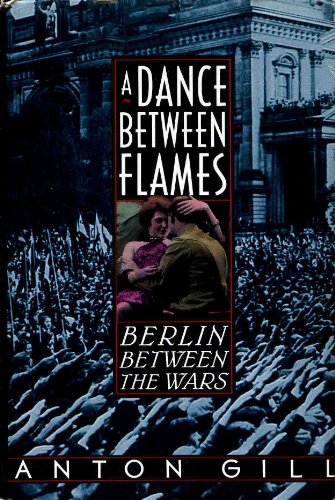
Explores the artistic ferment of the 1920s as it existed along with poverty and hardship and follows the rise of Nazism and its horrors in the 1930s
"synopsis" may belong to another edition of this title.
Reviews
This fast-paced, wonderfully evocative chronicle of interwar Berlin opens with the Communist revolution of 1918, which nearly took over Germany; it closes on Kristallnacht , Nov. 9, 1938, when Nazis burned and pillaged Jewish property and synagogues. Drawing primarily on German sources, British writer Gill re-creates the creative frenzy of a city that nurtured Bertolt Brecht, Max Reinhardt, Josephine Baker, Kathe Kollwitz, George Grosz, Arnold Schonberg, Christopher Isherwood, satirical journalist Kurt Tucholsky and dozens more against a backdrop of economic chaos and rising Nazism. He charts the Weimar Republic's doomed attempt to introduce democratic ideas to a wrecked, disillusioned people craving order, and he includes a wealth of fresh material on Berlin's cafe society, criminal underworld, theater, arts and its regimented university system--which emphasized militarist nationalism and actively harassed Jewish students and teachers. Photos.
Copyright 1994 Reed Business Information, Inc.
In a vivid, detailed, and powerful depiction of political and cultural life in Berlin from before WW I to 1938, Gill (The Journey Back from Hell--not reviewed, etc.) conveys the passion, diversity, energy, as well as the waste, rage and alienation that inspired the art, the politics, and ultimately the Second World War. Gill details the warring artistic ideologies of the time with an intensity equal to that with which he treats the political clashes: the nihilism and discontent of Dadaism; the architecture of Gropius and van der Rohe; the experimental art of Kandinsky and Klee; the obscurities of poets and novelists such as Rilke and Mann; the social commentary of playwrights such as Brecht and Weil; the film industry, which was reborn in a city where the air is ``like a dry white wine''; and the sense of possibility and novelty created by a remarkable concentration of talent that included publishers, entrepreneurs, and enthusiasts of all stripes. Behind the glamour of all that creativity, however, there was a level of decadence, that was reflected in a preoccupation with sex, crime, and suicide, exploited in the press, and captured so brilliantly in Isherwood's Good-bye Berlin. The cultural diversity included the rioting lower classes, the politically dispossessed trade unions, the displaced Russian emigr‚s (Stanislavsky, Eisenstein, Gorky, Pavlova), and the Jews, who were prominent in the sciences, the universities, and the entertainment industry until shortly before 1933, when Hitler initiated the campaign of anti-Semitism that led to the Holocaust. Against the great cultural background and the creative individualism of the artists, the emergence of Hitler is all the more sinister. While scrupulously maintaining his documentary perspective, Gill reveals the conditions that generated those crucial concerns about art and politics with which contemporary societies--the free and the unfree--are still preoccupied. -- Copyright ©1994, Kirkus Associates, LP. All rights reserved.
Gill ( Berlin to Bucharest , LJ 11/1/90) here collects wonderful anecdotes from Berliners who remember the Weimar era. A master raconteur who knows Berlin and Berliners well, he captures the Zeitgeist from the collective memory of a city that was both exhilarating and terrifying. Gill doesn't tell how Germany descended into a nightmare, but he shows how Berlin remembers the descent. This work is the perfect complement to the current explosion of books in Germany on the Weimar Republic, which consider whether there is anything to be learned from the pre-Hitler era concerning Germany's present difficulties. There is no fresh scholarship here, however, and Gill gets sloppy with his facts. For example, he cites the controversy about the republic's flag but describes the flag backward. Still, this book will be a good addition to public and undergraduate collections.
- Randall L. Schroeder, Augustana Coll. Lib., Rock Island, Ill.
Copyright 1994 Reed Business Information, Inc.
"About this title" may belong to another edition of this title.
Search results for A Dance Between Flames: Berlin Between the Wars

Stock Image
A Dance Between Flames: Berlin Between the Wars
Published by
Carroll & Graf Publishers, 1994
ISBN 10: 0786700637
ISBN 13: 9780786700639
Used
Hardcover
Seller: World of Books (was SecondSale), Montgomery, IL, U.S.A.
Seller rating 5 out of 5 stars

Hardback. Condition: Very Good. Seller Inventory # 00106056299
Stock Image
A Dance Between Flames: Berlin Between the Wars
Published by
Carroll & Graf Publishers, 1994
ISBN 10: 0786700637
ISBN 13: 9780786700639
Used
Hardcover
Seller: World of Books (was SecondSale), Montgomery, IL, U.S.A.
Seller rating 5 out of 5 stars
Hardback. Condition: Good. Seller Inventory # 00108274814
Stock Image
A Dance Between Flames: Berlin Between the Wars
Seller: ThriftBooks-Dallas, Dallas, TX, U.S.A.
Seller rating 5 out of 5 stars
Hardcover. Condition: Good. No Jacket. Missing dust jacket; Pages can have notes/highlighting. Spine may show signs of wear. ~ ThriftBooks: Read More, Spend Less. Seller Inventory # G0786700637I3N01
Stock Image
A Dance Between Flames: Berlin Between the Wars
Seller: ThriftBooks-Dallas, Dallas, TX, U.S.A.
Seller rating 5 out of 5 stars
Hardcover. Condition: Good. No Jacket. Pages can have notes/highlighting. Spine may show signs of wear. ~ ThriftBooks: Read More, Spend Less. Seller Inventory # G0786700637I3N00
Stock Image
A Dance Between Flames: Berlin Between the Wars
Seller: ThriftBooks-Reno, Reno, NV, U.S.A.
Seller rating 5 out of 5 stars
Hardcover. Condition: Good. No Jacket. Missing dust jacket; Pages can have notes/highlighting. Spine may show signs of wear. ~ ThriftBooks: Read More, Spend Less. Seller Inventory # G0786700637I3N01
Stock Image
A Dance Between Flames: Berlin Between the Wars
Seller: ThriftBooks-Phoenix, Phoenix, AZ, U.S.A.
Seller rating 5 out of 5 stars
Hardcover. Condition: Good. No Jacket. Pages can have notes/highlighting. Spine may show signs of wear. ~ ThriftBooks: Read More, Spend Less. Seller Inventory # G0786700637I3N00
Stock Image
A Dance Between Flames: Berlin Between the Wars
Seller: ThriftBooks-Atlanta, AUSTELL, GA, U.S.A.
Seller rating 5 out of 5 stars
Hardcover. Condition: Good. No Jacket. Missing dust jacket; Pages can have notes/highlighting. Spine may show signs of wear. ~ ThriftBooks: Read More, Spend Less. Seller Inventory # G0786700637I3N01
Seller Image
A Dance Between Flames: Berlin Between the Wars
Seller: -OnTimeBooks-, Phoenix, AZ, U.S.A.
Seller rating 5 out of 5 stars
Condition: good. A copy that has been read, remains in good condition. All pages are intact, and the cover is intact. The spine and cover show signs of wear. Pages can include notes and highlighting and show signs of wear, and the copy can include "From the library of" labels or previous owner inscriptions. 100% GUARANTEE! Shipped with delivery confirmation, if you're not satisfied with purchase please return item! Ships via media mail. Seller Inventory # OTV.0786700637.G
Stock Image
A Dance Between Flames: Berlin Between the Wars
Seller: Half Price Books Inc., Dallas, TX, U.S.A.
Seller rating 5 out of 5 stars
hardcover. Condition: Very Good. Connecting readers with great books since 1972! Used books may not include companion materials, and may have some shelf wear or limited writing. We ship orders daily and Customer Service is our top priority! Seller Inventory # S_478548846
Stock Image
A Dance Between Flames: Berlin Between the Wars
Seller: HPB Inc., Dallas, TX, U.S.A.
Seller rating 5 out of 5 stars
hardcover. Condition: Very Good. Connecting readers with great books since 1972! Used books may not include companion materials, and may have some shelf wear or limited writing. We ship orders daily and Customer Service is our top priority! Seller Inventory # S_472186111