
Items related to How to Become CEO: The Rules for Rising to the Top...
Synopsis
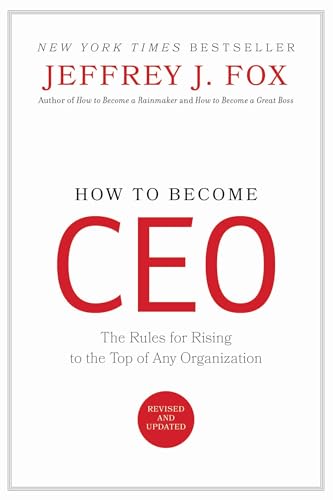
Vision, persistence, integrity, and respect for everyone in the workplace--these are all qualities of successful leaders. But Jeffrey J. Fox, the founder of a marketing consulting company, also gives these tips: never write a nasty memo, skip all office parties, and overpay your people. These are a few of his key ways to climb the corporate ladder.
"synopsis" may belong to another edition of this title.
About the Author
Prior to starting Fox & Co. Jeffrey J. Fox worked in senior positions for three high powered consumer and industrial marketing companies. He was Vice President, Marketing, and a Corporate Vice President of Loctite Corp, now Henkel/Loctite. He was Director of Marketing for the wine divisions of The Pillsbury Co. He was the Director of New Products for Heublein, Inc, now Diageo. (All three companies became clients of Fox & Co.) Jeffrey is the winner of Sales & Marketing Management magazine's "Outstanding Marketer Award;" winner of the American Marketing Association's "Outstanding Marketer in Connecticut;" and the National Distributors Association's award as the nation's "Best Industrial Marketer." He is the subject of a Harvard Business School case study that is rated one of the top 100 case studies, and which is thought to be the most widely taught marketing case in the world. His books have been published in 35 languages. His offices are in Chester, Connecticut.
Reviews
Fox heads his own marketing consulting company, and he demonstrates here that he knows how to package an idea. While there is nothing especially original about a list of rules for getting ahead, Fox's guide is filled with 75 tips that are short, sweet, and to the point. Moreover, the ideas themselves are fresh. You have to admire the pluck of someone who counsels spending one day a month in the library and recommends sending handwritten notes. For each suggestion, Fox includes one or two pages of elaboration. Other advice: Always take vacations. Always take the job that offers the most money. Never write a nasty memo. Don't take work home from the office. Never let a good boss make a mistake. And, nary a mention of Machiavelli or Sun-Tzu. Refreshing! David Rouse
Excerpt. © Reprinted by permission. All rights reserved.
Always Take the Job That Offers the Most Money
After you have decided what you want to do--whether it is banking, advertising, manufacturing, or something else--go to work for the company that offers you the most money. If you have not decided what kind of career or industry is for you, then take the job that offers the most money. If you are in a corporation, always take the transfer, promotion, or assignment that pays the most money.
There are several important reasons why you go for the money. First, all of your benefits, perquisites, bonuses, and subsequent raises will be based on your salary. Corporations give all extra compensation in percentages. Therefore, a 10 percent raise on a $22,000 salary is $200 better than the same raise on a $20,000 salary.
Second, the higher paid you are, the more visible to top management you will be.
Third, the more money you are paid, the more contribution will be expected of you. This means you will be given more responsibility, tasks, and problems to solve. And a chance to perform is an invitation to success.
Fourth, if two people are candidates for a promotion to a job that pays $50,000, and one person makes $30,000 and the other $40,000 the higher paid person always gets the job. The higher paid person gets the job regardless of talent, contribution, or anything else. Corporations usually take the easy way out, and it is easier to promote the higher paid than the lower.*
Finally, in business, money is the scoreboard. The more you make, the better you're doing. Simple.
*Promoting the higher paid is the path of no resistance in most organizations. Someone approved the higher paid person's compensation. Others concurred. To leapfrog the higher paid diminishes the sponsor of the higher paid. And the sponsors of the higher paid are, themselves, even higher paid. Promoting the higher paid endorses the wisdom of upper management.
"About this title" may belong to another edition of this title.
Search results for How to Become CEO: The Rules for Rising to the Top...

Stock Image
How to Become CEO: The Rules for Rising to the Top of Any Organization
Published by
Grand Central Publishing, 1998
ISBN 10: 0786864370
ISBN 13: 9780786864379
Used
Hardcover
Seller: World of Books (was SecondSale), Montgomery, IL, U.S.A.
Seller rating 5 out of 5 stars

Condition: Acceptable. Item in acceptable condition! Textbooks may not include supplemental items i.e. CDs, access codes etc. Seller Inventory # 00089297967
Stock Image
How to Become CEO: The Rules for Rising to the Top of Any Organization
Published by
Grand Central Publishing, 1998
ISBN 10: 0786864370
ISBN 13: 9780786864379
Used
Hardcover
Seller: World of Books (was SecondSale), Montgomery, IL, U.S.A.
Seller rating 5 out of 5 stars
Condition: Very Good. Item in very good condition! Textbooks may not include supplemental items i.e. CDs, access codes etc. Seller Inventory # 00107986738
Stock Image
How to Become Ceo: The Rules for Rising to the Top of Any Organization
Seller: World of Books (was SecondSale), Montgomery, IL, U.S.A.
Seller rating 5 out of 5 stars
Hardback. Condition: Good. Vision, persistence, integrity, and respect for everyone in the workplace--these are all qualities of successful leaders. But Jeffrey J. Fox, the founder of a marketing consulting company, also gives these tips: never write a nasty memo, skip all office parties, and overpay your people. These are a few of his key ways to climb the corporate ladder. Seller Inventory # 00087841575
Stock Image
How to Become CEO: The Rules for Rising to the Top of Any Organization
Seller: Gulf Coast Books, Cypress, TX, U.S.A.
Seller rating 5 out of 5 stars
Hardcover. Condition: Good. Seller Inventory # 0786864370-3-23344429
Stock Image
How to Become CEO: The Rules for Rising to the Top of Any Organization
Seller: Orion Tech, Kingwood, TX, U.S.A.
Seller rating 5 out of 5 stars
Hardcover. Condition: Fair. Seller Inventory # 0786864370-4-18231703
Stock Image
How to Become CEO: The Rules for Rising to the Top of Any Organization
Seller: Orion Tech, Kingwood, TX, U.S.A.
Seller rating 5 out of 5 stars
Hardcover. Condition: Very Good. Seller Inventory # 0786864370-2-22305235
Stock Image
How to Become CEO: The Rules for Rising to the Top of Any Organization
Seller: Gulf Coast Books, Cypress, TX, U.S.A.
Seller rating 5 out of 5 stars
Hardcover. Condition: Very Good. Seller Inventory # 0786864370-2-19820769
Stock Image
How to Become CEO: The Rules for Rising to the Top of Any Organization
Seller: Your Online Bookstore, Houston, TX, U.S.A.
Seller rating 5 out of 5 stars
Hardcover. Condition: Good. Seller Inventory # 0786864370-3-21394963
Stock Image
How to Become CEO: The Rules for Rising to the Top of Any Organization
Seller: Your Online Bookstore, Houston, TX, U.S.A.
Seller rating 5 out of 5 stars
Hardcover. Condition: Very Good. Seller Inventory # 0786864370-2-21251746
Seller Image
How to Become CEO: The Rules for Rising to the Top of Any Organization
Published by
Grand Central Publishing, 1998
ISBN 10: 0786864370
ISBN 13: 9780786864379
Used
Hardcover
Seller: 3Brothers Bookstore, Egg harbor township, NJ, U.S.A.
Seller rating 5 out of 5 stars
Condition: very_good. Cover may have light wear, pages in very good condition and binding is sturdy; may have other light shelf wear or creases. May have notes or highlighting. Seller Inventory # EVV.0786864370.VG