
Items related to Gravy Training: Inside the Business of Business Schools
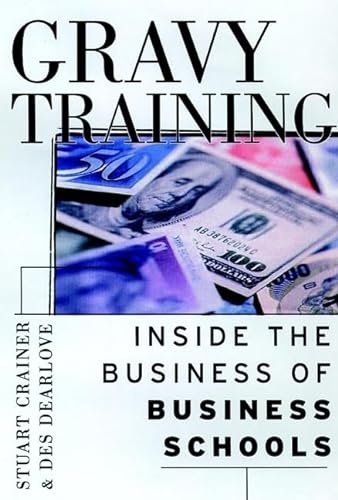
Synopsis
Are today's top business schools really crucibles of cutting-edge theory and management expertise? Or are they merely cash cows for universities and educators alike? In Gravy Training, two hard-hitting journalists uncover the inner workings of the world's top business schools, where the focus is often on generating huge enrollment fees and big-time consulting contracts for faculty. An intriguing mix of stories and hard data, Gravy Training clearly shows how many of our most revered business schools have reached a crucial crossroads in their development. The authors contAnd that, unsure of their role and facing intense competition, these schools must change dramatically if they are to survive. And they ask the hard questions these schools have so far failed to address.
"synopsis" may belong to another edition of this title.
About the Author
DES DEARLOVE are UK-based journalists who have been covering the business scene for more than twenty years. They are founders of the media content, concepts, and consulting firm, Suntop Media. Crainer's work has appeared in the Financial Times, Across the Board, and Strategy & Business. He is the author of numerous books on business, including the Ultimate series and the Financial Times Handbook of Management. Dearlove writes regularly for the London Times, the American Management Review, and Human Resources. He is the author of a number of books on management best practices.
From the Back Cover
"[Business schools] have lost their basic purpose....If you ask what are the best ideas in organizations over the last ten years, most didn't start with business schools. Most of the top ten business bestsellers didn't start with business faculty."
—Gary Hamel
Gary Hamel, the internationally acclaimed strategy guru and business school educator, shocked a group of journalists and academics at the London Business School with that frank appraisal of the state of higher business education today. But his comment, damning as it was, only hints at the full intrigue of money, politics, and power that has compromised the integrity of far too many such schools. There's more to be told. Much more.
In Gravy Training, two hard-hitting business writers present the controversial results of their own investigation into the world's most prestigious business schools. Are such elite centers of management education as Columbia, Stanford, and Wharton really crucibles of cutting-edge theory and expertise? Or are they merely cash cows for universities and faculty alike?
There's no doubt that business schools are big business. Part of a multi-billion dollar global industry, they also exert a growing influence on public as well as corporate life. President Clinton plays golf with Michael Porter of the Harvard Business School, and Britain's Prime Minister Tony Blair had his Shadow Cabinet trained at Oxford's esteemed Templeton College. Be that as it may, the authors of Gravy Training believe that business schools have reached a crossroads and that their future is uncertain as they face intensifying competition from corporate education upstarts and start-ups.
Crainer and Dearlove conducted extensive research and interviewed hundreds of administrators and faculty members to find out if business schools deliver on their promises and discern what their futures may hold. Their page-turning examination of the B-school phenomenon contains provocative stories and startling facts about the incredible speaking and consulting fees charged by B-school stars. They delve into the power networks that link alumni, show how academic affiliations affect the way top CEOs do their jobs, and reveal how Business Week and other media rankings drive business school curricula.
But Gravy Training is more than an expose. It proposes forty reforms that can return business schools to their original goal of training effective management professionals. It is a book that begins with the urgency of an exclamation point, yet ends with the hope of a question mark-a book rife with implications for everyone impacted by the quality of business education. Ultimately, that is everyone indeed.
From the Inside Flap
"[Business schools] have lost their basic purpose....If you ask what are the best ideas in organizations over the last ten years, most didn't start with business schools. Most of the top ten business bestsellers didn't start with business faculty."—Gary HamelGary Hamel, the internationally acclaimed strategy guru and business school educator, shocked a group of journalists and academics at the London Business School with that frank appraisal of the state of higher business education today. But his comment, damning as it was, only hints at the full intrigue of money, politics, and power that has compromised the integrity of far too many such schools. There's more to be told. Much more.In Gravy Training, two hard-hitting business writers present the controversial results of their own investigation into the world's most prestigious business schools. Are such elite centers of management education as Columbia, Stanford, and Wharton really crucibles of cutting-edge theory and expertise? Or are they merely cash cows for universities and faculty alike?There's no doubt that business schools are big business. Part of a multi-billion dollar global industry, they also exert a growing influence on public as well as corporate life. President Clinton plays golf with Michael Porter of the Harvard Business School, and Britain's Prime Minister Tony Blair had his Shadow Cabinet trained at Oxford's esteemed Templeton College. Be that as it may, the authors of Gravy Training believe that business schools have reached a crossroads and that their future is uncertain as they face intensifying competition from corporate education upstarts and start-ups. Crainer and Dearlove conducted extensive research and interviewedhundreds of administrators and faculty members to find out if business schools deliver on their promises and discern what their futures may hold. Their page-turning examination of the B-school phenomenon contains provocative stories and startling facts about the in
Reviews
Crainer and Dearlove are both business journalists who live in Oxford, England; Crainer previously compiled The Ultimate Business Library (1997). In this critique of business education worldwide, no school escapes unscathed. The authors question whether business schools have helped produce better managers and whether the research they carry out has helped the business community be more effective. They document a litany of complaints. Schools fail to provide any grounding in ethics or the human side of management. The Harvard case method is seriously flawed. Faculty members are recruited like athletes for their "marquee value," with little requirement that they actually teach. Too much time is devoted to outside consulting. Too much effort is devoted to securing a top ranking among the growing number of "best school" lists. Along with the criticisms, however, the authors recommend solutions. They also consider the future of business education in light of growing competition for the lucrative executive education market from consultants that conduct training seminars and from distance-learning providers. Published last year in Britain, this work has now been customized for American readers. David Rouse
After more than a century, have business schools delivered on their original promise? That depends on your interpretation, say British business journalists Crainer and Dearlove. But whatever impact business schools have had, they conclude, it hasn't all been positive. Times have changed, and business schools haven't; they need to face up to the competition from consultants and the more than 1500 "corporate universities" in the United States alone. The authors' frequent put-downs of Harvard Business School and their glorification of INSEAD, the elite French business school, may suggest a Eurocentric bent. But they support their arguments with quotes from quite a few well-known North Americans in business education with serious critiques of the major schools, their teaching methods, and the competence of graduates. Greater emphasis on technology, better philosophical connections with the market they serve, and cooperative programs and projects are some of the approaches that they think can save MBA programs. Required reading for aspiring MBA students and corporate human resources managers; MBA administrators and faculty should read it but probably won't.ASusan DiMattia, "Library Hotline" & "Corporate Library Update"
Copyright 1999 Reed Business Information, Inc.
"About this title" may belong to another edition of this title.
Search results for Gravy Training: Inside the Business of Business Schools

Stock Image
Gravy Training: Inside the Real World of Business Schools: Inside the World's Top Business Schools (Jossey Bass Business & Management Series)
Seller: WorldofBooks, Goring-By-Sea, WS, United Kingdom
Seller rating 5 out of 5 stars

Hardback. Condition: Very Good. The book has been read, but is in excellent condition. Pages are intact and not marred by notes or highlighting. The spine remains undamaged. Seller Inventory # GOR014594481
Buy Used
US$ 8.98
US$ 7.59 shipping
Ships from United Kingdom to U.S.A.
Ships from United Kingdom to U.S.A.
Quantity: 1 available
Stock Image
Gravy Training Inside the Busi
Seller: World of Books (was SecondSale), Montgomery, IL, U.S.A.
Seller rating 5 out of 5 stars
Condition: Very Good. Item in very good condition! Textbooks may not include supplemental items i.e. CDs, access codes etc. Seller Inventory # 00104910600
Stock Image
Gravy Training : Inside the Real World of Business Schools
Published by
Wiley & Sons, Incorporated, John, 1999
ISBN 10: 0787949310
ISBN 13: 9780787949310
Used
Hardcover
First Edition
Seller: Better World Books: West, Reno, NV, U.S.A.
Seller rating 5 out of 5 stars
Condition: Very Good. 1st Edition. Former library copy. Pages intact with possible writing/highlighting. Binding strong with minor wear. Dust jackets/supplements may not be included. Includes library markings. Stock photo provided. Product includes identifying sticker. Better World Books: Buy Books. Do Good. Seller Inventory # 8409830-6
Stock Image
Gravy Training: Inside the Business of Business Schools
Seller: Poverty Hill Books, Mt. Prospect, IL, U.S.A.
Seller rating 4 out of 5 stars

Hardcover. Condition: New. HARDCOVER, BRAND NEW COPY, Perfect Shape, No Remainder Mark, MH277-908Fast Shipping With Online Tracking, International Orders shipped Global Priority Air Mail, All orders handled with care and shipped promptly in secure packaging, we ship Mon-Sat and send shipment confirmation emails. Our customer service is friendly, we answer emails fast, accept returns and work hard to deliver 100% Customer Satisfaction! Seller Inventory # 0809290004
Stock Image
Gravy Training: Inside the World's Top Business Schools
Seller: World of Books Inc, Montgomery, IL, U.S.A.
Seller rating 2 out of 5 stars

Hardback. Condition: Very Good. This inside look at the lucrative world of top business schools reveals that they aren't always seats of new economic theory, strategic innovation and best management practices, but are sometimes cash cows or "gravy trains" for universities and faculty alike. Seller Inventory # CIN0787949310VG
Stock Image
Gravy Training: Inside the Business of Business Schools
Seller: PAPER CAVALIER UK, London, United Kingdom
Seller rating 5 out of 5 stars
Condition: very good. Gently used. May include previous owner's signature or bookplate on the front endpaper, sticker on back and/or remainder mark on text block. Seller Inventory # 9780787949310-3
Buy Used
US$ 37.06
US$ 8.13 shipping
Ships from United Kingdom to U.S.A.
Ships from United Kingdom to U.S.A.
Quantity: 1 available
Stock Image
Gravy Training: Inside the Business of Business Schools
Seller: BennettBooksLtd, Los Angeles, CA, U.S.A.
Seller rating 5 out of 5 stars
Hardcover. Condition: New. In shrink wrap. Looks like an interesting title! Seller Inventory # Q-0787949310