Synopsis
WHY? It's the most basic question known to humankind, the query that has set us apart from all other species ever since our earliest ancestor stood erect and wondered what made the sun rise every morning or how fire could be tamed. We call ourselves Homo sapiens -- the wise men -- and our thirst for knowledge is science in its purest form. Each answer sparks new questions in an endless quest for knowledge. The rigorous methods and sophisticated tools modern scientists use to investigate everything from the smallest subatomic particles to the farthest reaches of our universe all trace to our intellectual curiosity, that uniquely human trait acquired in our prehistoric past.
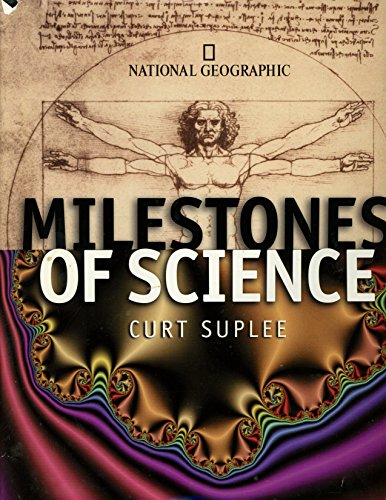
Highlighted by more than 300 vivid photographs and illustrations, this fascinating history chronicles the important milestones of scientific thought, each a building block for new revelations. Award-winning science writer Curt Suplee identifies the key ideas and discoveries that shaped our understanding of our world and ourselves and introduces the men and women whose questing intellects illuminated the very nature of reality itself.
We hear Archimedes shout "Eureka!" and listen as Aristotle ponders nature's mysteries. We peer through Galileo's telescope as he revolutionizes astronomy, and through Leeuwenhoek's microscope as he finds life teeming in a single drop of water. We meet Marie Curie in a darkened lab lit by the ghostly glow of radium and stand beside the physicists of Los Alamos as the nuclear age is born in a flash of blinding light. And these are only a few of the scientific pioneers whose insights are explored and explained, a brilliant roll call that sweeps from Euclid to Edison to Einstein, from Pythagoras and Ptolemy to Descartes, Newton, Darwin, Marconi, and many, many others.
In this engrossing, enlightening volume, Suplee brings science vividly to life, revealing a vital, intense pursuit far different from the dry and intimidating discipline we imagine all too often. Instead, he presents a comprehensive, compelling drama of discovery and accomplishment that encompasses every aspect of human experience as we seek to answer the quintessential question: why?
"synopsis" may belong to another edition of this title.
Reviews
YA-A colorful, attention-grabbing overview of scientific milestones, or as the author explains, "points at which some aspect of nature became substantially more understandable." The book is divided into 10 sections that represent time periods and eras of scientific thought. Beginning with the Dawn of Inquiry (pre-600 B.C.) and culminating in the crescendo to 20th-century technological advances, the text is highlighted by fascinating color photos and reproductions. Readers learn that in the Classical Era (600 B.C.-A.D. 500) people began to reason that the actions of nature followed predictable and logical principles that could be learned through observation and experimentation. They learn about the contributions of the Chinese (gunpowder, paper, and the compass) and their resulting influences on history. The Arab donation of the concept and notation of "zero"; the "Dark Ages" feats of mechanical clocks, waterwheels, and windmills; and the fact that Danish astronomer Tycho Brahe wore a gold-and-silver false nose to replace his own lost in a duel-these and many more fascinating facts are brought to life within the pages of this book. Vivid photos and reproductions, many dating from earlier centuries, and a concise, interesting text make this a great reference source for young adults needing an overview of scientific accomplishments. It is even captivating enough to read cover to cover.
Carol DeAngelo, Kings Park Library, Burke, VA
Copyright 2000 Reed Business Information, Inc.
Science journalist Suplee conducts an introductory tour through the biggest names and discoveries in the history of science. He hews to the traditional chronology, beginning with modern science's antecedents in classical Greece, and he narratively develops science's core dynamic, the recurring overthrow of an orthodox viewpoint by a revolutionary one. Occasionally, a giant like Newton or Einstein stages the coup, but Suplee, in one-page summaries of one scientific discipline or another, wisely underscores that understanding usually advances incrementally, albeit at the hands of insightful, determined people--Michael Faraday, for instance, or Marie Curie. Mentioning such names and presenting their portraits at full-page size, as this National Geographic product frequently does, make the book tantamount to a pantheon of scientists, which is a useful enough format to enlighten readers who are blank slates in their knowledge of science. An eminently browsable entree to the vast universe of scientific knowledge. Gilbert Taylor
Copyright © American Library Association. All rights reserved
"About this title" may belong to another edition of this title.
Other Popular Editions of the Same Title

Search results for Milestones of Science: The History of Humankind's...

Stock Image
Milestones of Science
Seller: World of Books (was SecondSale), Montgomery, IL, U.S.A.
Seller rating 5 out of 5 stars

Condition: Good. Item in good condition. Textbooks may not include supplemental items i.e. CDs, access codes etc. Seller Inventory # 00071604689
Stock Image
Milestones of Science
Seller: World of Books (was SecondSale), Montgomery, IL, U.S.A.
Seller rating 5 out of 5 stars
Condition: Very Good. Item in very good condition! Textbooks may not include supplemental items i.e. CDs, access codes etc. Seller Inventory # 00095245308
Stock Image
Milestones of Science: The History of Humankind's Greatest Ideas (reading line)
Seller: Once Upon A Time Books, Siloam Springs, AR, U.S.A.
Seller rating 4 out of 5 stars

Hardcover. Condition: Good. This is a used book in good condition and may show some signs of use or wear . This is a used book in good condition and may show some signs of use or wear . Seller Inventory # mon0001013793
Stock Image
Milestones of Science: The History of Humankind's Greatest Ideas (reading line)
Seller: Half Price Books Inc., Dallas, TX, U.S.A.
Seller rating 5 out of 5 stars
hardcover. Condition: Very Good. Connecting readers with great books since 1972! Used books may not include companion materials, and may have some shelf wear or limited writing. We ship orders daily and Customer Service is our top priority! Seller Inventory # S_403035915
Stock Image
Milestones of Science : The History of Humankind's Greatest Ideas (reading Line)
Published by
National Geographic Society, 2000
ISBN 10: 0792279069
ISBN 13: 9780792279068
Used
Hardcover
First Edition
Seller: Better World Books, Mishawaka, IN, U.S.A.
Seller rating 5 out of 5 stars
Condition: Good. 1st Edition. Used book that is in clean, average condition without any missing pages. Seller Inventory # 7610757-6
Stock Image
Milestones of Science : The History of Humankind's Greatest Ideas (reading Line)
Published by
National Geographic Society, 2000
ISBN 10: 0792279069
ISBN 13: 9780792279068
Used
Hardcover
First Edition
Seller: Better World Books, Mishawaka, IN, U.S.A.
Seller rating 5 out of 5 stars
Condition: Very Good. 1st Edition. Former library book; may include library markings. Used book that is in excellent condition. May show signs of wear or have minor defects. Seller Inventory # 10708050-6
Stock Image
Milestones of Science: The History of Humankind's Greatest Ideas (reading line)
Seller: HPB-Emerald, Dallas, TX, U.S.A.
Seller rating 5 out of 5 stars
Hardcover. Condition: Very Good. Connecting readers with great books since 1972! Used books may not include companion materials, and may have some shelf wear or limited writing. We ship orders daily and Customer Service is our top priority! Seller Inventory # S_432657497
Stock Image
Milestones of Science: The History of Humankind's Greatest Ideas (reading line)
Seller: HPB-Emerald, Dallas, TX, U.S.A.
Seller rating 5 out of 5 stars
Hardcover. Condition: Good. Connecting readers with great books since 1972! Used books may not include companion materials, and may have some shelf wear or limited writing. We ship orders daily and Customer Service is our top priority! Seller Inventory # S_338932154
Stock Image
Milestones of Science: The History of Humankind's Greatest Ideas (reading line)
Seller: HPB-Ruby, Dallas, TX, U.S.A.
Seller rating 5 out of 5 stars
Hardcover. Condition: Very Good. Connecting readers with great books since 1972! Used books may not include companion materials, and may have some shelf wear or limited writing. We ship orders daily and Customer Service is our top priority! Seller Inventory # S_357798279
Stock Image
Milestones of Science: The History of Humankind's Greatest Ideas (reading line)
Seller: HPB-Diamond, Dallas, TX, U.S.A.
Seller rating 5 out of 5 stars
Hardcover. Condition: Very Good. Connecting readers with great books since 1972! Used books may not include companion materials, and may have some shelf wear or limited writing. We ship orders daily and Customer Service is our top priority! Seller Inventory # S_403183503