
Items related to Rural Radicals: Righteous Rage in the American Grain
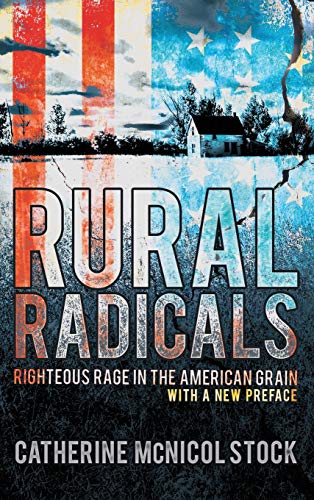
Synopsis
When terrorists blew up the Alfred P. Murrah Federal Building in Oklahoma City, a shocked nation could scarcely imagine the perpetrators were home-grown. If they were, Catherine McNicol Stock explains, they participated in a long tradition of rural extremism. The arrest of Timothy McVeigh, the alleged perpetrator, gave terrorism a face and it turned out to be the white-skinned, blue-eyed, clean-shaven face of a small-town boy who served in the Gulf War. Networks of militiamen, conspiracists, survivalists, and white supremacists suddenly visible to media attention had been there all along, Stock suggests. They are heirs to a tradition as old as the country itself, characteristically angry and frequently violent, rendering patriotism as intolerance.
As early as 1676, rural Virginians took up arms to protest what they considered economic and political injustices, and the fierce protective responses did not stop with the Revolution. Stock examines recurring themes in rural radical movements, including anti-federalism, white supremacy, populism, and vigilantism. These themes suggest to her some of the seemingly contradictory responses implicit in rural discontent. The politically conservative fear of outside power and authority in the form of government, corporations, international institutions, experts, and the media is juxtaposed with the potentially democratic desire to protect and revive community, culture, and the cooperative tradition. Stock believes we need to understand both the historic roots and the diverse manifestations of rural radicalism in order to make some sense of the action that tore a hole in this country's heartland in the spring of 1995.
"synopsis" may belong to another edition of this title.
About the Author
Catherine McNicol Stock is Associate Professor of History and Director of the American Studies Program at Connecticut College.
Reviews
How is it that whites from the rural heartland, long romanticized in popular culture as the salt of the American earth, have come to make up the United States' most violent domestic terrorist movements, including militias, Identity Christians and other "hate radicals"? In the wake of the bombing of the Alfred P. Murrah Federal Building in Oklahoma City, allegedly the work of blue-eyed Timothy McVeigh, historian Stock has attempted to trace the lineage of today's extremist white rural politics. She draws clear links between contemporary hate groups and a long tradition of rural political movements characterized by a fierce commitment to the rights of small landowners and family farmers, and by a culture of vigilantism. This tradition has never fit into urban categories of left and right. As far back as colonial times, she points out, rural Americans have organized simultaneous opposition, often violent, to elite Eastern landowners and elite Eastern government: such high-school textbook examples as Shays's Rebellion, the Whisky Rebellion and the Grange movement are just a few illustrations of the point. Rural Radicals is a wild ride, particularly for readers yet unfamiliar with the recent trend in history of conducting research from the perspective of less powerful groups; yet it vividly demonstrates the value of this approach. Photos not seen by PW.
Copyright 1996 Reed Business Information, Inc.
A first-rate and highly accessible history of radicalism in rural America. Recent events, such as the bombing of the federal building in Oklahoma, have brought to light an ugly element in American political life--militant agrarian groups who have decided to take the protection of this country into their own hands. The confusion sets in, of course, when we try to understand how bombing a government building achieves such purpose. To explicate this phenomenon, and identify the true position of these militants along the political spectrum, Stock (History and American Studies/Connecticut Coll.) first turns back to the very beginnings of American rural activism. Starting in colonial times, Stock identifies two divergent strands of grassroots activity in the American countryside: The first, which she terms ``rural producer radicalism,'' has traditionally manifested itself through demonstrations and organizations--like Shays' Rebellion, the Whiskey Rebels, the Farmers' Holiday Association--designed to protect the rights of small farmers. The second, ``the culture of vigilantism,'' has these same interests at heart, but manifests itself through violence and racism, in organizations such as the Ku Klux Klan. Stock presents these two cultures as distinct entities, but as she herself points out, rural producer radicalism and the culture of vigilantism are brought forth from the same soil: The same deeply rooted values that fostered the Mormon Church also nourish the fanatical beliefs of the militias. In fact, it is often harder to distinguish between the two cultures than Stock cares to admit. Ultimately, Stock refocuses our attention on what is perhaps the most frightening aspect of rural extremism: that it is not an aberration, but merely a violently skewed expression of our most deeply cherished national ideals. (8 b&w photos and 2 drawings, not seen) (History Book Club alternate selection) -- Copyright ©1996, Kirkus Associates, LP. All rights reserved.
When the federal building in Oklahoma City was bombed, the nation was stunned to learn that the terrorists could be U.S. citizens. Stock (Main Street in Crisis, Yale, 1988) argues that although the bombing was shocking, we should not be surprised that radicals exist in the rural areas of our nation. Using many secondary sources, she shows evidence of rural radicalism from Colonial times to the present. First, she looks at the political aspects of rural producer radicalism such as the Granger and Populist movements. Next, Stock addresses vigilantism from the perspectives of class (small producer vs. big business and wealth), race, and patriotism (e.g., attacks during World War I on Americans of German descent). In the final section, Stock brings all the political and vigilante aspects of rural radicalism together, discussing the shift from radicalism on the left to the far right and placing examples from our time in their historical context. A thorough, fascinating work, recommended for scholars and informed lay readers. [Alternate selection of the History Book Club.]?Linda L. McEwan, Elgin Community Coll., Ill.
-?Linda L. McEwan, Elgin Community Coll., Ill.
Copyright 1996 Reed Business Information, Inc.
"About this title" may belong to another edition of this title.
Search results for Rural Radicals: Righteous Rage in the American Grain

Stock Image
Rural Radicals: Righteous Rage in the American Grain (with a New Preface)
Published by
Cornell University Press, 1996
ISBN 10: 0801432944
ISBN 13: 9780801432941
Used
Hardcover
Seller: ThriftBooks-Dallas, Dallas, TX, U.S.A.
Seller rating 5 out of 5 stars

Hardcover. Condition: Good. No Jacket. Former library book; Pages can have notes/highlighting. Spine may show signs of wear. ~ ThriftBooks: Read More, Spend Less. Seller Inventory # G0801432944I3N10
Stock Image
Rural Radicals: Righteous Rage in the American Grain (with a New Preface)
Published by
Cornell University Press, 1996
ISBN 10: 0801432944
ISBN 13: 9780801432941
Used
Hardcover
Seller: ThriftBooks-Dallas, Dallas, TX, U.S.A.
Seller rating 5 out of 5 stars
Hardcover. Condition: Fair. No Jacket. Former library book; Readable copy. Pages may have considerable notes/highlighting. ~ ThriftBooks: Read More, Spend Less. Seller Inventory # G0801432944I5N10
Stock Image
Rural Radicals: Righteous Rage in the American Grain (with a New Preface)
Published by
Cornell University Press, 1996
ISBN 10: 0801432944
ISBN 13: 9780801432941
Used
Hardcover
Seller: ThriftBooks-Atlanta, AUSTELL, GA, U.S.A.
Seller rating 5 out of 5 stars
Hardcover. Condition: Very Good. No Jacket. Former library book; May have limited writing in cover pages. Pages are unmarked. ~ ThriftBooks: Read More, Spend Less. Seller Inventory # G0801432944I4N10
Stock Image
Rural Radicals: Righteous Rage in the American Grain (with a New Preface)
Published by
Cornell University Press, 1996
ISBN 10: 0801432944
ISBN 13: 9780801432941
Used
Hardcover
Seller: ThriftBooks-Atlanta, AUSTELL, GA, U.S.A.
Seller rating 5 out of 5 stars
Hardcover. Condition: Very Good. No Jacket. May have limited writing in cover pages. Pages are unmarked. ~ ThriftBooks: Read More, Spend Less. Seller Inventory # G0801432944I4N00
Stock Image
Rural Radicals: Righteous Rage in the American Grain (with a New Preface)
Published by
Cornell University Press, 1996
ISBN 10: 0801432944
ISBN 13: 9780801432941
Used
Hardcover
Seller: ThriftBooks-Dallas, Dallas, TX, U.S.A.
Seller rating 5 out of 5 stars
Hardcover. Condition: Very Good. No Jacket. May have limited writing in cover pages. Pages are unmarked. ~ ThriftBooks: Read More, Spend Less. Seller Inventory # G0801432944I4N00
Stock Image
Rural Radicals: Righteous Rage in the American Grain (with a New Preface)
Published by
Cornell University Press, 1996
ISBN 10: 0801432944
ISBN 13: 9780801432941
Used
Hardcover
Seller: ThriftBooks-Atlanta, AUSTELL, GA, U.S.A.
Seller rating 5 out of 5 stars
Hardcover. Condition: Good. No Jacket. Missing dust jacket; Pages can have notes/highlighting. Spine may show signs of wear. ~ ThriftBooks: Read More, Spend Less. Seller Inventory # G0801432944I3N01
Stock Image
Rural Radicals: Righteous Rage in the American Grain (with a New Preface)
Published by
Cornell University Press, 1996
ISBN 10: 0801432944
ISBN 13: 9780801432941
Used
Hardcover
Seller: ThriftBooks-Phoenix, Phoenix, AZ, U.S.A.
Seller rating 5 out of 5 stars
Hardcover. Condition: Good. No Jacket. Missing dust jacket; Pages can have notes/highlighting. Spine may show signs of wear. ~ ThriftBooks: Read More, Spend Less. Seller Inventory # G0801432944I3N01
Stock Image
Rural Radicals: Righteous Rage in the American Grain
Seller: Midtown Scholar Bookstore, Harrisburg, PA, U.S.A.
Seller rating 5 out of 5 stars
Hardcover. Condition: Very Good. Very Good - Crisp, clean, unread book with some shelfwear/edgewear, may have a remainder mark - NICE Standard-sized. Seller Inventory # M0801432944Z2
Stock Image
Rural Radicals: Righteous Rage in the American Grain
Seller: Midtown Scholar Bookstore, Harrisburg, PA, U.S.A.
Seller rating 5 out of 5 stars
Hardcover. Condition: Good. Good - Bumped and creased book with tears to the extremities, but not affecting the text block, may have remainder mark or previous owner's name - GOOD Standard-sized. Seller Inventory # M0801432944Z3
Stock Image
Rural Radicals : Righteous Rage in the American Grain
Published by
Cornell University Press, 1996
ISBN 10: 0801432944
ISBN 13: 9780801432941
Used
Hardcover
Seller: Better World Books, Mishawaka, IN, U.S.A.
Seller rating 5 out of 5 stars
Condition: Very Good. Former library copy. Pages intact with possible writing/highlighting. Binding strong with minor wear. Dust jackets/supplements may not be included. Includes library markings. Stock photo provided. Product includes identifying sticker. Better World Books: Buy Books. Do Good. Seller Inventory # 4178573-75