
Items related to In the Spirit of the Earth: Rethinking History and...
Synopsis
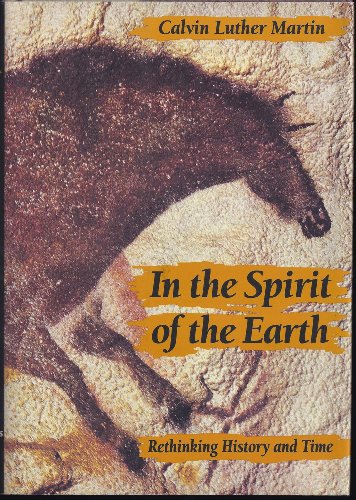
This meditation by an award winning historian calls for a new way oflooking at the natural world and our place in it, while boldly challenging theassumptions that underlie the way we teach and think about both history andtime. Calvin Luther Martin's In the Spirit of the Earth is a provocativeaccount of how the hunter-gatherer image of nature was lost--with devastatingconsequences for the environment and the human spirit.
According to Martin, our current ideas about nature emerged during neolithictimes, as humans began to domesticate animals and farm the land. In thehunter-gatherer mind, animals and plants were spiritual beings and the earth areliable provider. But in neolithic innovations Martin finds the roots of ourown curiously alienated relationship with other living things and with theearth itself. This alienation is revealed not only in our artifice--thetechnology that moves us further and further away from nature--but even in theway we speak about the world. It is revealed most dramatically, perhaps, inthe horrific destruction we have visited on animals and landscapes. Martin sees the shift to agricultural economies as a change in spiritual imagination. This new approach to food getting meant a new understanding ofourselves and the world--a new, powerful image of the self relative to plantsand animals. It led to food surpluses, a population boom, the appearance ofcities and ceremonial centers, and the emergence of priestly classes and rulingelites--in short, to all the achievements, follies, and horrors of"civilization."
Martin argues that history--his own discipline--and human centered historicalconsciousness lie at the heart of this ultimately destructive ideology. Notions of order and progress, of a chosen people and linear time, fuel oursense that the world is ours to improve, exploit, and even destroy. We need torediscover the wisdom and sanity of less presumptuous ideas of nature--aprocess that demands a much larger narrative than historians have been writingand telling. Without calling for a return to hunting and gathering, Martinasks if some of what we lost--or left behind--in the distant past might bereclaimed and used again. To make peace with the earth. To make peace withourselves.
"Many will respond with that oft heard reply, But we cannot go back!To which I respond, But we never left--never left our true, real context, thatis. Homo is still here on this planet earth, abiding in our most fundamentaland necessary nature by its fundamental and necessary terms. We left all ofthat only, really, in our fevered imagination. It all began as an act ofimagination, an illusory image--most fundamentally, an image of fear--and so thecorrective process must likewise begin with an image. Let us re-learn, as hunter-gatherers knew to the core of their being, that this place and itsprocesses (even in our death) always takes care of us--that Homo's citizenship,and errand, rest not with any creed or state, but with 'that star's substancefrom which he had arisen.'"--from In the Spirit of the Earth
"synopsis" may belong to another edition of this title.
About the Author
Calvin Luther Martin lives and writes in the Adirondacks in upstate New York. His book Keepers of the Game: Indian Animal Relationships and the Fur Trade received the American Historical Association's Albert J. Beveridge Award. His new book, The Way of the Human Being, is due out in 1999.
"About this title" may belong to another edition of this title.
Search results for In the Spirit of the Earth: Rethinking History and...

Stock Image
In the Spirit of the Earth: Rethinking History and Time
Published by
The Johns Hopkins University Press, 1992
ISBN 10: 0801843588
ISBN 13: 9780801843587
Used
Hardcover
Seller: World of Books (was SecondSale), Montgomery, IL, U.S.A.
Seller rating 5 out of 5 stars

Condition: Acceptable. Item in acceptable condition! Textbooks may not include supplemental items i.e. CDs, access codes etc. Seller Inventory # 00104098315
Stock Image
In the Spirit of the Earth: Rethinking History and Time
Published by
The Johns Hopkins University Press, 1992
ISBN 10: 0801843588
ISBN 13: 9780801843587
Used
Hardcover
Seller: ThriftBooks-Dallas, Dallas, TX, U.S.A.
Seller rating 5 out of 5 stars
Hardcover. Condition: Very Good. No Jacket. May have limited writing in cover pages. Pages are unmarked. ~ ThriftBooks: Read More, Spend Less. Seller Inventory # G0801843588I4N00
Stock Image
In the Spirit of the Earth: Rethinking History and Time
Published by
The Johns Hopkins University Press, 1992
ISBN 10: 0801843588
ISBN 13: 9780801843587
Used
Hardcover
Seller: ThriftBooks-Atlanta, AUSTELL, GA, U.S.A.
Seller rating 5 out of 5 stars
Hardcover. Condition: Good. No Jacket. Missing dust jacket; Pages can have notes/highlighting. Spine may show signs of wear. ~ ThriftBooks: Read More, Spend Less. Seller Inventory # G0801843588I3N01
Stock Image
In the Spirit of the Earth: Rethinking History and Time
Published by
The Johns Hopkins University Press, 1992
ISBN 10: 0801843588
ISBN 13: 9780801843587
Used
Hardcover
Seller: St Vincent de Paul of Lane County, Eugene, OR, U.S.A.
Seller rating 5 out of 5 stars
Condition: Acceptable. A GIFT NOTE IS WRITTEN INSIDE THE BOOK. hardcover 100% of proceeds go to charity! Acceptable reading copy with obvious signs of use, wear, and/or cosmetic issues. Item is complete and remains readable despite notable condition issues. Seller Inventory # 2FF-01-2463
Stock Image
IN THE SPIRIT OF THE EARTH: Rethinking History and Time.
Published by
Johns Hopkins University Press,, 1992
ISBN 10: 0801843588
ISBN 13: 9780801843587
Used
Hardcover
Seller: Nelson & Nelson, Booksellers, Trenton, SC, U.S.A.
Seller rating 5 out of 5 stars
Hardcover. Condition: G+. Dust Jacket Condition: VG-. Spotting/insect damage (minor) , 1 corner tip frayed ; gift inscription. ; Seller Inventory # 19136
Stock Image
In the Spirit of the Earth: Rethinking History and Time
Published by
Johns Hopkins University Press, Baltimore, Maryland, U.S.A., 1992
ISBN 10: 0801843588
ISBN 13: 9780801843587
Used
Hardcover
First Edition
Seller: Granada Bookstore, IOBA, Woodlawn, IL, U.S.A.
Seller rating 5 out of 5 stars
Hardcover. Condition: Near Fine. First Edition. First Edition (Nap - No Additional Printing Stated, Thus First). Near Fine Book And Jacket With Only A Hint Of Wear. Seller Inventory # 001256
Stock Image
In the Spirit of the Earth: Rethinking History and Time
Published by
The Johns Hopkins University Press, 1992
ISBN 10: 0801843588
ISBN 13: 9780801843587
New
Hardcover
Seller: GoldBooks, Denver, CO, U.S.A.
Seller rating 5 out of 5 stars
Hardcover. Condition: new. New Copy. Customer Service Guaranteed. Seller Inventory # 21A63_63_0801843588
Stock Image
In the Spirit of the Earth: Rethinking History and Time
Published by
The Johns Hopkins University Press, 1992
ISBN 10: 0801843588
ISBN 13: 9780801843587
New
Hardcover
Seller: BennettBooksLtd, Los Angeles, CA, U.S.A.
Seller rating 5 out of 5 stars
hardcover. Condition: New. In shrink wrap. Looks like an interesting title! Seller Inventory # Q-0801843588