Items related to Three Generations, No Imbeciles: Eugenics, the Supreme...
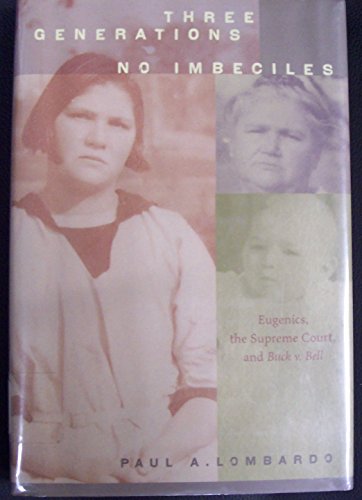

"Three generations of imbeciles are enough." Few lines from Supreme Court opinions are as memorable as this declaration by Justice Oliver Wendell Holmes Jr. in the landmark 1927 case Buck v. Bell. The ruling allowed states to forcibly sterilize residents in order to prevent "feebleminded and socially inadequate" people from having children. It is the only time the Supreme Court endorsed surgery as a tool of government policy. Paul Lombardo’s startling narrative exposes the Buck case’s fraudulent roots.
In 1924 Carrie Buck—involuntarily institutionalized by the State of Virginia after she was raped and impregnated—challenged the state’s plan to sterilize her. Having already judged her mother and daughter mentally deficient, Virginia wanted to make Buck the first person sterilized under a new law designed to prevent hereditarily "defective" people from reproducing. Lombardo’s more than twenty-five years of research and his own interview with Buck before she died demonstrate conclusively that she was destined to lose the case before it had even begun. Neither Carrie Buck nor her mother and daughter were the "imbeciles" condemned in the Holmes opinion. Her lawyer—a founder of the institution where she was held—never challenged Virginia’s arguments and called no witnesses on Buck’s behalf. And judges who heard her case, from state courts up to the U.S. Supreme Court, sympathized with the eugenics movement. Virginia had Carrie Buck sterilized shortly after the 1927 decision.
Though Buck set the stage for more than sixty thousand involuntary sterilizations in the United States and was cited at the Nuremberg trials in defense of Nazi sterilization experiments, it has never been overturned. Three Generations, No Imbeciles tracks the notorious case through its history, revealing that it remains a potent symbol of government control of reproduction and a troubling precedent for the human genome era.
"synopsis" may belong to another edition of this title.
From the Back Cover:
About the Author:
Winner, Georgia Author of the Year Award for Creative Nonfiction History
"Three generations of imbeciles are enough." Few lines from Supreme Court opinions are as memorable as this declaration by Justice Oliver Wendell Holmes Jr. in the landmark 1927 case Buck v. Bell. The ruling allowed states to forcibly sterilize residents to prevent "feebleminded and socially inadequate" people from having children. Paul Lombardo’s startling narrative exposes the fraudulent roots of this notorious case.
"Lucidly written, well researched, thorough, and provocative... A must read for anyone who wants to understand the historical context of Buck v. Bell and its implications for ethics, law and public policy."— New England Journal of Medicine
"The struggle for justice goes on. Bioethicists typically ask 'ought' questions; but not all follow up with activism. More bioethicists should accept the social activist role. Paul Lombardo demonstrates exactly how it can be done."— American Journal of Bioethics
"Meticulously researched... As Lombardo conclusively demonstrates, those who sought to have Buck sterilized did not let the facts get in the way of the story the law required them to tell."— Commonweal
"Heart-breaking and riveting... There is likely to be no better account of Buck v. Bell than Lombardo's book."— Journal of the History of Medicine and Allied Sciences
"A legal and historical masterpiece, combining meticulous ethical analysis with a liveliness that belies its scholarly roots and exhaustive footnotes and research."— PsycCRITIQUES
Paul A. Lombardo is a professor of law at Georgia State University College of Law.
Paul A. Lombardo is a professor of law at Georgia State University College of Law. He has played a key role, as both a historian and a lawyer, in the movement to solicit state apologies and legislative denunciations of past eugenics laws.
"About this title" may belong to another edition of this title.
- PublisherJohns Hopkins University Press
- Publication date2008
- ISBN 10 0801890101
- ISBN 13 9780801890109
- BindingHardcover
- Edition number1
- Number of pages384
- Rating
Buy New
Learn more about this copy
US$ 25.77
Shipping:
US$ 4.00
Within U.S.A.
Top Search Results from the AbeBooks Marketplace
Stock Image
Three Generations, No Imbeciles: Eugenics, the Supreme Court, and Buck v. Bell
Published by
Johns Hopkins University Press
(2008)
ISBN 10: 0801890101
ISBN 13: 9780801890109
New
Hardcover
Quantity: 1
Seller:
Rating

Book Description Hardcover. Condition: new. New. Fast Shipping and good customer service. Seller Inventory # Holz_New_0801890101
Buy New
US$ 25.77
Convert currency
Stock Image
Three Generations, No Imbeciles: Eugenics, the Supreme Court, and Buck v. Bell
Published by
Brand: Johns Hopkins University Press
(2008)
ISBN 10: 0801890101
ISBN 13: 9780801890109
New
Hardcover
Quantity: 1
Seller:
Rating
Book Description Condition: new. Seller Inventory # FrontCover0801890101
Buy New
US$ 26.89
Convert currency
Stock Image
Three Generations, No Imbeciles: Eugenics, the Supreme Court, and Buck v. Bell
Published by
Johns Hopkins University Press
(2008)
ISBN 10: 0801890101
ISBN 13: 9780801890109
New
Hardcover
Quantity: 1
Seller:
Rating
Book Description Hardcover. Condition: new. New. Seller Inventory # Wizard0801890101
Buy New
US$ 27.70
Convert currency
Stock Image
Three Generations, No Imbeciles: Eugenics, the Supreme Court, and Buck v. Bell
Published by
Johns Hopkins University Press
(2008)
ISBN 10: 0801890101
ISBN 13: 9780801890109
New
Hardcover
Quantity: 1
Seller:
Rating
Book Description Hardcover. Condition: new. Brand New Copy. Seller Inventory # BBB_new0801890101
Buy New
US$ 31.10
Convert currency
Stock Image
Three Generations, No Imbeciles: Eugenics, the Supreme Court, and Buck v. Bell
Published by
Johns Hopkins University Press
(2008)
ISBN 10: 0801890101
ISBN 13: 9780801890109
New
Hardcover
Quantity: 1
Seller:
Rating
Book Description Condition: New. Book is in NEW condition. Seller Inventory # 0801890101-2-1
Buy New
US$ 37.76
Convert currency
Stock Image
Three Generations, No Imbeciles: Eugenics, the Supreme Court, and Buck v. Bell
Published by
Johns Hopkins University Press
(2008)
ISBN 10: 0801890101
ISBN 13: 9780801890109
New
Hardcover
Quantity: 1
Seller:
Rating
Book Description Condition: New. New! This book is in the same immaculate condition as when it was published. Seller Inventory # 353-0801890101-new
Buy New
US$ 37.77
Convert currency
Stock Image
Three Generations, No Imbeciles: Eugenics, the Supreme Court, and Buck v. Bell
Published by
The Johns Hopkins University Press
(2008)
ISBN 10: 0801890101
ISBN 13: 9780801890109
New
Hardcover
Quantity: 1
Seller:
Rating
Book Description Hardcover. Condition: New. 1. Seller Inventory # DADAX0801890101
Buy New
US$ 38.87
Convert currency
Stock Image
Three Generations, No Imbeciles: Eugenics, the Supreme Court, and Buck v. Bell
Published by
Johns Hopkins University Press
(2008)
ISBN 10: 0801890101
ISBN 13: 9780801890109
New
Hardcover
Quantity: 1
Seller:
Rating
Book Description Hardcover. Condition: new. New Copy. Customer Service Guaranteed. Seller Inventory # think0801890101
Buy New
US$ 34.78
Convert currency
Stock Image
Three Generations, No Imbeciles: Eugenics, the Supreme Court, and Buck v. Bell
Published by
Johns Hopkins University Press
(2008)
ISBN 10: 0801890101
ISBN 13: 9780801890109
New
Hardcover
Quantity: 2
Seller:
Rating
Book Description Hardcover. Condition: New. Brand New!. Seller Inventory # VIB0801890101
Buy New
US$ 66.76
Convert currency
Seller Image
Three Generations, No Imbeciles: Eugenics, the Supreme Court, and Buck v. Bell
Published by
Johns Hopkins University Press
(2008)
ISBN 10: 0801890101
ISBN 13: 9780801890109
New
Hardcover
Quantity: 1
Seller:
Rating

Book Description Condition: new. 1. Book is in NEW condition. Satisfaction Guaranteed! Fast Customer Service!!. Seller Inventory # PSN0801890101
Buy New
US$ 70.03
Convert currency