
Items related to In Extremis
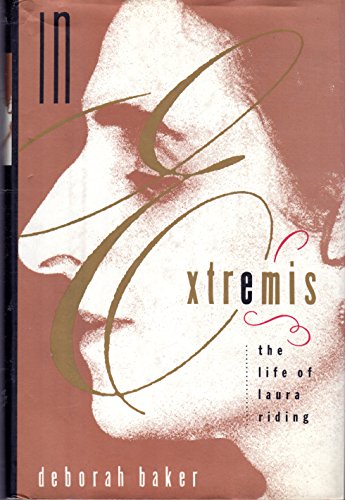
Synopsis
In her poetry, fiction, essays, and public statements, Laura Riding tackled Freud, feminism, communism, language and belief, sexuality, and the coming of age of the American dream. Her range of associations includes writers such as Hart Crane, Gertrude Stein, Allen Tate, and Robert Penn Warren. Now comes a brilliantly original biography of her life. 16 pages of photographs.
"synopsis" may belong to another edition of this title.
From the Back Cover
In her poetry, fiction, essays, and public statements, Laura Riding, the author of twenty-three books, tackled feminism, communism, sexuality, Freud, language and belief, and the coming-of-age of the American dream. In her personal relationships she was often at the center of a circle of friends and artists whose activities she inspired and sometimes controlled. Her extraordinary range of associates included writers as diverse as Hart Crane, Gertrude Stein, Edmund Wilson, Malcolm Cowley, Allen Tate, and Robert Penn Warren. During a long and "scandalous" affair with Robert Graves, she watched over his most productive period and guided much of his best work. Together they launched the New Criticism. Laura Riding, who died in 1991 at the age of ninety, was a deeply divided woman whose ability to create a personal mythology and continually reimagine herself could be both astonishing and maddening. The frequent subject of outrageous rumor and intense controversy, she has been portrayed as a megalomaniac, a sexual libertine, a femme fatale, even a witch. In this biography, Deborah Baker considers Laura Riding in the context of her background, her times, and, most importantly, her work. She removes the layers of conjecture, bias, and sometimes sheer nonsense that have distorted Riding's life, reputation, and scale of achievement.
Reviews
Acknowledging the difficulty of accurately portraying a writer who continuously reinvented herself, Baker ( Making a Farm ) draws heavily on unpublished works to achieve some success in illuminating the life of Laura Riding (1901-1991). Riding's verse-- Collected Poems was published in 1938--was acclaimed for the precision of its language. From 1927-1936 she lived on the island of Majorca with British writer Robert Graves, with whom she established an avant-garde literary salon and founded the Seizin Press. In 1941 Riding left Graves, returned to America and, amidst scandal, married critic Schuyler B. Jackson. Renouncing poetry, she worked with Jackson on the never-published The Dictionary of Meanings and wrote several philosophical treatises, e.g., The Telling (1972). Temperamental and controversial, Riding carried on active correspondences with critics and academics until her death. Illustrations not seen by PW.
Copyright 1993 Reed Business Information, Inc.
In her long and eventful life, Laura Riding (1901-91) played, according to Baker (Making a Farm, 1981, etc.--not reviewed), the roles of goddess, witch, poet, editor, critic, mistress, collaborator, inspiration, demon, and recluse. Born to a mad mother and a reprobate father on Manhattan's Lower East Side, Riding became a poet and, after a brief stay in Greenwich Village, joined the household of Robert Graves, who became her lover/companion for 14 years. She traveled to Egypt, London (where she attempted suicide), and Mallorca (for a 13-year period covered extensively by Baker)--where she ran a press, published Gertrude Stein, and developed a following of young literati who shared her ideas of communal life. At the start of WW II, Riding and Graves became the guests of Schuylar Jackson, who grew walnut trees in New Hope, Pennsylvania. After Riding reputedly drove Mrs. Jackson insane, she married Schuylar, destroyed her own poetry, invested many years in compiling a dictionary, and, finally, retired for the last 50 years of her life to a tin-roofed hut, without electricity or plumbing, in Wabasso, Florida. In her lifetime, Riding published over a dozen influential collections of poems and collaborated with Graves on an essay in A Survey of Modernist Poetry (1927) that helped initiate the modern age of criticism. She was, Baker says in this first full-length biography, offended by the moral ambiguity of Graves's The White Goddess--which she herself inspired. (Eight page of b&w photographs) -- Copyright ©1993, Kirkus Associates, LP. All rights reserved.
Baker presents a well-researched biography of Riding (1901-91), a writer whose work has been obfuscated by a difficult personality and estrangement from her colleagues. As is often the case in literary biography, Riding's life is examined through her writing and, accordingly, her inner being becomes as important as her actions. The core of the book is Riding's 14-year relationship with Robert Graves--treated most thoroughly. In addition, descriptions of Riding's suicide attempt, her collaborative efforts, and her personal associations with such literary luminaries as Gertrude Stein are telling of Riding's complex psyche. Baker has made extensive use of archival souces in tracing this unconventional woman's journey away from poetry and toward an absolute truth that could be exposed by means of other forms such as criticism. Recommended for humanities and woman's studies collections. (For a recent review of the work of Laura Riding Jackson, see The Word "Woman" and Other Related Writings , LJ 4/15/93.
-Ed.)-- Janice Braun, Hoover Institution Lib., Stanford, Cal.
Copyright 1993 Reed Business Information, Inc.
"About this title" may belong to another edition of this title.
Search results for In Extremis

Stock Image
In Extremis
Seller: Gulf Coast Books, Cypress, TX, U.S.A.
Seller rating 5 out of 5 stars

hardcover. Condition: Very Good. Seller Inventory # 0802113648-2-33380486
Stock Image
In Extremis
Seller: Bay State Book Company, North Smithfield, RI, U.S.A.
Seller rating 5 out of 5 stars
Condition: very_good. Seller Inventory # BSM.1DGFH
Stock Image
In Extremis
Seller: Greenworld Books, Arlington, TX, U.S.A.
Seller rating 5 out of 5 stars
Condition: very_good. Fast Free Shipping â" Very Good condition book with a firm cover and clean pages. Shows normal use and some light wear or limited notes markings. A solid, nice copy to enjoy. Seller Inventory # GWV.0802113648.VG
Stock Image
In Extremis
Seller: Open Books, Chicago, IL, U.S.A.
Seller rating 5 out of 5 stars
hardcover. Condition: Very Good. Open Books is a nonprofit social venture that provides literacy experiences for thousands of readers each year through inspiring programs and creative capitalization of books. Seller Inventory # mon0000857110
Stock Image
In Extremis
Seller: ThriftBooks-Dallas, Dallas, TX, U.S.A.
Seller rating 5 out of 5 stars
Hardcover. Condition: Good. No Jacket. Pages can have notes/highlighting. Spine may show signs of wear. ~ ThriftBooks: Read More, Spend Less. Seller Inventory # G0802113648I3N00
Stock Image
In Extremis
Seller: ThriftBooks-Atlanta, AUSTELL, GA, U.S.A.
Seller rating 5 out of 5 stars
Hardcover. Condition: Very Good. No Jacket. Former library book; Missing dust jacket; May have limited writing in cover pages. Pages are unmarked. ~ ThriftBooks: Read More, Spend Less. Seller Inventory # G0802113648I4N11
Stock Image
In Extremis
Seller: ThriftBooks-Dallas, Dallas, TX, U.S.A.
Seller rating 5 out of 5 stars
Hardcover. Condition: Fair. No Jacket. Former library book; Readable copy. Pages may have considerable notes/highlighting. ~ ThriftBooks: Read More, Spend Less. Seller Inventory # G0802113648I5N10
Stock Image
In Extremis
Seller: St Vincent de Paul of Lane County, Eugene, OR, U.S.A.
Seller rating 5 out of 5 stars
Condition: Acceptable. PLEASE NOTE: FORMER LIBRARY COPY, MAY HAVE STICKERS AND INDENTIFYING STAMPS AND/OR MARKERS ON IT BUT BOOK REMAINS IN ACCEPTABLE READING CONDITION. Former Library book. Hardcover 100% of proceeds go to charity! Acceptable reading copy with obvious signs of use, wear, and/or cosmetic issues. Item is complete and remains readable despite notable condition issues. Seller Inventory # 2FF-02-2735
Stock Image
In Extremis: The Life of Laura Riding
Seller: Dunaway Books, St. Louis, MO, U.S.A.
Seller rating 4 out of 5 stars

Hardcover. Condition: Acceptable. Seller Inventory # 74499
Stock Image
In Extremis The Life of Laura Riding
Seller: Willis Monie-Books, ABAA, Cooperstown, NY, U.S.A.
Seller rating 5 out of 5 stars
Hardcover. Condition: Very Good. Dust Jacket Condition: Very Good. Remainder mark bottom edge. Seller Inventory # 20770